Results by title
282 books match the query 'Caribbean & West Indies' and 5 start with v
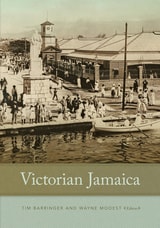
Victorian Jamaica
Timothy Barringer and Wayne Modest, editors
Duke University Press, 2018
Contributors. Anna Arabindan-Kesson, Tim Barringer, Anthony Bogues, David Boxer, Patrick Bryan, Steeve O. Buckridge, Julian Cresser, John M. Cross, Petrina Dacres, Belinda Edmondson, Nadia Ellis, Gillian Forrester, Catherine Hall, Gad Heuman, Rivke Jaffe, O'Neil Lawrence, Erica Moiah James, Jan Marsh, Wayne Modest, Daniel T. Neely, Mark Nesbitt, Diana Paton, Elizabeth Pigou-Dennis, Veerle Poupeye, Jennifer Raab, James Robertson, Shani Roper, Faith Smith, Nicole Smythe-Johnson, Dianne M. Stewart, Krista A. Thompson
Vodou Nation
Haitian Art Music and Cultural NationalismMichael Largey
University of Chicago Press, 2006
Around the time of the United States’s occupation of Haiti in 1915, African American composers began to incorporate Vodou-inspired musical idioms to showcase black artistry and protest white oppression. Together with Haitian musicians, these composers helped create what Michael Largey calls the “Vodou Nation,” an ideal vision of Haiti that championed its African-based culture as a bulwark against America’s imperialism. Highlighting the contributions of many Haitian and African American composers who wrote music that brought rhythms and melodies of the Vodou ceremony to local and international audiences, Vodou Nation sheds light on a black cosmopolitan musical tradition that was deeply rooted in Haitian culture and politics.
Vodou Songs in Haitian Creole and English
Benjamin Hebblethwaite
Temple University Press, 2011
Vodou songs constitute the living memory of Haitian Vodou communities, and song texts are key elements to understanding Haitian culture. Vodou songs form a profound religious and cultural heritage that traverses the past and refreshes the present. Offering a one-of-a-kind research tool on Vodou and its cultural roots in Haiti and pre-Haitian regions, Vodou Songs in Haitian Creole and English provides a substantial selection of hard to find or unpublished sacred Vodou songs in a side-by-side bilingual format.
Esteemed scholar Benjamin Hebblethwaite introduces the language, mythology, philosophy, origins, and culture of Vodou through several chapters of source songs plus separate analytical chapters. He guides readers through songs, chants, poems, magical formulae, invocations, prayers, historical texts and interviews, as well as Haitian Creole grammar and original sacred literature. An in-depth dictionary of key Vodou terms and concepts is also provided.
This corpus of songs and the research about them provide a crucial understanding of the meaning of Vodou religion, language, and culture.

Voices From the Other Side
An Oral History of Terrorism Against CubaKeith Bolender
Pluto Press, 2010
Keith Bolender brings to bear the enormous impact that terrorism has had on Cuba’s civilian population, with over 1,000 documented incidents resulting in more than 3,000 deaths and 2,000 injuries. Bolender allows the victims to articulate the atrocities the Cuban people have suffered - which largely originate from Cuban counter-revolutionaries based in the US, often with the active help of the CIA.
Voices From The Other Side includes first-person interviews with more than 75 Cuban citizens who have been victims of these terrorist acts, or have had family members or close friends die from the attacks. It is a unique resource for activists, journalists and students interested in Cuba's torrid relationship with the US.
Voices in Exile
Jamaican Texts of the 18th and 19th CenturiesJean D'Costa
University of Alabama Press, 2009
Recovering the voices that shaped Jamaica's language, literature, and identity.
Voices in Exile: Jamaican Texts of the 18th and 19th Centuries is a landmark anthology that brings together a rich collection of historical documents illuminating the origins and development of Jamaican language, culture, and identity. Edited by renowned scholars Jean D'Costa and Barbara Lalla, the volume gathers songs, sermons, folk narratives, eyewitness accounts, personal testimonies, and other primary materials that reveal the complex social and cultural world of Jamaica during the colonial and post-emancipation eras.
Spanning the eighteenth and nineteenth centuries, the collection traces the emergence of a distinctive Jamaican society forged through the interaction of African, European, and Caribbean peoples. The selected texts capture the realities of plantation life, slavery, resistance, religious expression, language development, and everyday experience while showcasing the creativity and resilience of communities whose voices have often been marginalized in traditional historical narratives.
Particularly valuable for its documentation of Jamaican Creole and evolving linguistic practices, the anthology provides readers with direct access to the words and perspectives of individuals living through profound social transformation. Materials from the periods before emancipation, during apprenticeship, and after emancipation illustrate how language and culture adapted to changing political and economic conditions.
More than a collection of historical texts, Voices in Exile serves as a window into the formation of Jamaican identity and the broader cultural history of the Caribbean. By preserving and contextualizing these remarkable documents, D'Costa and Lalla offer an indispensable resource for students and scholars of Caribbean studies, literature, linguistics, history, postcolonial studies, and the African diaspora. The result is a compelling archive of voices that continue to resonate across centuries and enrich our understanding of Jamaica's cultural heritage.