Results by title
208 books match the query 'Christian Church' and 4 start with v
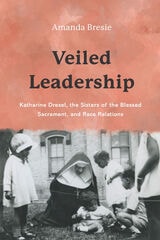
Veiled Leadership
Katharine Drexel, The Sisters of the Blessed Sacrament, and Race RelationsAmanda Bresie
Catholic University of America Press, 2023
On the rainy morning of October 1, 2000, Pope John Paul II canonized Mother Katharine Drexel. Born into a wealthy Philadelphia family, Drexel bucked society and formed the Sisters of the Blessed Sacrament for Indians and Colored People. Her compelling personal story has excited many biographers who have highlighted her holiness and catalogued her good deeds. During her life, newspapers called her the “Millionaire Nun,” and much of the literature on Drexel and the Sisters of the Blessed Sacrament exalts Katharine Drexel’s disbursement of her vast fortune to benefit Black and Indigenous people. The often repeated stories of a riches to rags holy woman miss the true significance of what Mother Katharine and the Sisters of the Blessed Sacrament attempted. Drexel was not merely the ATM of Catholic Home Missions; rather, she challenged the hierarchy to reimagine its mission in the United States. In an era when the Church controlled the actions and censored the opinions of women religious, they had to listen to Mother Katharine. Most writing on Drexel and the SBS focus on Drexel’s spiritual journey, but Veiled Leadership traces the daily operations of her charitable empire and looks at how the Sisters implemented Drexel’s vision in the field. The SBS were not always welcomed in the communities they served, and they experienced conflict from both white supremacists and the people they wanted to aid.
Veiled Leadership examines the lives of Mother Katharine and her congregation within the context of larger constructs of gender, race, religion, reform, and national identity. It explores what happens when a non-dominant culture tries to impose its views and morals on other non-dominant cultures. In other words, as outliers themselves—they were semi-cloistered Catholic women from primarily immigrant backgrounds in a culture that regarded their lifestyles as alien and unnatural—their attempts to Americanize and assimilate Black and Indigenous people, whose families had been in the country for generations longer than the nuns’ own, adds complexity to our understanding of cultural hegemony.
[more]
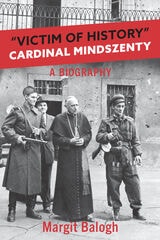
Victim of History
Cardinal Mindszenty, a biographyMargit Balogh
Catholic University of America Press, 2022
“Victim of history,” “a martyr from behind the Iron Curtain,” “the Hungarian Gandhi” – these are just some of the epithets which people used to describe Cardinal Mindszenty, archbishop of Esztergom, who was the last Hungarian prelate to use the title of prince primate. Today, Mindszenty has been forgotten in most countries except for Hungary, but when he died in 1975, he was known all over the world as a symbol of the struggle of the Catholic Church against communism.
Cardinal Mindszenty held the post of archbishop of Esztergom from 1945 until 1974, but during this period of almost three decades he served barely four years in office. The political police arrested him on December 26, 1948, and the Budapest People’s Court subsequently sentenced him to life imprisonment. Based on the Stalinist practice of show trials, one of the accusations against Mindszenty, referring to his legitimist leanings, was his alleged attempt to re-establish Habsburg rule in Hungary. He regained freedom during the 1956 revolution but only for a few days. He was granted refuge by the US Embassy in Budapest between November 4, 1956 –September 28, 1971. In the fifteen years he spent at the American embassy enormous changes took place in the world while his personality remained frozen into the past. When in 1971 Pope Paul VI received the Hungarian foreign minister, he called Mindszenty “the victim of history”. His last years were spent free at last, but far away from his homeland. In Hungary, the Catholic believers eagerly await his beatification.
[more]
Violence and the Medieval Clergy
Gerhard Jaritz
Central European University Press, 2012
Violence was omnipresent in medieval society and affected all areas of life and the members of all social strata. Surviving sources deal regularly with any issues of violent actions, signs and results of violence, violent people and coping with violence. In such evidence, also the members of the clergy played an important role – as writers about violence and critics of it, but also as perpetrators, victims, and witnesses.
[more]
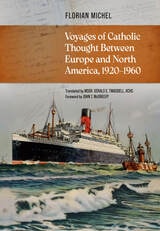
Voyages of Catholic Thought to North America
Intellectual Networks and Cultural Exchanges Between Europe, Canada, and the United States, 1920-1950Florian Michel
Catholic University of America Press, 2026
In the first half of the 20th century, the reputation of American Catholics was not so good. Didn't the novelist Flannery O'Connor write that their main concern was to “install central heating in holy places”? This book reveals a little-known page in the intellectual history of American Catholicism, and shows another face of transatlantic relations. “It is in the order of spirit and culture that the Atlantic community assumes its most fundamental historical importance”, as Jacques Maritain noted. Before many European intellectuals found themselves in exile in New York between 1940 and 1945, and long before the influence of “French Theory” in the United States, Jacques Maritain, Étienne Gilson, Father Marie-Dominique Chenu, Charles De Koninck and Yves Simon taught in North America between the wars and founded institutes in Toronto, Notre Dame, Laval, Princeton, destined to play a decisive role in the intellectual mutations of North American Catholicism and beyond. To trace the history of these philosophers, Florian Michel had access to archives in France, Italy, the USA and Canada.
[more]