Results by title
401 books match the query 'Civil War, 1861-1865' and 3 start with v
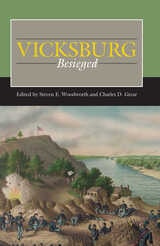
Vicksburg Besieged
Edited by Steven E. Woodworth and Charles D. Grear
Southern Illinois University Press, 2020
Vicksburg, Mississippi, held strong through a bitter, hard-fought, months-long Civil War campaign, but General Ulysses S. Grant’s forty-day siege ended the stalemate and, on July 4, 1863, destroyed Confederate control of the Mississippi River. In the first anthology to examine the Vicksburg Campaign’s final phase, nine prominent historians and emerging scholars provide in-depth analysis of previously unexamined aspects of the historic siege.
Ranging in scope from military to social history, the contributors’ invitingly written essays examine the role of Grant’s staff, the critical contributions of African American troops to the Union Army of the Tennessee, both sides’ use of sharpshooters and soldiers’ opinions about them, unusual nighttime activities between the Union siege lines and Confederate defensive positions, the use of West Point siege theory and the ingenuity of Midwestern soldiers in mining tunnels under the city’s defenses, the horrific experiences of civilians trapped in Vicksburg, the Louisiana soldier's defense of Jackson amid the strains of piano music, and the effect of the campaign on Confederate soldiers from the Trans-Mississippi region.
The contributors explore how the Confederate Army of Mississippi and residents of Vicksburg faced food and supply shortages as well as constant danger from Union cannons and sharpshooters. Rebel troops under the leadership of General John C. Pemberton sought to stave off the Union soldiers, and though their morale plummeted, the besieged soldiers held their ground until starvation set in. Their surrender meant that Grant’s forces succeeded in splitting in half the Confederate States of America.
Editors Steven E. Woodworth and Charles D. Grear, along with their contributors—Andrew S. Bledsoe, John J. Gaines, Martin J. Hershock, Richard H. Holloway, Justin S. Solonick, Scott L. Stabler, and Jonathan M. Steplyk—give a rare glimpse into the often overlooked operations at the end of the most important campaign of the Civil War.
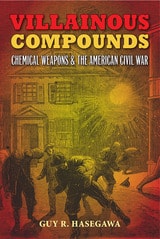
Villainous Compounds
Chemical Weapons and the American Civil WarGuy R. Hasegawa
Southern Illinois University Press, 2015
In chilling detail, Hasegawa describes the weapons proposed and prepared for use during the war and introduces the people behind the concepts. Although many of the ideas for chemical weapons had a historical precedent, most of the suggested agents were used in industry or medicine, and their toxicity was common knowledge. Proponents, including a surprisingly high number of civilian physicians, suggested a wide variety of potential chemical weapons—from liquid chlorine in artillery shells to cayenne pepper solution sprayed from fire engines. Some weapons advocates expressed ethical qualms, while others were silent on the matter or justified their suggestions as necessary under current circumstances.
As Hasegawa explains, bureaucrats in the war departments of both armies either delayed or rejected outright most of these unusual weapons, viewing them as unneeded or unworkable. Nevertheless, many of the proposed armaments presaged the widespread use of chemical weapons in the twentieth and twenty-first centuries. For example, while Civil War munitions technology was not advanced enough to deliver poison gas in artillery shells as some advocates suggested, the same idea saw extensive use during World War I. Similarly, forms of an ancient incendiary weapon, Greek fire, were used sparingly during the Civil War and appeared in later conflicts as napalm bombs and flamethrowers.
Especially timely with today’s increased chemical threats from terrorists and the alleged use of chemical agents in the Syrian Civil War, Villainous Compounds: Chemical Weapons and the American Civil War reveals the seldom-explored chemical side of Civil War armaments and illuminates an underappreciated stage in the origins of modern chemical warfare.
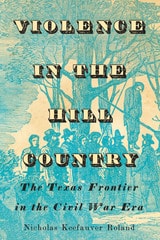
Violence in the Hill Country
The Texas Frontier in the Civil War EraBy Nicholas Keefauver Roland
University of Texas Press, 2021
2022 Ramirez Family Award for Most Significant Scholarly Book, Texas Institute of Letters
An in-depth history of the Civil War in the Texas Hill Country, this book examines patterns of violence on the Texas frontier to illuminate white Americans’ cultural and political priorities in the nineteenth century.
In the nineteenth century, Texas’s advancing western frontier was the site of one of America’s longest conflicts between white settlers and native peoples. The Texas Hill Country functioned as a kind of borderland within the larger borderland of Texas itself, a vast and fluid area where, during the Civil War, the slaveholding South and the nominally free-labor West collided. As in many borderlands, Nicholas Roland argues, the Hill Country was marked by violence, as one set of peoples, states, and systems eventually displaced others.
In this painstakingly researched book, Roland analyzes patterns of violence in the Texas Hill Country to examine the cultural and political priorities of white settlers and their interaction with the century-defining process of national integration and state-building in the Civil War era. He traces the role of violence in the region from the eve of the Civil War, through secession and the Indian wars, and into Reconstruction. Revealing a bitter history of warfare, criminality, divided communities, political violence, vengeance killings, and economic struggle, Roland positions the Texas Hill Country as emblematic of the Southwest of its time.