Results by title
603 books match the query 'Description and travel' and 5 start with v
Victorian Travelers and the Opening of China 1842–1907
Susan Shoenbauer Thurin
Ohio University Press, 1999
Three men and three women: a plant collector, a merchant and his novelist wife, a military officer, and two famous women travelers went to China between the Opium War and the formal end of the opium trade, 1842–1907. Their range of perspectives, their acquaintance with one another and their similar scope of travel to Hong Kong, the treaty ports, and Sichuan lend intensity to their picture of China and the Western presence there.
What the travelers record reveals is a continuity in the response of the West and China to each other. Susan Schoenbauer Thurin’s study of these writings presents a rich tapestry of impressions, biases, and cultural perspectives that inform our own understanding of the Victorians and their views of the world outside their own.
The strange mix of opium and missionaries, the aura of fabled “Cathay” and its valuable trade items, the attraction and repulsion of the exotic otherness the travelers experience, reflect the political, religious, and racial views of their era, and explain the allure of the Orient that, in part, characterized their age. Victorian Travelers and the Opening of China, 1842–1907 is a remarkable look into the cultural past.
Views of Nature
Alexander von Humboldt
University of Chicago Press, 2014
Views of Nature, or Ansichten der Natur, was Humboldt’s best-known and most influential work—and his personal favorite. While the essays that comprise it are themselves remarkable as innovative, early pieces of nature writing—they were cited by Thoreau as a model for his own work—the book’s extensive endnotes incorporate some of Humboldt’s most beautiful prose and mature thinking on vegetation structure, its origins in climate patterns, and its implications for the arts. Written for both a literary and a scientific audience, Views of Nature was translated into English (twice), Spanish, and French in the nineteenth century, and it was read widely in Europe and the Americas. But in contrast to many of Humboldt’s more technical works, Views of Nature has been unavailable in English for more than one hundred years. Largely neglected in the United States during the twentieth century, Humboldt’s contributions to the humanities and the sciences are now undergoing a revival to which this new translation will be a critical contribution.
Views of the Cordilleras and Monuments of the Indigenous Peoples of the Americas
A Critical EditionAlexander von Humboldt
University of Chicago Press, 2013
Vincent's Arles
As It Is and as It WasLinda Seidel
University of Chicago Press, 2023
Once admired as “a little Rome” on the banks of the Rhône, the town of Arles in the south of France had been a place of significance long before the painter Vincent van Gogh arrived in February of 1888. Aware of Arles’s history as a haven for poets, van Gogh spent an intense fifteen months there, scouring the city’s streets and surroundings in search of subjects to paint when he wasn’t thinking about other places or lamenting his woeful circumstances.
In Vincent’s Arles, Linda Seidel serves as a guide to the mysterious and culturally rich town of Arles, taking us to the places immortalized by van Gogh and cherished by innumerable visitors and pilgrims. Drawing on her extensive expertise on the region and the medieval world, Seidel presents Arles then and now as seen by a walker, visiting sites old and new. Roman, Romanesque, and contemporary structures come alive with the help of the letters the artist wrote while in Arles. The result is the perfect blend of history, art, and travel, a chance to visit a lost past and its lingering, often beautiful, traces in the present.
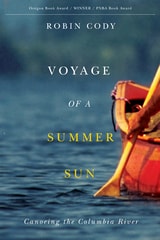
Voyage of a Summer Sun
Canoeing the Columbia RiverRobin Cody
Oregon State University Press, 2012
On a June morning in 1990, high up in the Canadian Rockies, Robin Cody pushed his sixteen-foot Kevlar canoe through tall grass and mud to launch it on peaceful Columbia Lake, the nominal source of the river that heaves more water into the Pacific ocean than any other in North or South America. For the next eighty-two days, Cody would portage massive dams and revel in the rapids as the great river plunges 2,700 feet in 1,200 miles before reaching the river’s mouth in Astoria.
Cody’s canoe sneaks up on the bear and moose and raptors and beavers who make a living on the Columbia. He drops in on riverpeople: the trapper, the wind surfer, the archeologist, the lock operator, the native woman who grew up at riverside in a dwelling of tule reeds. With a generous and infectious spirit, Cody draws us into the mysteries of a much-altered and regulated river that is still, at heart, a life-giving place.
This first OSU Press edition of Voyage of a Summer Sun—winner of the Pacific Northwest Booksellers Association Book Award and the Oregon Book Award, and an Oregon State Library choice for “150 Books for the Oregon Sesquicentennial”—includes a new afterword by the author.