Results by title
204 books match the query 'Direction & Production' and 2 start with v
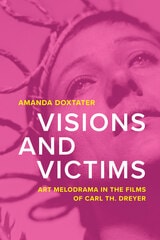
Visions and Victims
Art Melodrama in the Films of Carl Th. DreyerAmanda Doxtater
University of Wisconsin Press, 2024
Amanda Doxtater offers a necessary corrective to this narrative of his bifurcated career. Close readings of Dreyer’s Nordisk films alongside his mature work reveal a stylistic throughline Doxtater terms “art melodrama,” a form combining the ambiguity, stylization, and consciousness of art cinema with the heightened emotional expressivity and dramatic embodiments characteristic of melodrama. She argues that Dreyer’s major artistic concerns known from his later work—pathos, authenticity, the embodiment of psychological duress, and so on—find their first expression in his Nordisk melodramas, complicating our understanding not only of his later films but also of his early works, and even our understanding of the melodramatic mode in general. Indeed, extending well beyond the career of a singular director, this book challenges assumptions about the relationship between “low-brow” melodrama and “high-brow” art cinema.
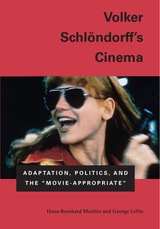
Volker Schlondorff's Cinema
Adaptation, Politics, and the "Movie-Appropriate"Hans-Bernhard Moeller and George Lellis
Southern Illinois University Press, 2002
Volker Schlöndorff’s Cinema: Adaptation, Politics and the “Movie-Appropriate”examines the work of major postwar Germandirector Volker Schlöndorff in historical, economic, and artistic contexts. Incorporating a film-by-film, twenty-eight chapter study, Hans-Bernhard Moeller & George Lellis reveal a complexity and formalambitiousness of Schlöndorff that is comparable to that found in Wenders, Herzog, andFassbinder. In spite of Schlöndorff’s successes with films like The Lost Honor ofKatharina Blum and The Tin Drum, as well as his acclaimed work in the U.S. with Death of a Salesman, Gathering of Old Men and The Handmaid’s Tale, this is the first in-depthcritical study of the filmmaker’s career.
In the context of film and television history, this book relates Schlöndorff’s oeuvre to the New German Cinema, to his formative years as a student and production assistant in France, and to his roots in the Weimar cinema’s tradition. It reveals how Schlöndorff entered into the German film production system in the 1960s, how he came to rely on German public television in the 1970s, and then moved to the international and American financing in the 1980s, attempting to redevelop the Babelsberg studios in a 1990s post-Wall Germany while continuing to make his own films into the 21st century. The book captures how Schlöndorff’s nearly half century of ongoing creativity and productivity ties together.
The authors analyze the artistry of each Schlöndorff movie arguing that his output as a whole embodies a provocative and sometimes contradictory set of balances. Schlöndorff combines commercial interest with significant artistic ambition, blends the kinesthetic pleasures of moving images with the seriousness of fine literature, links the intensity of individualized personal experience to an awareness of broader political issues, and represents a specifically German sensibility even as he reaches out to the international audiences.
The authors demonstrate the cyclical recurrence in his cinema of certain themes (individual and collective rebellion, fascist suppression, masochistic love), narrative patterns (the Western, the thriller, the subjective mood piece), and stylistic approaches (Brechtian Verfremdung, the creation of careful leitmotif structures, the use of the grotesque). In over thirty years of filmmaking, Schlöndorff has produced a remarkable unified body of work that deserves the attention of a book-length study. Authors Hans-Bernhard Moeller and George Lellis offer the first such study of its kind.
Volker Schlöndorff’s Cinema: Adaptation, Politics, and the “Movie-Appropriate” features forty-one illustrations.