436 books match the query 'Disability' and 6 start with v
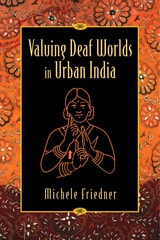
cover of Valuing Deaf Worlds in Urban India

Valuing Deaf Worlds in Urban India

Michele Friedner

Rutgers University Press, 2015
Although it is commonly believed that deafness and disability limits a person in a variety of ways, Valuing Deaf Worlds in Urban India describes the two as a source of value in postcolonial India. Michele Friedner argues that the experiences of deaf people offer an important portrayal of contemporary self-making and sociality under new regimes of labor and economy in India. 
 
Friedner contends that deafness actually becomes a source of value for deaf Indians as they interact with nongovernmental organizations, with employers in the global information technology sector, and with the state. In contrast to previous political economic moments, deaf Indians increasingly depend less on the state for education and employment, and instead turn to novel and sometimes surprising spaces such as NGOs, multinational corporations, multilevel marketing businesses, and churches that attract deaf congregants. They also gravitate towards each other. Their social practices may be invisible to outsiders because neither the state nor their families have recognized Indian Sign Language as legitimate, but deaf Indians collectively learn sign language, which they use among themselves, and they also learn the importance of working within the structures of their communities to maximize their opportunities.  
 
Valuing Deaf Worlds in Urban India analyzes how diverse deaf people become oriented toward each other and disoriented from their families and other kinship networks. More broadly, this book explores how deafness, deaf sociality, and sign language relate to contemporary society. 
 
 
[more]
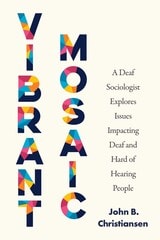
cover of Vibrant Mosaic: A Deaf Sociologist Explores Issues Impacting Deaf and Hard of Hearing People

Vibrant Mosaic

A Deaf Sociologist Explores Issues Impacting Deaf and Hard of Hearing People

John B. Christiansen

Gallaudet University Press, 2025
In Vibrant Mosaic, John B. Christiansen examines a variety of topics that are relevant to deaf and hard of hearing people through the lens of a deaf sociologist. The book explores the arts and sports, the intersections of various cultures within Deaf communities, work and rehabilitation, advocacy, telecommunications and technology, and the Deaf President Now protest. Written in a conversational tone, each chapter is thoughtfully framed by a narrative vignette, illustrating the lived experiences of individuals and serving as a gateway to a broader discussion. Christiansen invites readers to engage with the rich history and contributions of deaf and hard of hearing people and shows how they have shaped their communities and transformed broader societal structures. Vibrant Mosaic is a celebration of a dynamic, multifaceted mosaic and its enduring impact on the human experience.
[more]
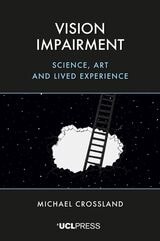
cover of Vision Impairment: Science, Art and Lived Experience

Vision Impairment

Science, Art and Lived Experience

Michael Crossland

University College London, 2024

Breathing life into the science of vision, the book illuminates scientific concepts by intertwining them with the personal stories of those affected by sight loss.

What is it like to go blind? Three hundred and fifty million people around the world live with severe vision impairment, ranging from those who can see a couple of letters on a sight chart to those who perceive no light at all. Vision Impairment introduces the readers to some of them, including artists, poets, scientists, architects, politicians, broadcasters, and musicians. Through their stories, this book discusses life with vision impairment–from childhood and education to dating, employment, and aging–as well as the portrayal of blind people in literature and film, the use of technology by people with vision impairment, and the psychological effects of losing vision.

Based on Michael Crossland’s extensive work in children’s and adults’ low vision clinics, and his twenty years of research into vision impairment, the book blends individual stories, key research findings, and the most recent scientific discoveries to present an informative yet optimistic overview of living with sight loss.
 
[more]
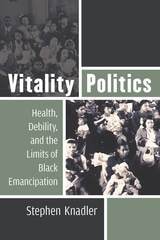
cover of Vitality Politics: Health, Debility, and the Limits of Black Emancipation

Vitality Politics

Health, Debility, and the Limits of Black Emancipation

Stephen Knadler

University of Michigan Press, 2019
Vitality Politics focuses on a slow racial violence against African Americans through everyday, accumulative, contagious, and toxic attritions on health. The book engages with recent critical disability studies scholarship to recognize that debility, or the targeted maiming and distressing of Black populations, is a largely unacknowledged strategy of the U.S. liberal multicultural capitalist state. This politicization of biological health serves as an instrument for insisting on a racial state of exception in which African Americans’ own unhealthy habits and disease susceptibility justifies their legitimate suspension from full rights to social justice, economic opportunity, and political freedom and equality. The book brings together disability studies, Black Studies, and African American literary history as it highlights the urgent need and gives weight to a biopolitics of debilitation and medicalization to better understand how Black lives are made not to matter in our supposedly race-neutral multicultural democracy.
[more]
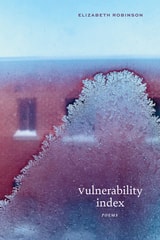
cover of Vulnerability Index: Poems

Vulnerability Index

Poems

Elizabeth Robinson

Northwestern University Press, 2026

Poems from the halls of shelters, courthouses, and soup kitchens

During Elizabeth Robinson’s six years working with chronically unhoused people in Boulder, Colorado, her relationships with the community’s most vulnerable deepened—even as they were filtered through a web of paperwork, systems, and strictures. The Vulnerability Index questionnaire is just one such system. Ubiquitous in shelters across America, it is representative of the endless tasks that people living on the street must complete to receive even minor assistance. 

Moving between the local court, jail, shelter, and soup kitchen, Robinson’s poems capture the strange juxtapositions of the intimate, bureaucratic, and absurd that such spaces demand: a frostbite victim wants to share his state-sponsored recovery room with a friend from the street, a domestic violence survivor must change her name and even her social security number, an unhoused activist joins a vigil for another woman only to discover that she is, mistakenly, the person being mourned. Spare yet richly empathetic, Robinson’s verse works to implicate the reader’s own vulnerability on every page.
[more]
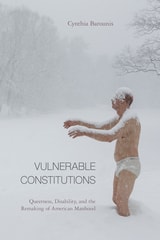
cover of Vulnerable Constitutions: Queerness, Disability, and the Remaking of American Manhood

Vulnerable Constitutions

Queerness, Disability, and the Remaking of American Manhood

Cynthia Barounis

Temple University Press, 2019

Amputation need not always signify castration; indeed, in Jack London’s fiction, losing a limb becomes part of a process through which queerly gendered men become properly masculinized. In her astute book, Vulnerable Constitutions, Cynthia Barounis explores the way American writers have fashioned alternative—even resistant—epistemologies of queerness, disability, and masculinity. She seeks to understand the way perverse sexuality, physical damage, and bodily contamination have stimulated—rather than created a crisis for—masculine characters in twentieth- and early twenty-first-century literature.  

Barounis introduces the concept of “anti-prophylactic citizenship”—a mode of political belonging characterized by vulnerability, receptivity, and risk—to examine counternarratives of American masculinity. Investigating the work of authors including London, William Faulkner, James Baldwin, and Eli Clare, she presents an evolving narrative of medicalized sexuality and anti-prophylactic masculinity. Her literary readings interweave queer theory, disability studies, and the history of medicine to demonstrate how evolving scientific conversations around deviant genders and sexualities gave rise to a new model of national belonging—ultimately rewriting the story of American masculinity as a story of queer-crip rebellion.

[more]