Results by title
577 books match the query 'Earth Sciences' and 4 start with v
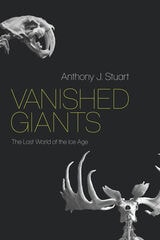
Vanished Giants
The Lost World of the Ice AgeAnthony J. Stuart
University of Chicago Press, 2021
Featuring numerous illustrations, this book explores the many lessons to be learned from Pleistocene megafauna, including the role of humans in their extinction, their disappearance at the start of the Sixth Extinction, and what they might teach us about contemporary conservation crises.
Long after the extinction of dinosaurs, when humans were still in the Stone Age, woolly rhinos, mammoths, mastodons, sabertooth cats, giant ground sloths, and many other spectacular large animals that are no longer with us roamed the Earth. These animals are regarded as “Pleistocene megafauna,” named for the geological era in which they lived—also known as the Ice Age.
In Vanished Giants: The Lost World of the Ice Age, paleontologist Anthony J. Stuart explores the lives and environments of these animals, moving between six continents and several key islands. Stuart examines the animals themselves via what we’ve learned from fossil remains, and he describes the landscapes, climates, vegetation, ecological interactions, and other aspects of the animals’ existence. Illustrated throughout, Vanished Giants also offers a picture of the world as it was tens of thousands of years ago when these giants still existed. Unlike the case of the dinosaurs, there was no asteroid strike to blame for the end of their world. Instead, it appears that the giants of the Ice Age were driven to extinction by climate change, human activities—especially hunting—or both. Drawing on the latest evidence provided by radiocarbon dating, Stuart discusses these possibilities. The extinction of Ice Age megafauna can be seen as the beginning of the so-called Sixth Extinction, which is happening right now. This has important implications for understanding the likely fate of present-day animals in the face of contemporary climate change and vastly increasing human populations.
[more]

Victorian Toronto, 1850 to 1900
Pattern and Process of GrowthPeter G. Goheen
University of Chicago Press, 1970
[more]
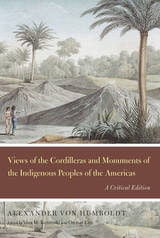
Views of the Cordilleras and Monuments of the Indigenous Peoples of the Americas
A Critical EditionAlexander von Humboldt
University of Chicago Press, 2013
In 1799, Alexander von Humboldt and Aimé Bonpland set out to determine whether the Orinoco River connected with the Amazon. But what started as a trip to investigate a relatively minor geographical controversy became the basis of a five-year exploration throughout South America, Mexico, and Cuba. The discoveries amassed by Humboldt and Bonpland were staggering, and much of today’s knowledge of tropical zoology, botany, geography, and geology can be traced back to Humboldt’s numerous records of these expeditions.
One of these accounts, Views of the Cordilleras and Monuments of the Indigenous Peoples of the Americas, firmly established Alexander von Humboldt as the founder of Mesoamerican studies. In Views of the Cordilleras—first published in French between 1810 and 1813—Humboldt weaves together magnificently engraved drawings and detailed texts to achieve multifaceted views of cultures and landscapes across the Americas. In doing so, he offers an alternative perspective on the New World, combating presumptions of its belatedness and inferiority by arguing that the “old” and the “new” world are of the same geological age.
This critical edition of Views of the Cordilleras—the second volume in the Alexander von Humboldt in English series—contains a new, unabridged English translation of Humboldt’s French text, as well as annotations, a bibliography, and all sixty-nine plates from the original edition, many of them in color.
[more]
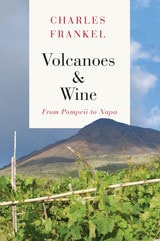
Volcanoes and Wine
From Pompeii to NapaCharles Frankel
University of Chicago Press, 2019
There’s a reason we pay top dollar for champagne and that bottles of wine from prestige vineyards cost as much as a car: a place’s distinct geographical attributes, known as terroir to wine buffs, determine the unique profile of a wine—and some rarer locales produce wines that are particularly coveted. In Volcanoes and Wine, geologist Charles Frankel introduces us to the volcanoes that are among the most dramatic and ideal landscapes for wine making.
Traveling across regions wellknown to wine lovers like Sicily, Oregon, and California, as well as the less familiar places, such as the Canary Islands, Frankel gives an in-depth account of famous volcanoes and the wines that spring from their idiosyncratic soils. From Santorini’s vineyards of rocky pumice dating back to a four-thousand-year-old eruption to grapes growing in craters dug in the earth of the Canary Islands, from Vesuvius’s famous Lacryma Christi to the ambitious new generation of wine growers reviving the traditional grapes of Mount Etna, Frankel takes us across the stunning and dangerous world of volcanic wines. He details each volcano’s most famous eruptions, the grapes that grow in its soils, and the people who make their homes on its slopes, adapting to an ever-menacing landscape. In addition to introducing the history and geology of these volcanoes, Frankel's book serves as a travel guide, offering a host of tips ranging from prominent vineyards to visit to scenic hikes in each location.
This illuminating guide will be indispensable for wine lovers looking to learn more about volcanic terroirs, as well as anyone curious about how cultural heritage can survive and thrive in the shadow of geological danger.
[more]