Results by title
679 books match the query 'Ecology' and 3 start with v
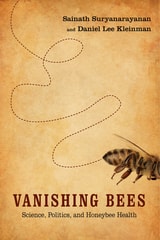
Vanishing Bees
Science, Politics, and Honeybee HealthSuryanarayanan, Sainath
Rutgers University Press, 2016
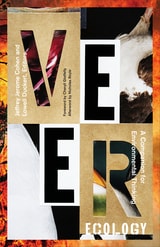
Veer Ecology
A Companion for Environmental ThinkingJeffrey Jerome Cohen
University of Minnesota Press, 2017
The words most commonly associated with the environmental movement—save, recycle, reuse, protect, regulate, restore—describe what we can do to help the environment, but few suggest how we might transform ourselves to better navigate the sudden turns of the late Anthropocene. Which words can help us to veer conceptually along with drastic environmental flux? Jeffrey Jerome Cohen and Lowell Duckert asked thirty brilliant thinkers to each propose one verb that stresses the forceful potential of inquiry, weather, biomes, apprehensions, and desires to swerve and sheer. Each term is accompanied by a concise essay contextualizing its meaning in times of resource depletion, environmental degradation, and global climate change.
Some verbs are closely tied to natural processes: compost, saturate, seep, rain, shade, sediment, vegetate, environ. Many are vaguely unsettling: drown, unmoor, obsolesce, power down, haunt. Others are enigmatic or counterintuitive: curl, globalize, commodify, ape, whirl. And while several verbs pertain to human affect and action—love, represent, behold, wait, try, attune, play, remember, decorate, tend, hope—a primary goal of Veer Ecology is to decenter the human. Indeed, each of the essays speaks to a heightened sense of possibility, awakening our imaginations and inviting us to think the world anew from radically different perspectives. A groundbreaking guide for the twenty-first century, Veer Ecology foregrounds the risks and potentialities of living on—and with—an alarmingly dynamic planet.
Contributors: Stacy Alaimo, U of Texas at Arlington; Joseph Campana, Rice U; Holly Dugan, George Washington U; Lara Farina, West Virginia U; Cheryll Glotfelty, U of Nevada, Reno; Anne F. Harris, DePauw U; Tim Ingold, U of Aberdeen; Serenella Iovino, U of Turin; Stephanie LeMenager, U of Oregon; Scott Maisano, U of Massachusetts, Boston; Tobias Menely, U of California, Davis; Steve Mentz, St. John’s U; J. Allan Mitchell, U of Victoria; Timothy Morton, Rice U; Vin Nardizzi, U of British Columbia; Laura Ogden, Dartmouth College; Serpil Opperman, Hacettepe U, Ankara; Daniel C. Remein, U of Massachusetts, Boston; Margaret Ronda, U of California, Davis; Nicholas Royle, U of Sussex; Catriona Sandilands, York U; Christopher Schaberg, Loyola U; Rebecca R. Scott, U of Missouri; Theresa Shewry, U of California, Santa Barbara; Mick Smith, Queen’s U; Jesse Oak Taylor, U of Washington; Brian Thill, Golden West College; Coll Thrush, U of British Columbia, Vancouver; Cord J. Whitaker, Wellesley College; Julian Yates, U of Delaware.
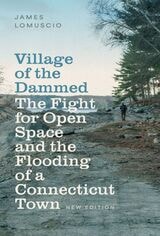
Village of the Dammed
The Fight for Open Space and the Flooding of a Connecticut TownJames Lomuscio
Brandeis University Press, 2025
In the early 1940s, the Bridgeport Hydraulic Company flooded Connecticut’s Saugatuck River Valley to create a reservoir that would meet the region’s growing population. Under twelve billion gallons of water lay Valley Forge, once a thriving iron and steel manufacturing town, which was seized by eminent domain to create the reservoir and dam. In Village of the Dammed, journalist James Lomuscio tells the story of the rise and fall of Valley Forge, drawing on Civil War-era photographs of the town and other sources to show what the town was like, document the futile battle to save it, and reveal the flooding’s life-altering repercussions. He also recounts a grassroots movement to prevent the development of nearby Trout Brook Valley in the 1990s, a heated fight with a different outcome. As the population of the American northeast continues to swell and spread, placing new demands on existing resources, communities are frequently confronted with forces and choices not unlike those faced by Valley Forge and Trout Brook Valley. Village of the Dammed reminds us to be ever vigilant in the protection of our irreplaceable environmental heritage.