Results by title
295 books match the query 'Ecosystems & Habitats' and 4 start with v
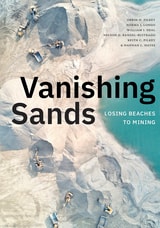
Vanishing Sands
Losing Beaches to MiningOrrin H. Pilkey, Norma J. Longo, William J. Neal, Nelson G. Rangel-Buitrago, Keith C. Pilkey, and Hannah L. Hayes
Duke University Press, 2022
In a time of accelerating sea level rise and increasingly intensifying storms, the world’s sandy beaches and dunes have never been more crucial to protecting coastal environments. Yet, in order to meet the demands of large-scale construction projects, sand mining is stripping beaches and dunes, destroying environments, and exploiting labor in the process. The authors of Vanishing Sands track the devastating impact of legal and illegal sand mining over the past twenty years, ranging from Africa, Asia, and the Caribbean to South America and the eastern United States. They show how sand mining has reached crisis levels: beach, dune, and river ecosystems are in danger of being lost forever, while organized crime groups use deadly force to protect their illegal mining operations. Calling for immediate and widespread resistance to sand mining, the authors demonstrate that its cessation is paramount for saving not only beaches, dunes, and associated environments but also lives and tourism economies everywhere.
[more]
Visualizing Posthuman Conservation in the Age of the Anthropocene
Amy D. Propen
The Ohio State University Press, 2018
How do we understand the lives of nonhuman animals and our relationship with and responsibilities to them? What are the artifacts or things that help configure such perceived responsibility? And what does it mean to practice conservation in the Anthropocene? Amy D. Propen seeks to answer these questions in Visualizing Posthuman Conservation in the Age of the Anthropocene, which brings a visual-material rhetorical approach into conversation with material feminisms and environmental humanities to describe how technologies, environments, bodies, and matter work together to shape and reshape how we coexist with our nonhuman kin.
Through case studies in which visual technologies and science play a prominent role in arguments to protect threatened marine species—from photographs showing the impact of ocean plastics on vulnerable sea birds, to debates about seismic testing and its impact on marine species, to maps created from GPS tracking projects—Propen advances a notion of posthuman environmental conservation that decenters the human enough to consider ideas about the material world from the vantage point of the nonhuman animal. In so bringing together work in environmental humanities, animal studies, human geography, and visual-material rhetoric, Propen further shows how interdisciplinary ways of knowing can further shape and illuminate our various lived and embodied experiences.
Through case studies in which visual technologies and science play a prominent role in arguments to protect threatened marine species—from photographs showing the impact of ocean plastics on vulnerable sea birds, to debates about seismic testing and its impact on marine species, to maps created from GPS tracking projects—Propen advances a notion of posthuman environmental conservation that decenters the human enough to consider ideas about the material world from the vantage point of the nonhuman animal. In so bringing together work in environmental humanities, animal studies, human geography, and visual-material rhetoric, Propen further shows how interdisciplinary ways of knowing can further shape and illuminate our various lived and embodied experiences.
[more]
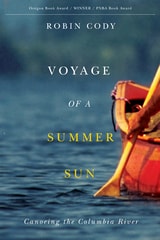
Voyage of a Summer Sun
Canoeing the Columbia RiverRobin Cody
Oregon State University Press, 2012
“The story is the Columbia River, not the canoe and me, but I’ve learned that friends can’t hear me tell about the river until they know why I was out there. This is not an adventure story, though some adventure was unavoidable, and I didn’t set out to find myself if I could help it. Nor did I launch the trip with a large point to prove. It was a voyage of discovery, and its telling is the uncovering of surprise on a river I thought I knew…” —Robin Cody, from the prologue
On a June morning in 1990, high up in the Canadian Rockies, Robin Cody pushed his sixteen-foot Kevlar canoe through tall grass and mud to launch it on peaceful Columbia Lake, the nominal source of the river that heaves more water into the Pacific ocean than any other in North or South America. For the next eighty-two days, Cody would portage massive dams and revel in the rapids as the great river plunges 2,700 feet in 1,200 miles before reaching the river’s mouth in Astoria.
Cody’s canoe sneaks up on the bear and moose and raptors and beavers who make a living on the Columbia. He drops in on riverpeople: the trapper, the wind surfer, the archeologist, the lock operator, the native woman who grew up at riverside in a dwelling of tule reeds. With a generous and infectious spirit, Cody draws us into the mysteries of a much-altered and regulated river that is still, at heart, a life-giving place.
This first OSU Press edition of Voyage of a Summer Sun—winner of the Pacific Northwest Booksellers Association Book Award and the Oregon Book Award, and an Oregon State Library choice for “150 Books for the Oregon Sesquicentennial”—includes a new afterword by the author.
[more]
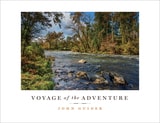
Voyage of the Adventure
Retracing the Donelson Party's Journey to the Founding of NashvilleJohn Guider
Vanderbilt University Press, 2021
In the harsh winter of 1779, as the leader of a flotilla of settlers, John Donelson loaded his family and thirty slaves into a forty-foot flatboat at the present site of Kingsport, Tennessee. Their journey into the wilderness led to the founding of a settlement now known as Nashville—over one thousand river miles away. In the fall of 2016, photographer John Guider retraced the Donelson party’s journey in his hand-built 14½' motorless rowing sailboat while making a visual documentation of the river as it currently exists 240 years later.
This photo book contains more than 120 striking images from the course of the journey, allowing the reader to see how much has changed and how much has remained untouched in the two and a half centuries since Donelson first took to the water. Equally significant, the essays include long-ignored contemporary histories of both the Cherokee whom Donelson encountered and the slaves he brought with him, some of whom did not survive the journey.
Guider, a professional photographer, has created images of every point in the thousand-mile trip from a platform just a few feet above the waterline of three of Tennessee’s most notable rivers.
[more]