Results by title
2728 books match the query 'Education' and 15 start with v
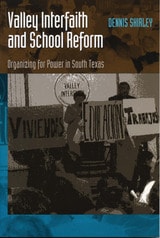
Valley Interfaith and School Reform
Organizing for Power in South TexasBy Dennis Shirley
University of Texas Press, 2002
Can public schools still educate America's children, particularly in poor and working class communities? Many advocates of school reform have called for dismantling public education in favor of market-based models of reform such as privatization and vouchers. By contrast, this pathfinding book explores how community organizing and activism in support of public schools in one of America's most economically disadvantaged regions, the Rio Grande Valley of South Texas, has engendered impressive academic results.
Dennis Shirley focuses the book around case studies of three schools that have benefited from the reform efforts of a community group called Valley Interfaith, which works to develop community leadership and boost academic achievement. He follows the remarkable efforts of teachers, parents, school administrators, clergy, and community activists to take charge of their schools and their communities and describes the effects of these efforts on students' school performance and testing results.
Uniting gritty realism based on extensive field observations with inspiring vignettes of educators and parents creating genuine improvement in their schools and communities, this book demonstrates that public schools can be vital "laboratories of democracy," in which students and their parents learn the arts of civic engagement and the skills necessary for participating in our rapidly changing world. It persuasively argues that the American tradition of neighborhood schools can still serve as a bedrock of community engagement and academic achievement.
Valuing Us All
Feminist Pedagogy and EconomicsApril Laskey Aerni and KimMarie McGoldrick, Editors
University of Michigan Press, 1999
Vanderbilt Divinity School
Education, Contest and ChangeDale A. Johnson
Vanderbilt University Press, 2002
Engagement with southern culture, present from the beginnings of the university but taking on special significance in the mid-twentieth century around the issue of race;
The transition from an institution of the church (Methodist) to an independent and interdenominational school with a liberal Protestant orientation;
The development of the modern research university, evident in the establishment of a graduate program in religion in addition to its program for the profession of ministry;
From the 1950s, a growing concern with diversity and inclusivity, in keeping with national and international issues and developments both religious and cultural, which has broadened the school's sense of ecumenism and deepened its commitments to social justice.
Conflict has played an important part in shaping the history of the Vanderbilt Divinity School, from struggles over initial visions to questions of financial support and institutional control, from local debates over academic freedom to national issues of social justice. Especially noteworthy are the transformations the school has undergone since 1960: the "James Lawson affair," where the divinity school faculty resigned over the expulsion of an African American graduate student who was organizing local lunch counter sit-ins; the impact of social change on the school since the late 1960s; and the contributions of women and African Americans, including their appointment to the faculty.
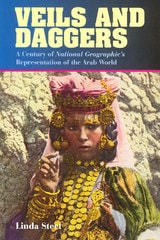
Veils And Daggers
Linda Steet
Temple University Press, 2000
In Veils and Daggers, Linda Steet provides a critically insightful and alternative interpretation of National Geographic. Through an analysis of the journal's discourses in Orientalism, patriarchy, and primitivism in the Arab world as well as textual and visual constructions of Arab men and women, Islam, and Arab culture, Veils and Daggers unpacks the ideological perspectives that have guided National Geographic throughout its history. Drawing on cultural, feminist, and postcolonial criticism, Steet generates alternative readings that challenge the magazine's claims to objectivity. In this fascinating journey, it becomes clear that neither text nor image in the magazine can be regarded as natural or self-evident and she artfully demonstrates that the act of representing others "inevitably involves some degree of violence, decontextualization, minaturization, etc." The subject area known as Orientalism, she shows, is a manmade concept that as such must be studied as an integral component of the social, rather than the natural or divine world.
Veils and Daggers repositions and redefines National Geographic as an educational journal. Steet's work is an important and groundbreaking contribution in the area of social construction of knowledge, social foundations of education, popular educational media, and social studies as well as racial identity, ethnicity, gender. Once encountered, readers of National Geographic will never regard it in the same manner again.
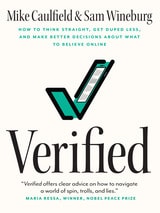
Verified
How to Think Straight, Get Duped Less, and Make Better Decisions about What to Believe OnlineMike Caulfield and Sam Wineburg
University of Chicago Press, 2023
An indispensable guide for telling fact from fiction on the internet—often in less than 30 seconds.
The internet brings information to our fingertips almost instantly. The result is that we often jump to thinking too fast, without taking a few moments to verify the source before engaging with a claim or viral piece of media. Information literacy expert Mike Caulfield and educational researcher Sam Wineburg are here to enable us to take a moment for due diligence with this informative, approachable guide to the internet. With this illustrated tool kit, you will learn to identify red flags, get quick context, and make better use of common websites like Google and Wikipedia that can help and hinder in equal measure.
This how-to guide will teach you how to use the web to verify the web, quickly and efficiently, including how to
• Verify news stories and other events in as little as thirty seconds (seriously)
• Determine if the article you’re citing is by a reputable scholar or a quack
• Detect the slippery tactics scammers use to make their sites look credible
• Decide in a minute if that shocking video is truly shocking
• Deduce who’s behind a site—even when its ownership is cleverly disguised
• Uncover if that feature story is actually a piece planted by a foreign government
• Use Wikipedia wisely to gain a foothold on new topics and leads for digging deeper
And so much more. Building on techniques like SIFT and lateral reading, Verified will help students and anyone else looking to get a handle on the internet’s endless flood of information through quick, practical, and accessible steps.
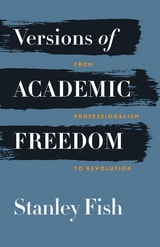
Versions of Academic Freedom
From Professionalism to RevolutionStanley Fish
University of Chicago Press, 2014
Depending on who’s talking, academic freedom is an essential bulwark of democracy, an absurd fig leaf disguising liberal agendas, or, most often, some in-between muddle that both exaggerates its own importance and misunderstands its actual value to scholarship. Fish enters the fray with his typical clear-eyed, no-nonsense analysis. The crucial question, he says, is located in the phrase “academic freedom” itself: Do you emphasize “academic” or “freedom”? The former, he shows, suggests a limited, professional freedom, while the conception of freedom implied by the latter could expand almost infinitely. Guided by that distinction, Fish analyzes various arguments for the value of academic freedom: Is academic freedom a contribution to society's common good? Does it authorize professors to critique the status quo, both inside and outside the university? Does it license and even require the overturning of all received ideas and policies? Is it an engine of revolution? Are academics inherently different from other professionals? Or is academia just a job, and academic freedom merely a tool for doing that job?
No reader of Fish will be surprised by the deftness with which he dismantles weak arguments, corrects misconceptions, and clarifies muddy arguments. And while his conclusion—that academic freedom is simply a tool, an essential one, for doing a job—may surprise, it is unquestionably bracing. Stripping away the mystifications that obscure academic freedom allows its beneficiaries to concentrate on what they should be doing: following their intellectual interests and furthering scholarship.

Victors for Dentistry (1962–2017)
Decades of Innovation and DiscoverySharon K. Grayden, Editor; Jerry Mastey, Contributor
Michigan Publishing Services, 2018
This book celebrates all that the professional community known as the U-M School of Dentistry has accomplished. Through good times and times of change, it has always been about the people—the drivers, the visionaries, and the innovators—who persisted regardless of the usual obstacles and inertia that often stand in the path of progress in higher education. They elevated the school to a world-class prominence that most definitely exemplifies the university’s history as home to the “leaders and best.”
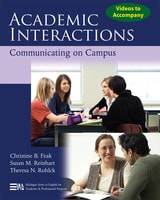
Videos to Accompany Academic Interactions
Communicating on CampusChristine B. Feak, Susan M. Reinhart, Theresa N. Rohlck
University of Michigan Press, 2019
The videos on this site are designed to be used with the textbook (9780472033423 or 9780472124770). The book must purchased separately at https://www.press.umich.edu/363197/academic_interactions or via another retailer). Video access is only available through our online platform: https://michelt.ublish.com.
The ability to understand and be understood when communicating with professors and with native speakers is crucial to academic success. The Academic Interactions videos focus on actual academic speaking events, particularly classroom interactions and office hours, and give students practice improving the ways that they communicate in a college/university setting.
The Academic Interactions textbook addresses skills like using names and names of locations correctly on campus, giving directions, understanding instructors and their expectations, interacting during office hours, participating in class and in seminars, and delivering formal and informal presentations. In addition, advice is provided for communicating via email with professors and working in groups with native speakers (including negotiating tasks in groups).
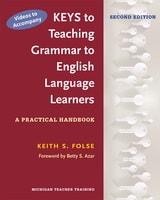
Videos to Accompany Keys to Teaching Grammar to English Language Learners
Keith S. Folse
University of Michigan Press, 2019
- Key 6, Prepositions
- Key 11, Phrasal Verbs
- Chapter 4: Hot Seat Questions
These videos are only available through our online platform: michelt.ublish.com.
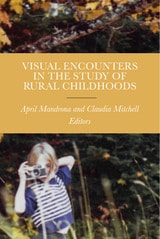
Visual Encounters in the Study of Rural Childhoods
Mandrona, April R.
Rutgers University Press, 2018
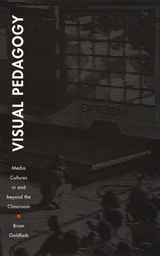
Visual Pedagogy
Media Cultures in and beyond the ClassroomBrian Goldfarb
Duke University Press, 2002
Looking beyond the popular media texts and mainstream classroom technologies that are the objects of most analyses of media and education, Goldfarb encourages readers to see a range of media subcultures as pedagogical tools. The projects he analyzes include media produced by AIDS/HIV advocacy groups and social services agencies for classroom use in the 1990s; documentary and fictional cinemas of West Africa used by the French government and then by those resisting it; museum exhibitions; and TV Anhembi, a municipally sponsored collaboration between the television industry and community-based videographers in São Paolo, Brazil.
Combining media studies, pedagogical theory, and art history, and including an appendix of visual media resources and ideas about the most productive ways to utilize visual technologies for educational purposes, Visual Pedagogy will be useful to educators, administrators, and activists.
Vocabulary and Second Language Writing
David Hirsh
University of Michigan Press, 2021
Each chapter concludes with a list of key points and tasks and discussion questions for pre- and in-service instructors. Several chapters also include sample activities for teaching vocabulary at various instructional levels, designed to encourage readers to consider more deeply how they will include vocabulary instruction in their classrooms.
Vocabulary and Second Language Writing will be an excellent guide for all college-level writing instructors and help them understand the critical role that vocabulary plays in writing quality—something that is often disregarded in favor of holistic features like genre and rhetoric. The volume may also be useful for writing center administrators and those who train writing tutors.
Voices of Experience
How Teachers Manage Student-Centered ESL ClassesJanet Giannotti
University of Michigan Press, 2015
Voices of Experience was designed and written with teachers-in-training and seasoned professionals in mind; the book would be used differently by each.
The book has five units: The Classroom Environment, Lesson Planning, Pair and Group Work, Classroom Interactions, and Classroom Trouble Spots. Each unit has two or three chapters that discuss the survey responses and relevant quotes from participants. Each unit concludes with a Connections section that features:
· *Challenging Beliefs: What Teachers Think, which presents a statement for readers to respond to and compare their responses to others who completed the survey.
· * Classroom Connections: What Teachers Do, which lists reflection or discussion questions
· * Strategies and Motivations: What Teachers Say, which presents more quotes from respondents, particularly those that look at what’s behind teachers’ choices. These too could be used for reflection or discussion.
Voices of Indigenuity
Michelle Montgomery
University Press of Colorado, 2023
Advocating for and providing an expansion of place-based Indigenized education that infuses Indigenous epistemologies for student success in both K–12 and higher education curricula, these essays explore topics such as land fragmentation, remote sensing, and outreach through the lens of TEK, demonstrating methods of fusing learning with Indigenous knowledge (IK). Contributors emphasize the need to increase the perspectives of IK within institutionalized knowledge beyond being co-opted into non-Indigenous frameworks that may be fundamentally different from Indigenous ways of thinking.
Decolonizing current harmful pedagogical curricula and research training about the natural world through an Indigenous- guided approach is an essential first step to rebuilding a healthy relationship with our environment while acknowledging that all relationships come with an ethical responsibility. Voices of Indigenuity captures the complexities of exploring the contextu- alized meanings for why TEK should be integrated into Western environmental science processes and frameworks while rooted in Indigenous studies programs.
Voyage to the Island
Raija Nieminen
Gallaudet University Press, 2014