Results by title
314 books match the query 'Environmental aspects' and 4 start with v
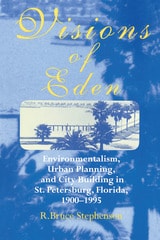
VISIONS OF EDEN
Environmentalism, Urban Planning, and City Building in St. Petersburg, Florida, 1900–1995R. Bruce Stephenson
The Ohio State University Press, 1997
"Stephenson's story of the rise, fall, and resurrections of a good idea takes the reader on a whirlwind tour through planning, political, and public works history. It also contains several messages we should all bear in mind. One is that any city planning should be truly comprehensive and environmentally responsible, considering both what we have built and what we have inherited, and balancing what we want with what we need. Another is that planners and zoning officers must share the same goals. The third is a timely and painful reminder to those of us who frequently lose patience with the way things work, and that is that no one really cares about the future when the present is glittering so brightly." --Environmental History
"This study is the first book-length treatment of St. Petersburg's development and is a major contribution to American urban and urban-planning history." --Choice
Florida enjoys the only subtropical climate in the continental United States. Its burgeoning population and robust tourist economy attest to the state's special allure. Innovative new towns like Miami Lakes and Seaside, along with established communities such as Winter Park and Coral Gables, exemplify Florida's beauty and potential.
St. Petersburg, the largest city in Florida's most urbanized county, epitomizes the best and the worst of the state's city planning history. Enterprise and technology transformed this once struggling backwater into an air-conditioned vision of Eden, but a heavy debt was accumulated in the process. Paradise is under siege: wetlands have been drained, mangroves cleared, sand dunes leveled, bays degraded and filled; water must be imported from inland wells. Although the city now has an innovative growth management system, it was perilously late in coming. In Visions of Eden, R. Bruce Stephenson examines how St. Petersburg learned to control its development.
Since the turn of the century, the opportunity to design a city nestled in a subtropical garden has attracted the nation's preeminent planners to St. Petersburg. The most ambitious plan was developed in 1923 by John Nolen, who believed that an interconnected system of preserves and parks would enhance the city's development and attract tourists for generations. His initiative failed miserably at the polls, however, because it threatened the conflicting notion of paradise held by hundreds of investors, who were profiting from the greatest real estate boom in the nation's history and feared that planning would curtail speculation. As Stephenson points out, a half century would pass until a series of ecological disasters in the 1970s finally compelled city officials to adopt an environmentally sound development plan that reflected Nolen's original vision.
Stephenson carefully explores St. Petersburg's slow awakening to ecological responsibility--to the importance of designing a community that meets both human needs and economic demands. As the debate over the "New Urbanism" moves forward, this book will serve as a useful guide for those who will plan, build, and inhabit the cities of the twenty-first century.
R. Bruce Stephenson is an associate professor and chair of the environmental studies department at Rollins College in Winter Park, Florida.
[more]
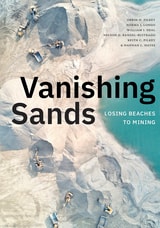
Vanishing Sands
Losing Beaches to MiningOrrin H. Pilkey, Norma J. Longo, William J. Neal, Nelson G. Rangel-Buitrago, Keith C. Pilkey, and Hannah L. Hayes
Duke University Press, 2022
In a time of accelerating sea level rise and increasingly intensifying storms, the world’s sandy beaches and dunes have never been more crucial to protecting coastal environments. Yet, in order to meet the demands of large-scale construction projects, sand mining is stripping beaches and dunes, destroying environments, and exploiting labor in the process. The authors of Vanishing Sands track the devastating impact of legal and illegal sand mining over the past twenty years, ranging from Africa, Asia, and the Caribbean to South America and the eastern United States. They show how sand mining has reached crisis levels: beach, dune, and river ecosystems are in danger of being lost forever, while organized crime groups use deadly force to protect their illegal mining operations. Calling for immediate and widespread resistance to sand mining, the authors demonstrate that its cessation is paramount for saving not only beaches, dunes, and associated environments but also lives and tourism economies everywhere.
[more]
Virulent Zones
Animal Disease and Global Health at China's Pandemic EpicenterLyle Fearnley
Duke University Press, 2020
Scientists have identified southern China as a likely epicenter for viral pandemics, a place where new viruses emerge out of intensively farmed landscapes and human--animal interactions. In Virulent Zones, Lyle Fearnley documents the global plans to stop the next influenza pandemic at its source, accompanying virologists and veterinarians as they track lethal viruses to China's largest freshwater lake, Poyang Lake. Revealing how scientific research and expert agency operate outside the laboratory, he shows that the search for origins is less a linear process of discovery than a constant displacement toward new questions about cause and context. As scientists strive to understand the environments from which the influenza virus emerges, the unexpected scale of duck farming systems and unusual practices such as breeding wild geese unsettle research objects, push scientific inquiry in new directions, and throw expert authority into question. Drawing on fieldwork with global health scientists, state-employed veterinarians, and poultry farmers in Beijing and at Poyang Lake, Fearnley situates the production of ecological facts about disease emergence inside the shifting cultural landscapes of agrarian change and the geopolitics of global health.
[more]
Visionary Pragmatism
Radical and Ecological Democracy in Neoliberal TimesRomand Coles
Duke University Press, 2016
As neoliberal capitalism destroys democracy, commonwealth, and planetary ecology, the need for radically rethinking and generating transformative responses to these catastrophes is greater than ever. Given that, Romand Coles presents an invigorating new mode of scholarship and political practice he calls "visionary pragmatism." Coles explores the profound interrelationships among everyday micropractices of grassroots politics and pedagogy, institutional transformation, and political protest through polyfocal lenses of political and social theory, neuroscience research, complex systems theory, and narratives of his cutting-edge action research. Visionary Pragmatism offers a theory of revolutionary cooptation that, in part, selectively employs practices and strategies of the dominant order to radically alter the coordinates of power and possibility. Underscoring the potential, vitality, and power of emerging democratic practices to change the world, Visionary Pragmatism's simultaneous theoretical rigor and grounding in actual political and ecological practices provokes and inspires new ways of cocreating knowledge and action in dark times.
[more]