Results by title
421 books match the query 'Evolution' and 4 start with v
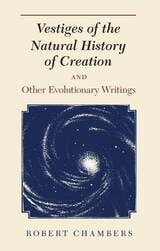
Vestiges of the Natural History of Creation and Other Evolutionary Writings
Robert Chambers
University of Chicago Press, 1994
Originally published anonymously in 1844, Vestiges proved to be as controversial as its author expected. Integrating research in the burgeoning sciences of anthropology, geology, astronomy, biology, economics, and chemistry, it was the first attempt to connect the natural sciences to a history of creation. The author, whose identity was not revealed until 1884, was Robert Chambers, a leading Scottish writer and publisher. Vestiges reached a huge popular audience and was widely read by the social and intellectual elite. It sparked debate about natural law, setting the stage for the controversy over Darwin's Origin. In response to the surrounding debate and criticism, Chambers published Explanations: A Sequel, in which he offered a reasoned defense of his ideas about natural law, castigating what he saw as the narrowness of specialist science.
With a new introduction by James Secord, a bibliography of reviews, and a new index, this volume adds to Vestiges and Explanations Chambers's earliest works on cosmology, an essay on Darwin, and an autobiographical essay, raising important issues about the changing meanings of popular science and religion and the rise of secular ideologies in Western culture.
With a new introduction by James Secord, a bibliography of reviews, and a new index, this volume adds to Vestiges and Explanations Chambers's earliest works on cosmology, an essay on Darwin, and an autobiographical essay, raising important issues about the changing meanings of popular science and religion and the rise of secular ideologies in Western culture.
[more]
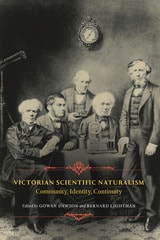
Victorian Scientific Naturalism
Community, Identity, ContinuityEdited by Gowan Dawson and Bernard Lightman
University of Chicago Press, 2014
Victorian Scientific Naturalism examines the secular creeds of the generation of intellectuals who, in the wake of The Origin of Species, wrested cultural authority from the old Anglican establishment while installing themselves as a new professional scientific elite. These scientific naturalists—led by biologists, physicists, and mathematicians such as William Kingdon Clifford, Joseph Dalton Hooker, Thomas Henry Huxley, and John Tyndall—sought to persuade both the state and the public that scientists, not theologians, should be granted cultural authority, since their expertise gave them special insight into society, politics, and even ethics.
In Victorian Scientific Naturalism, Gowan Dawson and Bernard Lightman bring together new essays by leading historians of science and literary critics that recall these scientific naturalists, in light of recent scholarship that has tended to sideline them, and that reevaluate their place in the broader landscape of nineteenth-century Britain. Ranging in topic from daring climbing expeditions in the Alps to the maintenance of aristocratic protocols of conduct at Kew Gardens, these essays offer a series of new perspectives on Victorian scientific naturalism—as well as its subsequent incarnations in the early twentieth century—that together provide an innovative understanding of the movement centering on the issues of community, identity, and continuity.
[more]
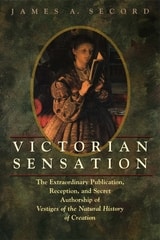
Victorian Sensation
The Extraordinary Publication, Reception, and Secret Authorship of Vestiges of the Natural History of CreationJames A. Secord
University of Chicago Press, 2000
Fiction or philosophy, profound knowledge or shocking heresy? When Vestiges of the Natural History of Creation was published anonymously in 1844, it sparked one of the greatest sensations of the Victorian era. More than a hundred thousand readers were spellbound by its startling vision—an account of the world that extended from the formation of the solar system to the spiritual destiny of humanity. As gripping as a popular novel, Vestiges combined all the current scientific theories in fields ranging from astronomy and geology to psychology and economics. The book was banned, it was damned, it was hailed as the gospel for a new age. This is where our own public controversies about evolution began.
In a pioneering cultural history, James A. Secord uses the story of Vestiges to create a panoramic portrait of life in the early industrial era from the perspective of its readers. We join apprentices in a factory town as they debate the consequences of an evolutionary ancestry. We listen as Prince Albert reads aloud to Queen Victoria from a book that preachers denounced as blasphemy vomited from the mouth of Satan. And we watch as Charles Darwin turns its pages in the flea-ridden British Museum library, fearful for the fate of his own unpublished theory of evolution. Using secret letters, Secord reveals how Vestiges was written and how the anonymity of its author was maintained for forty years. He also takes us behind the scenes to a bustling world of publishers, printers, and booksellers to show how the furor over the book reflected the emerging industrial economy of print.
Beautifully written and based on painstaking research, Victorian Sensation offers a new approach to literary history, the history of reading, and the history of science. Profusely illustrated and full of fascinating stories, it is the most comprehensive account of the making and reception of a book (other than the Bible) ever attempted.
Winner of the 2002 Pfizer Award from the History of Science Society
[more]
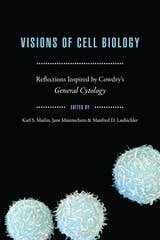
Visions of Cell Biology
Reflections Inspired by Cowdry's "General Cytology"Edited by Karl S. Matlin, Jane Maienschein, and Manfred D. Laubichler
University of Chicago Press, 2017
Although modern cell biology is often considered to have arisen following World War II in tandem with certain technological and methodological advances—in particular, the electron microscope and cell fractionation—its origins actually date to the 1830s and the development of cytology, the scientific study of cells. By 1924, with the publication of Edmund Vincent Cowdry’s General Cytology, the discipline had stretched beyond the bounds of purely microscopic observation to include the chemical, physical, and genetic analysis of cells. Inspired by Cowdry’s classic, watershed work, this book collects contributions from cell biologists, historians, and philosophers of science to explore the history and current status of cell biology.
Despite extraordinary advances in describing both the structure and function of cells, cell biology tends to be overshadowed by molecular biology, a field that developed contemporaneously. This book remedies that unjust disparity through an investigation of cell biology’s evolution and its role in pushing forward the boundaries of biological understanding. Contributors show that modern concepts of cell organization, mechanistic explanations, epigenetics, molecular thinking, and even computational approaches all can be placed on the continuum of cell studies from cytology to cell biology and beyond. The first book in the series Convening Science: Discovery at the Marine Biological Laboratory, Visions of Cell Biology sheds new light on a century of cellular discovery.
Despite extraordinary advances in describing both the structure and function of cells, cell biology tends to be overshadowed by molecular biology, a field that developed contemporaneously. This book remedies that unjust disparity through an investigation of cell biology’s evolution and its role in pushing forward the boundaries of biological understanding. Contributors show that modern concepts of cell organization, mechanistic explanations, epigenetics, molecular thinking, and even computational approaches all can be placed on the continuum of cell studies from cytology to cell biology and beyond. The first book in the series Convening Science: Discovery at the Marine Biological Laboratory, Visions of Cell Biology sheds new light on a century of cellular discovery.
[more]