Results by title
375 books match the query 'Excavations (Archaeology)' and 3 start with v
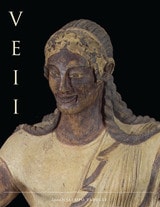
Veii
Edited by Jacopo Tabolli with Orlando Cerasuolo
University of Texas Press, 2019
Reputed to be the richest city of Etruria, Veii was one of the most important cities in the ancient Mediterranean world. It was located ten miles northwest of Rome, and the two cities were alternately allied and at war for over three hundred years until Veii fell to Rome in 396 BCE, although the city continued to be inhabited until the Middle Ages. Rediscovered in the seventeenth century, Veii has undergone the longest continuous excavation of any of the Etruscan cities.
The most complete volume on the city in English, Veii presents the research and interpretations of multiple generations of Etruscan scholars who are at the forefront of the discipline. Their essays are grouped into four parts. The first provides a general overview of archaeological excavation at Veii and discusses the different types of methodologies employed over the years. The second part narrates the history of Etruscan occupation of the city and its role in the greater Mediterranean world. The third section examines the surviving material culture of Veii, including pottery, painting, sculpture, metalworking, and architectural terracottas. Finally, the legacy of Veii is discussed, and a chronology of the site is presented. This pioneering research offers all students of the ancient Mediterranean a new understanding of the development of Veii and its territory from the late Bronze Age to the Roman conquest, as well as of the interactions of Veii with nearby sites and territories in central Tyrrhenian Italy.
Vintage Moquegua
History, Wine, and Archaeology on a Colonial Peruvian PeripheryBy Prudence M. Rice
University of Texas Press, 2011
The microhistory of the wine industry in colonial Moquegua, Peru, during the colonial period stretches from the sixteenth through nineteenth centuries, yielding a wealth of information about a broad range of fields, including early modern industry and labor, viniculture practices, the cultural symbolism of alcohol consumption, and the social history of an indigenous population. Uniting these perspectives, Vintage Moquegua draws on a trove of field research from more than 130 wineries in the Moquegua Valley.
As Prudence Rice walked the remnants of wine haciendas and interviewed Peruvians about preservation, she saw that numerous colonial structures were being razed for development, making her documentary work all the more crucial. Lying far from imperial centers in pre-Hispanic and colonial times, the area was a nearly forgotten administrative periphery on an agricultural frontier. Spain was unable to supply the Peruvian viceroyalty with sufficient wine for religious and secular purposes, leading colonists to import and plant grapevines. The viniculture that flourished produced millions of liters, most of it distilled into pisco brandy. Summarizing archaeological data and interpreting it through a variety of frameworks, Rice has created a three-hundred-year story that speaks to a lost world and its inhabitants.
Voyage To The Other World
The Legacy of Sutton HooCalvin Kendall
University of Minnesota Press, 1992
A fascinating exploration of pagan Anglo-Saxon culture-a world caught on the boundary between competing ideologies and contrasting social systems.
Contributors: James Campbell, Martin Carver, Robert Payson Creed, Roberta Frank, Michael N. Geselowitz, Gloria Polizzotti Greis, Henrik M. Jansen, Simon Keynes, Edward Schoenfeld, Jana Schulman, Alan M. Stahl, Wesley M. Stevens, and Else Roesdahl.Medieval Cultures Series, volume 5