Results by title
183 books match the query 'Feminist' and 2 start with v

Virginia Woolf Icon
Brenda R. Silver
University of Chicago Press, 1999
This is a book about "Virginia Woolf": the face that sells more postcards than any other at Britain's National Portrait Gallery, the name that Edward Albee's play linked with fear, the cultural icon so rich in meanings that it has been used to market everything from the New York Review of Books to Bass Ale. Brenda Silver analyzes Virginia Woolf's surprising visibility in both high and popular culture, showing how her image and authority have been claimed or challenged in debates about art, politics, anger, sexuality, gender, class, the canon, feminism, race, and fashion.
From Virginia Woolf's 1937 appearance on the cover of Time magazine to her current roles in theater, film, and television, Silver traces the often contradictory representations and the responses they provoke, highlighting the recurring motifs that associate Virginia Woolf with fear. By looking more closely at who is afraid and the contexts in which she is perceived to be frightening, Silver illustrates how Virginia Woolf has become the site of conflicts about cultural boundaries and legitimacy that continue to rage today.
From Virginia Woolf's 1937 appearance on the cover of Time magazine to her current roles in theater, film, and television, Silver traces the often contradictory representations and the responses they provoke, highlighting the recurring motifs that associate Virginia Woolf with fear. By looking more closely at who is afraid and the contexts in which she is perceived to be frightening, Silver illustrates how Virginia Woolf has become the site of conflicts about cultural boundaries and legitimacy that continue to rage today.
[more]
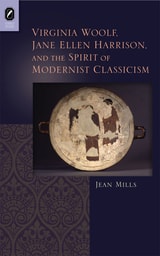
Virginia Woolf, Jane Ellen Harrison, and the Spirit of Modernist Classicism
Jean Mills
The Ohio State University Press, 2014
In a work that re-investigates archival materials and deploys an innovative theoretical framework, Jean Mills explores the intellectual and political relationship between Virginia Woolf and the Cambridge classicist Jane Ellen Harrison. Virginia Woolf, Jane Ellen Harrison, and the Spirit of Modernist Classicism discovers an intimate connection crucial to Woolf’s professional identity and intellectual and artistic development in Harrison’s controversial, feminist interpretations of Greek mythology. Mills argues that cross-reading Jane Harrison and Virginia Woolf exposes a distinctive relationship between two women intellectuals, one that does not rehearse the linearity of influence but instead demonstrates the intricacy of intertextuality—an active and transformative use of one body of writing by another writer—that makes of Virginia Woolf’s modernism a specifically feminist amplification. This cross-reading reveals a dimension of modernism that has been overlooked or minimized: Mills demonstrates that the questions preoccupying Harrison also resonated with Woolf, who adapted Harrison’s ideas to her own intellectual, political, and literary pursuits.
To an extent, Virginia Woolf, Jane Ellen Harrison, and the Spirit of Modernist Classicism participates in an act of classical recovery. It is an effort to revive and reclaim Harrison’s work and to illustrate the degree to which her cultural, political, and scholastic example informed one of the major modernist voices of the twentieth century.
To an extent, Virginia Woolf, Jane Ellen Harrison, and the Spirit of Modernist Classicism participates in an act of classical recovery. It is an effort to revive and reclaim Harrison’s work and to illustrate the degree to which her cultural, political, and scholastic example informed one of the major modernist voices of the twentieth century.
[more]