Results by title
522 books match the query 'Gender' and 7 start with v

Vetting for Passion
Race, Gender, and Inequalities in the Veterinary ProfessionAdilia E. E. James
Temple University Press, 2027
Despite calls from industry associations for a diverse workforce to meet a changing client base, racial and gendered occupational segregation persists in the veterinary profession. As of 2018, nearly 90% of veterinarians identify as White and more than 70% are women. Adilia James explains the causes and effects of this growing and alarming trend in Vetting for Passion.
James interviews aspiring and employed veterinarians about why marginalized groups are, ironically, not making equitable progress in an elite labor market that encourages diversity and inclusion policies. She shows how cultural and structural barriers exclude people of color from the profession and how relationships with animals are used as racialization tools. People of color are also hindered by factors such as social and lived experiences, the debt-to-income ratio, and an uncomfortable working environment.
Additionally, James finds that hiring managers, veterinary schools, and mentors rely on “constrained choice narratives” to justify their assumption that only White women are likely to appreciate the unique benefits of a career in veterinary medicine, leading these gatekeepers to excuse their opportunity hoarding as benevolent.
Vetting for Passion offers a critical case study of a profession whose associations, colleges, and workplaces justify and perpetuate a culture of racial exclusion.
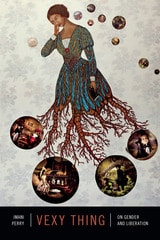
Vexy Thing
On Gender and LiberationImani Perry
Duke University Press, 2018
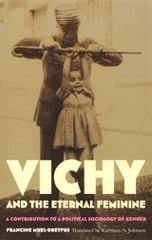
Vichy and the Eternal Feminine
A Contribution to a Political Sociology of GenderFrancine Muel-Dreyfus
Duke University Press, 2001
Drawing on an extensive body of legislative, religious, educational, medical, and literary texts, Muel-Dreyfus examines how the Vichy regime brutally resurrected the gender politics that had been rejected during France’s social struggles in the 1930s. Strikingly, she reveals how this resurrection in turn fed into racial politics: childless women, for instance, and those who had abortions were construed—like Jews—as threats to France’s racial “purity.” With its atendant patterns of social inclusion and exclusion that were deeply rooted in the political and cultural history of the Third Republic, Muel-Dreyfus claims, a pervasive range of gendered metaphors helped to structure the very laws and policies of the Vichy regime.
The French language edition of this book was published in 1996 to wide acclaim. Contributing to theories about the role of gender in political philosophy, to the cultural anthropology of symbolic representation, and to our understanding of the history of fascism, Vichy and the Eternal Feminine will appeal to French, European, and twentieth-century historians; students and scholars of gender and racial studies; political scientists; and anthropologists.
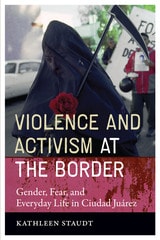
Violence and Activism at the Border
Gender, Fear, and Everyday Life in Ciudad JuarezBy Kathleen Staudt
University of Texas Press, 2008
Between 1993 and 2003, more than 370 girls and women were murdered and their often-mutilated bodies dumped outside Ciudad Juárez in Chihuahua, Mexico. The murders have continued at a rate of approximately thirty per year, yet law enforcement officials have made no breakthroughs in finding the perpetrator(s). Drawing on in-depth surveys, workshops, and interviews of Juárez women and border activists, Violence and Activism at the Border provides crucial links between these disturbing crimes and a broader history of violence against women in Mexico. In addition, the ways in which local feminist activists used the Juárez murders to create international publicity and expose police impunity provides a unique case study of social movements in the borderlands, especially as statistics reveal that the rates of femicide in Juárez are actually similar to other regions of Mexico.
Also examining how non-governmental organizations have responded in the face of Mexican law enforcement's "normalization" of domestic violence, Staudt's study is a landmark development in the realm of global human rights.
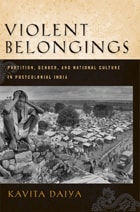
Violent Belongings
Partition, Gender, and National Culture in Postcolonial IndiaKavita Daiya
Temple University Press, 2008
In addition to challenging the official narratives of independence and Partition, these narratives challenge our contemporary understanding of gender and ethnicity in history and politics. Violent Belongings argues that both male and female bodies, and heterosexual coupledom, became symbols of the nation in public life. In the newly independent Indian nation both men and women were transformed into ideal citizens or troubling bodies, immigrants or refugees, depending on whether they were ethnically Hindu, Muslim, Jewish or Sikh. The divisions set in motion during Partition continue into our own time and account for ethnic violence in South Asia.
Violent Encounters
Gender, Colonialism, and the First World War in Cameroon, 1884–1916George N. Njung
Ohio University Press, 2027
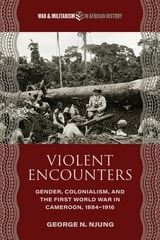
Violent Encounters offers a powerful and original gendered history of colonial rule and warfare in Cameroon from the advent of German imperialism to the end of the First World War. Centering German Cameroon as an understudied but pivotal site of empire and global conflict, George N. Njung demonstrates that violence was a calculated instrument of colonial governance, which was systematically organized along racial and gendered lines to conquer territory, discipline African communities, and suppress resistance.
Drawing on extensive archival research in Africa and Europe, oral traditions, and interdisciplinary gender analysis, Njung reconstructs how empire and war were lived differently by African men and women. He shows that gender-based violence—especially sexual abuse—functioned as a deliberate political strategy embedded in military campaigns, forced labor regimes, and systems of punishment. African women bore disproportionate burdens at the intersection of gender, race, and militarization, even as they acted as resisters, mobilizers, and negotiators. African men, meanwhile, experienced forced recruitment, battlefield violence, and profound challenges to social authority under colonial rule.
Reinterpreting the First World War in Africa as an escalation rather than a rupture, Violent Encounters situates wartime atrocities, mass displacement, and one of the twentieth century’s earliest refugee crises within a longer continuum of imperial violence. By foregrounding gender, the book repositions Cameroon—and Africa more broadly—as central to understanding the global dynamics of empire, militarization, and resistance in the early twentieth century.

Voice, Silence and Gender in South Africa's Anti-Apartheid Struggle
The Shadow of a Young WomanRachel E. Johnson
University of London Press, 2025
Who spoke about the liberation struggle whilst it was ongoing? When did they speak and how? And what effects do the gendered history of speech and silence within anti-apartheid politics continue to have upon our knowledge of the past? Arguing that she is emblematic of the way gendered narratives of the struggle have been made, this book listens for the voice and silence of Masabata Loate and her contemporaries within political trials; newspapers; photography; human rights reportage; creative fiction, drama, poetry and song; autobiography and memoir; and oral histories. The result is an unconventional biography that sees this young woman as a shadow within the story of South Africa’s anti-apartheid liberation struggle.