Results by title
932 books match the query 'Genres & Styles' and 7 start with v
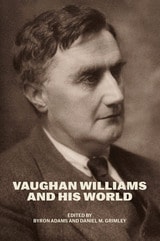
Vaughan Williams and His World
Edited by Byron Adams and Daniel M. Grimley
University of Chicago Press, 2023
A biography of Ralph Vaughan Williams, published in collaboration with the Bard Music Festival.
Ralph Vaughan Williams (1872–1958) was one of the most innovative and creative figures in twentieth-century music, whose symphonies stand alongside those of Sibelius, Nielsen, Shostakovich, and Roussel. After his death, shifting priorities in the music world led to a period of critical neglect. What could not have been foreseen is that by the second decade of the twenty-first century, a handful of Vaughan Williams’s scores would attain immense popularity worldwide. Yet the present renown of these pieces has led to misapprehension about the nature of Vaughan Williams’s cultural nationalism and a distorted view of his international cultural and musical significance.
Vaughan Williams and His World traces the composer’s stylistic and aesthetic development in a broadly chronological fashion, reappraising Vaughan Williams’s music composed during and after the Second World War and affirming his status as an artist whose leftist political convictions pervaded his life and music. This volume reclaims Vaughan Williams’s deeply held progressive ethical and democratic convictions while celebrating his achievements as a composer.
[more]
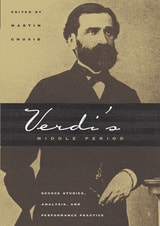
Verdi's Middle Period
Source Studies, Analysis, and Performance PracticeEdited by Martin Chusid
University of Chicago Press, 1997
During the middle phase of his career, 1849-59, Verdi adopted new compositional procedures to create some of his best-loved and most-performed works. Focusing on the operas he composed during this period, this volume explores Verdi's work from three interlinked perspectives: studies of the original source material, cross-disciplinary analyses of musical and textual issues, and the relationship of performance practice to Verdi's musical and dramatic conception.
In addition to offering new insights into such staples as Il trovatore, La traviata, and Un ballo in maschera, Verdi's Middle Period also highlights works which have only recently begun to re-enter public consciousness, such as Stiffelio, as well as lesser-known works such as Luisa Miller and Les Vêpres siciliennes. Comprising major essays by some of the best-known Verdians of our day, as well as articles from up-and-coming scholars, this volume has much to offer readers ranging from musicologists to serious opera buffs.
Contributors are Martin Chusid, Markus Engelhardt, Linda B. Fairtile, Philip Gossett, Kathleen Kuzmick Hansell, Elizabeth Hudson, James Hepokoski, Roberta Montemorra Marvin, Carlo Matteo Mossa, Roger Parker, Harold S. Powers, David Rosen, and Mary Ann Smart.
[more]
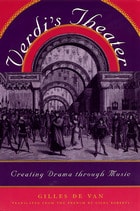
Verdi's Theater
Creating Drama through MusicGilles de Van
University of Chicago Press, 1998
In this innovative study, Gilles de Van focuses on an often neglected aspect of Verdi's operas: their effectiveness as theater. De Van argues that two main aesthetic conceptions underlie all of Verdi's works: that of the "melodrama" and the "musical drama." In the melodrama the composer relies mainly on dramatic intensity and the rhythm linking various stages of the plot, using exemplary characters and situations. But in the musical drama reality begins to blur, the musical forms lose their excessively neat patterns, and doubt and ambiguity undermine characters and situations, reflecting the crisis of character typical of modernity.
Although melodrama tends to dominate Verdi's early work and musical drama his later, both aesthetics are woven into all his operas: musical drama is already present in Ernani (1844), and melodrama is still present in Otello (1887). Indeed, much of the interest and originality of Verdi's operas lies in his adherence to both these contradictory systems, allowing the composer/dramatist to be simultaneously classical and modern, traditionalist and innovator.
Although melodrama tends to dominate Verdi's early work and musical drama his later, both aesthetics are woven into all his operas: musical drama is already present in Ernani (1844), and melodrama is still present in Otello (1887). Indeed, much of the interest and originality of Verdi's operas lies in his adherence to both these contradictory systems, allowing the composer/dramatist to be simultaneously classical and modern, traditionalist and innovator.
[more]

Vinyl Freak
Love Letters to a Dying MediumJohn Corbett
Duke University Press, 2017
From scouring flea markets and eBay to maxing out their credit cards, record collectors will do just about anything to score a long-sought-after album. In Vinyl Freak, music writer, curator, and collector John Corbett burrows deep inside the record fiend’s mind, documenting and reflecting on his decades-long love affair with vinyl. Discussing more than 200 rare and out-of-print LPs, Vinyl Freak is composed in part of Corbett's long-running DownBeat magazine column of the same name, which was devoted to records that had not appeared on CD. In other essays where he combines memoir and criticism, Corbett considers the current vinyl boom, explains why vinyl is his preferred medium, profiles collector subcultures, and recounts his adventures assembling the Alton Abraham Sun Ra Archive, an event so all-consuming that he claims it cured his record-collecting addiction. Perfect for vinyl newbies and veteran crate diggers alike, Vinyl Freak plumbs the motivations that drive Corbett and collectors everywhere.
[more]
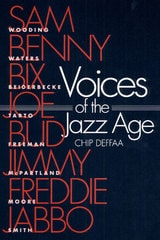
Voices of the Jazz Age
Profiles of Eight Vintage JazzmenChip Deffaa
University of Illinois Press, 1990
In Voices of the Jazz Age, Chip Deffaa interviews eight musicians who rose to popularity during the 1920s. Sam Wooding, Benny Waters, Bix Beiderbecke, Joe Tarto, Bud Freeman, Jimmy McPartland, Freddie Moore, Jabbo Smith bring the Jazz Age back to life with vivid memories, amazing stories, and their own larger-than-life personalities. Deffaa draws out their glory days in the Twenties but also invites them to share the stories of their long lives in music, often in obscurity, but in many cases still working and gigging well into their eighties.
[more]
Voices of the Magi
Enchanted Journeys in Southeast BrazilSuzel Reily
University of Chicago Press, 2002
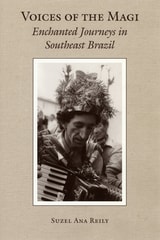
Voices of the Magi explores the popular Catholic musical ensembles of southeastern Brazil known as folias de reis (companies of kings). Composed predominantly of low-income workers, the folias reenact the journey of the Wise Men to Bethlehem and back to the Orient, as they roam from house to house, singing to bless the families they visit in exchange for food and money. These gifts, in turn, are used to prepare a festival on Kings' Day, January 6, to which all who contributed are invited.
Focusing on urban folias, Suzel Ana Reily shows how participants use the ritual journeys and musical performances of the folias to create sacred spheres distinct from, yet intimately related to, their everyday world. Reily calls this practice "enchantment" and argues that it allows the folia communities to temporarily make the social ideals of mutual reciprocity and equality embodied in their religious beliefs a reality. The contrast between their ritual experiences and the daily lives of these impoverished workers, in turn, reinforces the religious convictions of these devotees of the music of the Magi.
Focusing on urban folias, Suzel Ana Reily shows how participants use the ritual journeys and musical performances of the folias to create sacred spheres distinct from, yet intimately related to, their everyday world. Reily calls this practice "enchantment" and argues that it allows the folia communities to temporarily make the social ideals of mutual reciprocity and equality embodied in their religious beliefs a reality. The contrast between their ritual experiences and the daily lives of these impoverished workers, in turn, reinforces the religious convictions of these devotees of the music of the Magi.
[more]
Vyšší Brod 42
A Unique Music Source from Pre-Hussite BohemiaLenka Hlávková, Jan Ciglbauer, and Pavel Kodýtek
Karolinum Press, 2025
An in-depth study of a medieval manuscript of songs from the Cistercian monastery in Vyšší Brod.
Manuscript 42 from the Cistercian monastery in Vyšší Brod (Hohenfurth), Czech Republic, compiled in 1410, today represents one of the most important music sources from medieval Bohemia, providing insight into the rich and varied liturgical and devotional repertory circulating in Central Europe just before the outbreak of the Hussite Wars in 1419. The manuscript’s collection of monophonic and polyphonic songs, one of the oldest ones in Europe, serves as a starting point for studies of the Latin mensural cantio, an important late medieval music form and cultural phenomenon.
In Vyšší Brod 42, three extensive studies explore various aspects of the manuscript and its contents. In the first, Jan Ciglbauer examines its creation process and the involvement of various scribes in noting down new texts and melodies. In the second, Hana Vlhová-Wörner delves into the variety of late medieval chant compositions contained within it and the relationship of this truly novel repertory to the formalized Cistercian liturgy. The last chapter, co-authored by Lenka Hlávková and Pavel Kodýtek, scrutinizes the manuscript’s remarkable collection of spiritual songs and identifies their inscription as “snapshots” of a vivid oral tradition.
Together, these three studies bring a new perspective on musical life in Cistercian monasteries in Central Europe in the late Middle Ages, a topic that has received very little exploration until now.
[more]