383 books match the query 'Globalization' and 4 start with v

cover of Value Wars: The Global Market Versus the Life Economy

Value Wars

The Global Market Versus the Life Economy

John McMurtry

Pluto Press, 2002

[more]
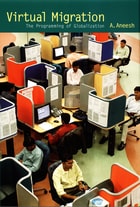
cover of Virtual Migration: The Programming of Globalization

Virtual Migration

The Programming of Globalization

A. Aneesh

Duke University Press, 2006

Workers in India program software applications, transcribe medical dictation online, chase credit card debtors, and sell mobile phones, diet pills, and mortgages for companies based in other countries around the world. While their skills and labor migrate abroad, these workers remain Indian citizens, living and working in India. A. Aneesh calls this phenomenon “virtual migration,” and in this groundbreaking study he examines the emerging “transnational virtual space” where labor and vast quantities of code and data cross national boundaries, but the workers themselves do not. Through an analysis of the work of computer programmers in India working for the American software industry, Aneesh argues that the programming code connecting globally dispersed workers through data servers and computer screens is the key organizing structure behind the growing phenomenon of virtual migration. This “rule of code,” he contends, is a crucial and underexplored aspect of globalization.

Aneesh draws on the sociology of science, social theory, and research on migration to illuminate the practical and theoretical ramifications of virtual migration. He combines these insights with his extensive ethnographic research in offices in three locations in India—in Delhi, Gurgaon, and Noida—and one in New Jersey. Aneesh contrasts virtual migration with “body shopping,” the more familiar practice of physically bringing programmers from other countries to work on site, in this case, bringing them from India to New Jersey. A significant contribution to the social theory of globalization, Virtual Migration maps the expanding transnational space where globalization is enacted via computer programming code.

[more]
cover of Viscous Performances: The Persistence of Creative Resistances in Neoliberal Chile

Viscous Performances

The Persistence of Creative Resistances in Neoliberal Chile

María José Contreras Lorenzini

Duke University Press, 2026

Viscous Performances examines the endurance of creative protest performances in Chile from the 2011 student mobilizations to the aftermath of the 2019 social revolt. Drawing from performance theory, feminist new materialisms, affect studies, and decolonial perspectives, María José Contreras Lorenzini situates Chilean practices of resistance within a global conversation about the politics of performance while attending closely to the historical and material specificities of the Chilean context. Case studies include student interventions, feminist mobilizations, and commemorative actions that unfolded along a two-kilometer stretch of Santiago’s main avenue, La Alameda. Contreras Lorenzini argues that repeated creative resistances that insistently occupied this same urban corridor generated a sticky, persistent, and affectively charged antidote to neoliberalism’s slow violence. These temporally dispersed acts territorialized the urban space as a site of resistance where echoes and reverberations of repertoires accumulated, thickened, and remained available for reenactment. By theorizing resistance as viscous rather than fleeting, Viscous Performances challenges neoliberal framings of dissent that privilege visibility and spectacle and highlights the quieter, less visible practices of care, collaboration, and imagination through which communities sustain long-term struggles.
[more]
cover of Voluminous States: Sovereignty, Materiality, and the Territorial Imagination

Voluminous States

Sovereignty, Materiality, and the Territorial Imagination

Franck Billé

Duke University Press, 2020

From the Arctic to the South China Sea, states are vying to secure sovereign rights over vast maritime stretches, undersea continental plates, shifting ice flows, airspace, and the subsoil. Conceiving of sovereign space as volume rather than area, the contributors to Voluminous States explore how such a conception reveals and underscores the three-dimensional nature of modern territorial governance. In case studies ranging from the United States, Europe, and the Himalayas to Hong Kong, Korea, and Bangladesh, the contributors outline how states are using airspace surveillance, maritime patrols, and subterranean monitoring to gain and exercise sovereignty over three-dimensional space. Whether examining how militaries are digging tunnels to create new theaters of operations, the impacts of climate change on borders, or the relation between borders and nonhuman ecologies, they demonstrate that a three-dimensional approach to studying borders is imperative for gaining a fuller understanding of sovereignty.

Contributors. Debbora Battaglia, Franck Billé, Wayne Chambliss, Jason Cons, Hilary Cunningham (Scharper), Klaus Dodds, Elizabeth Cullen Dunn, Gastón Gordillo, Sarah Green, Tina Harris, Caroline Humphrey, Marcel LaFlamme, Lisa Sang Mi Min, Aihwa Ong, Clancy Wilmott, Jerry Zee
[more]