Results by title
405 books match the query 'Human Geography' and 8 start with v
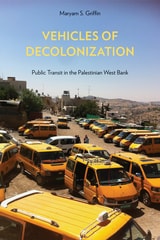
Vehicles of Decolonization
Public Transit in the Palestinian West BankMaryam S. Griffin
Temple University Press, 2022
Examining the border-enclosure strategy Israel uses to impose Palestinian im/mobilization, Maryam Griffin considers the ways public transportation in the Palestinian West Bank is a constant site of social struggle. Her illuminating book, Vehicles of Decolonization, studies collective movement, resistance, and everyday life in the West Bank to show how Palestinians assert a kind of Indigenous self-determination over mobility that Israeli settler colonialism seeks to undermine.
Having immersed herself in a year of fieldwork, Griffin maps multiple engagements with the flexible bus, shared van, and private taxi services to demonstrate that the politics of mobility are shaped by ongoing settler colonialism and Indigenous struggle. Griffin uses critical border studies to look at the contested nature of mobility at the sites of transit, where Palestinians practice self-determination through routine participation, spectacular political organizing and demonstration, and artistic renderings.
Featuring a variety of street images, Vehicles of Decolonization shows that multiple registers of people power work in concert not only to resist settler colonial logics but to reinhabit the land through the practice and preservation of alternative relations of mobility.
Viapolitics
Borders, Migration, and the Power of LocomotionWilliam Walters, Charles Heller, and Lorenzo Pezzani, editors
Duke University Press, 2021
Contributors. Ethan Blue, Maribel Casas-Cortes, Julie Y. Chu, Sebastian Cobarrubias, Glenda Garelli, Charles Heller, Sabine Hess, Bernd Kasparek, Clara Lecadet, Johan Lindquist, Renisa Mawani, Lorenzo Pezzani, Ranabir Samaddar, Amaha Senu, Martina Tazzioli, William Walters

Victoria County History of Cumbria
Kirkoswald and RenwickRichard Brockington and with Sarah Rose
University of London Press, 2019
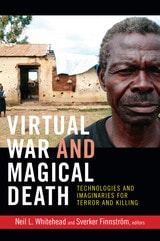
Virtual War and Magical Death
Technologies and Imaginaries for Terror and KillingNeil L. Whitehead and Sverker Finnström, eds.
Duke University Press, 2013
Another significant focus of the collection is the U.S. military's exploitation of ethnographic research, particularly through its controversial Human Terrain Systems (HTS) Program, which embeds anthropologists as cultural experts in military units. Several pieces address the ethical dilemmas that HTS and other counterinsurgency projects pose for anthropologists. Other essays reveal the relatively small scale of those programs in relation to the military's broader use of, and ambitions for, social scientific data.
Contributors. Robertson Allen, Brian Ferguson, Sverker Finnström, Roberto J. González, David H. Price, Antonius Robben, Victoria Sanford, Jeffrey Sluka, Koen Stroeken, Matthew Sumera, Neil L. Whitehead
Visions of the Southland
A Year in Los Angeles CountyEdited by Wade Graham and William Deverell
University of Chicago Press, 2026
Experience a year in Los Angeles County, in all its glitter and grit, through a unique anthology that pairs essays by acclaimed writers and historians with custom maps.
When many of us picture Los Angeles, we’re actually thinking of LA County. Home to roughly ten million people, the county alone is more populous than forty-two US states. Its eighty-eight cities include places made famous by Hollywood glamor and California dreaming—Beverly Hills, Malibu, and Santa Monica—but also working-class municipalities and the self-explanatory City of Industry. With a territory that includes the Pacific coastline, mountain ranges, and the high Mojave Desert, the county’s landscapes have been touched by earthquakes, droughts, and, of course, devastating fires. LA County is a place of extremes: progress and injustice, innovation and stagnation.
Visions of the Southland collects essays by writers, journalists, and historians to create a nuanced portrait of LA that’s grounded in the county itself—its sites, structures, and stories. Contributors—including Gustavo Arellano, Keri Blakinger, Lynell George, Christopher Hawthorne, Michael Hiltzik, Greg Hise, Carolina Miranda, Becky Nicolaides, Susan Straight, and David L. Ulin—delve into LA’s infamous air pollution, movie ranches, prisons, aqueducts, urban forests, SoCal Bohemianism, and more. A custom map by Ezra Rawitsch enriches each piece and grounds the reader in specific locations throughout the county. Unfolding over the course of a year, the book traces the rhythms of politics, sports, weather, and wildlife across this sprawling and enigmatic place.
Sweeping in its scope and gorgeous in its design, Visions of the Southland will delight Angelenos, history buffs, urbanists, and map enthusiasts alike.

Visual Cultures of Japanese Imperialism, Volume 8
Gennifer Weisenfeld, ed.
Duke University Press, 0
The articles, contributed by scholars in the fields of art history, cultural history, and Japanese literature, address the interactions between Japan, the West, and the rest of Asia. Costumes, architecture, tourism propaganda, pottery, and a host of other sources provide the raw materials for Visual Cultures of Japanese Imperialism, and the incisive essays built from these sources will change readers’ understanding of the visual culture(s) of imperialism.
Contributors. Kim Brandt, Leo Ching, Carol Ann Christ, Christine Guth, Jordan Sand, Gennifer Weisenfeld, Cherie Wendelken

Voluminous States
Sovereignty, Materiality, and the Territorial ImaginationFranck Billé
Duke University Press, 2020
Contributors. Debbora Battaglia, Franck Billé, Wayne Chambliss, Jason Cons, Hilary Cunningham (Scharper), Klaus Dodds, Elizabeth Cullen Dunn, Gastón Gordillo, Sarah Green, Tina Harris, Caroline Humphrey, Marcel LaFlamme, Lisa Sang Mi Min, Aihwa Ong, Clancy Wilmott, Jerry Zee
Voluntourism and Multispecies Collaboration
Life, Death, and Conservation in the Mesoamerican Barrier ReefKeri Vacanti Brondo
University of Arizona Press, 2021
Winner of the 2022 Edward M. Bruner Book Award
Voluntourism and Multispecies Collaboration is a lively ethnographic exploration of the world of conservation voluntourism and its engagement with marine and terrestrial biodiversity on the Honduran Bay Island of Utila, located in the ecologically critical Mesoamerican Barrier Reef.
In this highly readable text, anthropologist Keri Vacanti Brondo provides a pioneering theoretical framework that conceptualizes conservation voluntourism as a green industry. Brondo argues that the volunteer tourism industry is the product of coloniality and capitalism that works to produce and sustain an economy of affect while generating inequalities and dispossession. Employing a decolonizing methodology based on landscape assemblage theory, Brondo offers “thinking-like-a-mangrove” to attend to alternative worldings in Utila beyond the hegemonic tourist spectacle–dominated world attached to the volunteer tourism industry. Readers journey through the mangroves and waters alongside voluntourists, iguanas, whale sharks, turtles, lionfish, and islanders to build valuable research experience in environmental management while engaging in affective labor and multispecies relations of care.
Conservation organizations benefit from the financial capital and labor associated with conservation tourism, an industry boosted by social media. This critical work asks us to consider the impacts of this new alternative tourism market, one that relies on the exchange of “affect” with other species. How are human socialities made through interactions with other species? What lives and dies in Utila’s affect economy? Why are some species killable? Who gets to decide?