Results by title
433 books match the query 'Immigrants' and 3 start with v
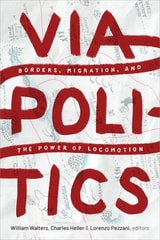
Viapolitics
Borders, Migration, and the Power of LocomotionWilliam Walters, Charles Heller, and Lorenzo Pezzani, editors
Duke University Press, 2021
Vehicles, their infrastructures, and the environments they traverse are fundamental to the movement of migrants and states' attempts to govern them. This volume's contributors use the concept of viapolitics to name and foreground this contested entanglement and examine the politics of migration and bordering across a range of sites. They show how these elements constitute a key site of knowledge and struggle in migratory processes and offer a privileged vantage point from which to interrogate practices of mobility and systems of control in their deeper histories and wider geographic connections. This transdisciplinary group of scholars explores a set of empirically rich and diverse cases: from the Spanish and European authorities' attempts to control migrants' entire trajectories to infrastructures of escort of Indonesian labor migrants; from deportation train cars in the 1920s United States to contemporary stowaways at sea; from illegalized migrants walking across treacherous Alpine mountain passes to aerial geographies of deportation. Throughout, Viapolitics interrogates anew the phenomenon called “migration,” questioning how different forms of contentious mobility are experienced, policed, and contested.
Contributors. Ethan Blue, Maribel Casas-Cortes, Julie Y. Chu, Sebastian Cobarrubias, Glenda Garelli, Charles Heller, Sabine Hess, Bernd Kasparek, Clara Lecadet, Johan Lindquist, Renisa Mawani, Lorenzo Pezzani, Ranabir Samaddar, Amaha Senu, Martina Tazzioli, William Walters
Contributors. Ethan Blue, Maribel Casas-Cortes, Julie Y. Chu, Sebastian Cobarrubias, Glenda Garelli, Charles Heller, Sabine Hess, Bernd Kasparek, Clara Lecadet, Johan Lindquist, Renisa Mawani, Lorenzo Pezzani, Ranabir Samaddar, Amaha Senu, Martina Tazzioli, William Walters
[more]
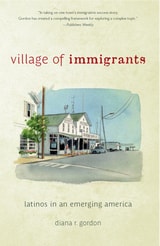
Village of Immigrants
Latinos in an Emerging AmericaGordon, Diana R
Rutgers University Press, 2015
Greenport, New York, a village on the North Fork of Long Island, has become an exemplar of a little-noted national trend—immigrants spreading beyond the big coastal cities, driving much of rural population growth nationally. In Village of Immigrants, Diana R. Gordon illustrates how small-town America has been revitalized by the arrival of these immigrants in Greenport, where she lives.
Greenport today boasts a population that is one-third Hispanic. Gordon contends that these immigrants have effectively saved the town’s economy by taking low-skill jobs, increasing the tax base, filling local schools, and patronizing local businesses. Greenport’s seaside beauty still attracts summer tourists, but it is only with the support of the local Latino workforce that elegant restaurants and bed-and-breakfasts are able to serve these visitors. For Gordon the picture is complex, because the wave of immigrants also presents the town with challenges to its services and institutions. Gordon’s portraits of local immigrants capture the positive and the negative, with a cast of characters ranging from a Guatemalan mother of three, including one child who is profoundly disabled, to a Colombian house painter with a successful business who cannot become licensed because he remains undocumented. Village of Immigrants weaves together these people’s stories, fears, and dreams to reveal an environment plagued by threats of deportation, debts owed to coyotes, low wages, and the other bleak realities that shape the immigrant experience—even in the charming seaport town of Greenport.
A timely contribution to the national dialogue on immigration, Gordon’s book shows the pivotal role the American small town plays in the ongoing American immigrant story—as well as how this booming population is shaping and reviving rural communities.
[more]

Visions and Divisions
American Immigration Literature, 1870-1930Prchal, Timothy
Rutgers University Press, 2008
For many years, America cherished its image as a Golden Door for the world’s oppressed. But during the Progressive Era, mounting racial hostility along with new national legislation that imposed strict restrictions on immigration began to show the nation in a different light. The literature of this period reflects the controversy and uncertainty that abounded regarding the meaning of “American.” Literary output participated in debates about restriction, assimilation, and whether the idea of the “Melting Pot” was worth preserving. Writers advocated—and also challenged—what emerged as a radical new way of understanding the nation’s ethnic and racial identity: cultural pluralism.
From these debates came such novels as Willa Cather’s My Ántonia and Upton Sinclair’s The Jungle. Henry James, Charlotte Perkins Gilman, and Carl Sandburg added to the diversity of viewpoints of native born Americans while equally divergent immigrant perspectives were represented by writers such as Anzia Yezierska, Kahlil Gibran, and Claude McKay. This anthology presents the writing of these authors, among others less well known, to show the many ways literature participated in shaping the face of immigration. The volume also includes an introduction, annotations, a timeline, and historical documents that contextualize the literature.
From these debates came such novels as Willa Cather’s My Ántonia and Upton Sinclair’s The Jungle. Henry James, Charlotte Perkins Gilman, and Carl Sandburg added to the diversity of viewpoints of native born Americans while equally divergent immigrant perspectives were represented by writers such as Anzia Yezierska, Kahlil Gibran, and Claude McKay. This anthology presents the writing of these authors, among others less well known, to show the many ways literature participated in shaping the face of immigration. The volume also includes an introduction, annotations, a timeline, and historical documents that contextualize the literature.
[more]