Results by title
751 books match the query 'International Relations' and 5 start with v

Value Wars
The Global Market Versus the Life EconomyJohn McMurtry
Pluto Press, 2002
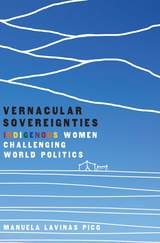
Vernacular Sovereignties
Indigenous Women Challenging World PoliticsManuela Lavinas Picq
University of Arizona Press, 2018
In Vernacular Sovereignties, Manuela Lavinas Picq shows that Indigenous women have long been dynamic political actors who have partaken in international politics and have shaped state practices carrying different forms of resistance. Her research on Ecuador shows that although Kichwa women face overlapping oppressions from socioeconomic exclusions to sexual violence, they are achieving rights unparalleled in the world. They successfully advocated for women’s participation in the administration of Indigenous justice during the 2008 constitutional reform, creating the first constitution in Latin America to explicitly guarantee the rights of Indigenous women and the first constitution worldwide to require gender parity in the administration of justice.
Picq argues that Indigenous women are among the important forces reshaping states in Latin America. She offers empirical research that shows the significance of Indigenous women in international politics and the sophistication of their activism. Indigenous women strategically use international norms to shape legal authority locally, defying Western practices of authority as they build what the author calls vernacular sovereignties. Weaving feminist perspectives with Indigenous studies, this interdisciplinary work expands conceptual debates on state sovereignty.
Picq persuasively suggests that the invisibility of Indigenous women in high politics is more a consequence of our failure to recognize their agency than a result of their de facto absence. It is an invitation not merely to recognize their achievements but also to understand why they matter to world politics.

Veto Power
Institutional Design in the European UnionJonathan B. Slapin
University of Michigan Press, 2011
"This is a terrific book. The questions that Slapin asks about intergovernmental conferences (IGCs) in the European Union are extraordinarily important and ambitious, with implications for the EU and for international cooperation more generally. Furthermore, Slapin's theorizing of his core questions is rigorous, lucid, and accessible to scholarly readers without extensive formal modeling background . . . This book is a solid, serious contribution to the literature on EU studies."
---Mark Pollack, Temple University
"An excellent example of the growing literature that brings modern political science to bear on the politics of the European Union."
---Michael Laver, New York University
Veto rights can be a meaningful source of power only when leaving an organization is extremely unlikely. For example, small European states have periodically wielded their veto privileges to override the preferences of their larger, more economically and militarily powerful neighbors when negotiating European Union treaties, which require the unanimous consent of all EU members.
Jonathan B. Slapin traces the historical development of the veto privilege in the EU and how a veto---or veto threat---has been employed in treaty negotiations of the past two decades. As he explains, the importance of veto power in treaty negotiations is one of the features that distinguishes the EU from other international organizations in which exit and expulsion threats play a greater role. At the same time, the prominence of veto power means that bargaining in the EU looks more like bargaining in a federal system. Slapin's findings have significant ramifications for the study of international negotiations, the design of international organizations, and European integration.

Violence and Peace
From the Atomic Bomb to Ethnic CleansingPierre Hassner
Central European University Press, 1997

Virtual Americas
Transnational Fictions and the Transatlantic ImaginaryPaul Giles
Duke University Press, 2002
Throughout Virtual Americas Giles focuses on specific examples of transatlantic cultural interactions such as Frederick Douglass’s experiences and reputation in England; Herman Melville’s satirizing fictions of U.S. and British nationalism; and Vladimir Nabokov’s critique of European high culture and American popular culture in Lolita. He also reverses his perspective, looking at the representation of San Francisco in the work of British-born poet Thom Gunn and Sylvia Plath’s poetic responses to England. Giles develops his theory about the need to defamiliarize the study of American literature by considering the cultural legacy of Surrealism as an alternative genealogy for American Studies and by examining the transatlantic dimensions of writers such as Henry James and Robert Frost in the context of Surrealism.