Results by title
593 books match the query 'Jews' and 5 start with v
Venus in the Afternoon
Tehila Lieberman
University of North Texas Press, 2012
[more]
Victims or Villains
Jewish Images in Classic English Detective FictionMalcolm J. Turnbull
University of Wisconsin Press, 1998
Portrayed as dubious moneylenders, underworld operatives, megalomaniacs, Bolshevik saboteurs, or unscrupulous war-profiteers, Jewish characters have surfaced in English detective fiction from the very beginning. Starting with Conan Doyle, and focusing on the Golden Age of the genre, Tunrbull uses multiple examples to trace the evolution of Jewish caricature in British crime writing, and examines fictional representations of Jews in relation to burgeoning antisemitic sentiment within British society. Attention is paid to crime writers as wide-ranging as Baroness Orczy, Sydney Horler, R. Austin Freeman, Ngaio Marsh, and S. T. Haymon, and the depiction of Jews by Golden Age giants Dorothy L. Sayers, Agatha Christie, and Anthony Berkeley Cox.
[more]

Vigil
Alan Shapiro
University of Chicago Press, 1997
The New York Times Book Review praised Alan Shapiro's The Last Happy Occasion as a "touching and intelligent, emotionally satisfying and elegant testimony to the power of poetry to instruct, heal and inspire." Vigi emerges from the final chapter of that book, "Sittin' in a Funeral Place," a powerful essay about Shapiro's sister Beth, her struggle with breast cancer, and the limitations of poetry in confronting the untransformable pain of loss.
In Vigil, Shapiro chronicles with heart-wrenching lyricism the final four weeks of Beth's life in a hospice, attended by her parents, brothers, husband, daughter and friends. One by one, as loved ones arrive to visit Beth, Shapiro reveals fragments of their personal history, bringing to life a troubled and poignant past. A visit from their brother David triggers the memory of a searing betrayal—the parents disowned Beth after learning from David that she was secretly dating a black man; a visit from the parents recalls their bitter quarrels over Beth's radical politics; a visit from Beth's black husband brings the painful memory of their wedding and her parents' refusal to attend. These recollections and feelings that surface with each visit evoke the unresolved, deeply disturbing issues that kept the Shapiro family estranged for so long, making the reconciliation that Beth's death brings to her family all the more extraordinary.
Shapiro gives an unconventionally honest account of our responses—horror, relief, impatience, exhaustion, exhilaration, projection, fear, self-criticism, and a sense of fulfillment—in the presence of the dying. Concluding with a selection of moving poems, Shapiro affirms the astonishing link between creativity and healing, and provides a coda to the whole experience. The price of human connection may be great, but human connection, in the end, has the power to redeem even the most painful of human experiences.
[more]
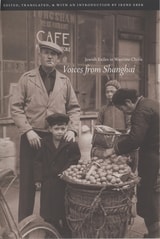
Voices from Shanghai
Jewish Exiles in Wartime ChinaEdited by Irene Eber
University of Chicago Press, 2008
When Hitler came to power and the German army began to sweep through Europe, almost 20,000 Jewish refugees fled to Shanghai. A remarkable collection of the letters, diary entries, poems, and short stories composed by these refugees in the years after they landed in China, Voices from Shanghai fills a gap in our historical understanding of what happened to so many Jews who were forced to board the first ship bound for anywhere.
Once they arrived, the refugees learned to navigate the various languages, belief systems, and ethnic traditions they encountered in an already booming international city, and faced challenges within their own community based on disparities in socioeconomic status, levels of religious observance, urban or rural origin, and philosophical differences. Recovered from archives, private collections, and now-defunct newspapers, these fascinating accounts make their English-languge debut in this volume. A rich new take on Holocaust literature, Voices from Shanghai reveals how refugees attempted to pursue a life of creativity despite the hardships of exile.
[more]

Voices of a People
THE STORY OF YIDDISH FOLKSONGRuth Rubin
University of Illinois Press, 1974
The seminal work of Ruth Rubin, a pioneering collector, singer, folklorist, writer, and crusader for the vanishing legacy of the Yiddish world, Voices of a People remains the only general introduction to Yiddish folksong.
A priceless collection of song texts in Yiddish and English, as well as a selection of tunes Rubin transcribed, this volume brings the Jews' ancient, itinerant culture alive through children's songs, dancing songs, and songs about love and courtship, poverty and work, crime and corruption, immigration, and the dream of a homeland. Rubin's notes and annotations weave each text into the larger story of the Jewish experience.
Noted scholar Mark Slobin provides a new foreword that includes a biographical sketch of Rubin and an assessment of her contributions over a lifetime of collecting, absorbing, and disseminating Yiddish folksong.
[more]