Results by title
622 books match the query 'Language Study' and 7 start with v
Vertical Grammar of Parallelism in Biblical Hebrew
David Toshio Tsumura
SBL Press, 2023
An essential resource for sound exegesis of biblical poetry
While previous books on parallelism have focused almost exclusively on semantic classification, in his new book David Toshio Tsumura focuses on the grammatical and phonetic aspects as well. In particular, he defines and illustrates the vertical grammatical relationship between parallel lines. Readers will master how to read Biblical Hebrew poetry effectively by focusing on the basic linguistic features of word order, parallelistic structure, and rhetorical devices. For the benefit of nonspecialists, all Hebrew poems are given in accessible transliteration. This book is an indispensable companion to the Hebrew Bible for both beginners and experienced scholars.
Videos to Accompany Academic Interactions
Communicating on CampusChristine B. Feak, Susan M. Reinhart, Theresa N. Rohlck
University of Michigan Press, 2019
The videos on this site are designed to be used with the textbook (9780472033423 or 9780472124770). The book must purchased separately at https://www.press.umich.edu/363197/academic_interactions or via another retailer). Video access is only available through our online platform: https://michelt.ublish.com.
The ability to understand and be understood when communicating with professors and with native speakers is crucial to academic success. The Academic Interactions videos focus on actual academic speaking events, particularly classroom interactions and office hours, and give students practice improving the ways that they communicate in a college/university setting.
The Academic Interactions textbook addresses skills like using names and names of locations correctly on campus, giving directions, understanding instructors and their expectations, interacting during office hours, participating in class and in seminars, and delivering formal and informal presentations. In addition, advice is provided for communicating via email with professors and working in groups with native speakers (including negotiating tasks in groups).
Vocabulary Building in Indonesian
An Advanced ReaderSoenjono Dardjowidjojo
Ohio University Press, 1984
Vocabulary Myths
Applying Second Language Research to Classroom TeachingKeith S. Folse
University of Michigan Press, 2004
In Vocabulary Myths, Keith S. Folse breaks down the teaching of second language vocabulary into eight commonly held myths. In debunking each myth, he introduces the myth with a story based on his 25 years of teaching experience (in the United States and abroad), continues with a presentation of what empirical research has shown on the topic, and finishes with a list of what teachers can do in their classrooms to facilitate true vocabulary acquisition.
The goal of Vocabulary Myths is to foster a paradigm shift that correctly views vocabulary as fundamental in any second language learning process and demonstrates that research supports this goal-that in fact there is a wealth of empirical evidence to support these views. In addition, an important theme is that teachers have overestimated how much vocabulary students really understand, and as a result, the so-called "comprehensible input" is neither comprehensible nor input.
The second language vocabulary acquisition myths reexamined in this book are:
*In learning another language, vocabulary is not as important as grammar or other areas.
*Using word lists to learn L2 vocabulary is unproductive.
*Presenting new vocabulary in semantic sets facilitates learning.
*The use of translations to learn new vocabulary should be discouraged.
*Guessing words from context is an excellent strategy for learning L2 vocabulary.
*The best vocabulary learners make use of one or two really specific vocabulary learning strategies.
*The best dictionary for L2 learners is a monolingual dictionary.
*Teachers, textbooks, and curricula cover L2 vocabulary adequately.
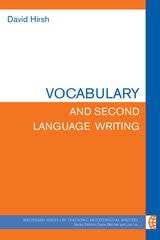
Vocabulary and Second Language Writing
David Hirsh
University of Michigan Press, 2021
Each chapter concludes with a list of key points and tasks and discussion questions for pre- and in-service instructors. Several chapters also include sample activities for teaching vocabulary at various instructional levels, designed to encourage readers to consider more deeply how they will include vocabulary instruction in their classrooms.
Vocabulary and Second Language Writing will be an excellent guide for all college-level writing instructors and help them understand the critical role that vocabulary plays in writing quality—something that is often disregarded in favor of holistic features like genre and rhetoric. The volume may also be useful for writing center administrators and those who train writing tutors.
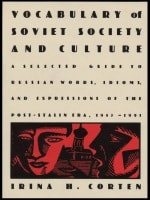
Vocabulary of Soviet Society and Culture
A Selected Guide to Russian Words, Idioms, and Expressions of the Post-Stalin Era, 1953–1991Irina H. Corten
Duke University Press, 1992
The entries are listed alphabetically in English transliteration followed by the Cyrillic, although readers familiar with Russian may prefer to use the Cyrillic alphabet listing included in this volume. In each entry, the author provides a succinct but full explanation of the term and, whenever possible, cross-references to other entries, authentic examples of its use, and samples of relevant Soviet jokes. A reader may approach the lexicon either sequentially or with the aid of a subject thesaurus that divides the material into specific topics. A listing of complementary sources of reference appears in a useful bibliography.
With this fascinating lexicon of "Sovietisms," Corten provides an invaluable and easily accessible medium for those general readers and scholars of the Russian language and Soviet culture interested in understanding contemporary Soviet life.
Selected entries from the Vocabulary of Soviet Society and Culture
Anekdótchik (anekdótchitsa) (cyrillic spelling) (n.)
1: A person who tells jokes (anekdoty); 2: coll. since the late Stalin era, a person arrested and given a prison sentence for the telling of political jokes. The phenomenon indicates the important role of the political joke in Soviet culture and, specifically, in the dissident movement. See iazychnik; sident.
The following jokes were popular during the Brezhnev era:
1. "Comrade Brezhnev, what is your hobby?"
"Collecting jokes about myself."
"And how many have you collected so far?"
"Two and a half labor camps."
2. Question: What is a marked-down joke?
Answer: A joke which, under Stalin, got you ten years in a labor camp, and now gets you only five.
egoístiki (cyrillic) (n.; pl.). Lit., little egotists; coll. since the 1970s referring to headsets worn by music lovers, especially teenage fans of rock music. The idea is that, by wearing headsets, one shuts out the world and becomes indifferent to everything except oneself.
zhrál'nia (cyrillic) (n.). Der. zhrat', to gorge, devour (vulg.); coll. since the 1970s denoting an eating establishment with inexpensive and often bad-tasting food. In the late 1980s, the term also has been applied to new fast-food restaurants which have been built in Soviet cities by Western concerns, for example, McDonald's. See amerikanka; stekliashka; stoiachka.
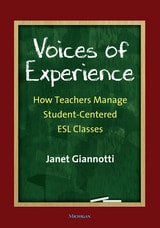
Voices of Experience
How Teachers Manage Student-Centered ESL ClassesJanet Giannotti
University of Michigan Press, 2015
Voices of Experience was designed and written with teachers-in-training and seasoned professionals in mind; the book would be used differently by each.
The book has five units: The Classroom Environment, Lesson Planning, Pair and Group Work, Classroom Interactions, and Classroom Trouble Spots. Each unit has two or three chapters that discuss the survey responses and relevant quotes from participants. Each unit concludes with a Connections section that features:
· *Challenging Beliefs: What Teachers Think, which presents a statement for readers to respond to and compare their responses to others who completed the survey.
· * Classroom Connections: What Teachers Do, which lists reflection or discussion questions
· * Strategies and Motivations: What Teachers Say, which presents more quotes from respondents, particularly those that look at what’s behind teachers’ choices. These too could be used for reflection or discussion.