Results by title
1445 books match the query 'Life Sciences' and 17 start with v
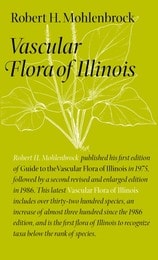
Vascular Flora of Illinois
Robert H. Mohlenbrock
Southern Illinois University Press, 2002
This latest Vascular Flora of Illinois includes over thirty-two hundred species, an increase of almost three hundred since 1986. In addition, for the first time, taxa below the rank of species are recognized and may be identified by keys. Investigating seldom-visited patches of prairies, wetlands, and forested canyons, Mohlenbrock has added several native species to this flora. And while there has been extensive exploration for plants, Mohlenbrock has also researched the herbaria in an attempt to verify previous reports of records of Illinois plants.
Because of a reinterpretation of existing genera, the number of genera of Illinois plants has increased markedly. Recent biosystematic techniques have begun to substantiate the genera that botanists such as John Kunkel Small, Per Axel Rydberg, and Edmund C. Greene proposed nearly a century ago.
The sequence of groups in this book is ferns, conifers, and flowering plants, with dicotyledons given before monocotyledons. Within each group, the families are arranged alphabetically, as are the genera within each family and the species within each genus.
For each taxon recognized in this book, Mohlenbrock gives a common name if one is generally used in Illinois. He follows this by an indication of flowering time for flowering plants and of spore-production time for ferns and their relatives. He also provides a habitat statement and a general comment on distribution in Illinois for each taxon. Synonyms for some other scientific names used previously for a taxon appear in italics. This book contains indexes both for common names and for family and genus names.
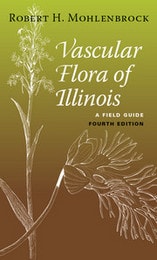
Vascular Flora of Illinois
A Field Guide, Fourth EditionRobert H. Mohlenbrock
Southern Illinois University Press, 2013
This latest edition of Vascular Flora of Illinois includes over thirty-four hundred species of flora from Illinois, adding more than 250 newly-recognized plants to this definitive collection. Because cataloguing our heritage is foremost in importance among naturalists, this book compiles essential information about plants in Illinois. Mohlenbrock includes all known taxa native to Illinois either at present or in the past and all non-native vascular plants that grow spontaneously and appear able to maintain themselves year after year without cultivation. The sequence of groups in the guide is ferns, conifers, and flowering plants, with cotyledons given before monocotyledons. Within each group, the families are arranged alphabetically, as are the genera within each family and the species within each genus. For each taxon recognized in this book, Mohlenbrock gives us a common name if one is generally used in Illinois. He follows this with an indication of flowering time for flowering plants, and of spore-production time in the case of ferns and their relatives. He also provides a habitat statement and a general comment on distribution in Illinois for each taxon.
Containing information on Illinois flora not available anywhere else, this fourth edition of Vascular Flora of Illinois is essential for ecologists, environmentalists, and land developers. Those interested in wildflower identification will also find this guide helpful.
Vascular Plant Families and Genera
R. K. Brummitt
Royal Botanic Gardens, Kew, 2000
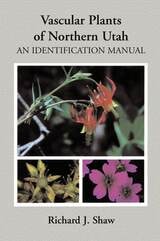
Vascular Plants of Northern Utah
An Identification ManualRichard Shaw
Utah State University Press, 1989
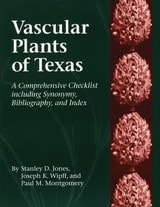
Vascular Plants of Texas
A Comprehensive Checklist Including Synonymy, Bibliography, and IndexBy Stanley D. Jones, Joseph K. Wipff, and Paul M. Montgomery
University of Texas Press, 1997
Everyone with a professional interest in the flora of Texas will welcome this checklist of the vascular plants. This comprehensive list also includes crops, persistent perennials, and naturalized plants and encompasses over 1,000 changes to the previous (Hatch, 1990) checklist. The authors have arranged this checklist phylogenetically by classes following the Cronquist system.
Several features make this checklist especially useful. Chief among them is the relative synonymy (name history). An extensive index makes current classification and correct nomenclature readily accessible, while the botanical bibliography is the most extensive ever compiled for Texas. The authors also note which plants have been listed as threatened or endangered by the Texas Organization of Endangered Species, which are designated as Federal Noxious Weeds, and which have been chosen as state tree, flower, fruit, etc. by the Texas Legislature.
Veer Ecology
A Companion for Environmental ThinkingJeffrey Jerome Cohen
University of Minnesota Press, 2017
The words most commonly associated with the environmental movement—save, recycle, reuse, protect, regulate, restore—describe what we can do to help the environment, but few suggest how we might transform ourselves to better navigate the sudden turns of the late Anthropocene. Which words can help us to veer conceptually along with drastic environmental flux? Jeffrey Jerome Cohen and Lowell Duckert asked thirty brilliant thinkers to each propose one verb that stresses the forceful potential of inquiry, weather, biomes, apprehensions, and desires to swerve and sheer. Each term is accompanied by a concise essay contextualizing its meaning in times of resource depletion, environmental degradation, and global climate change.
Some verbs are closely tied to natural processes: compost, saturate, seep, rain, shade, sediment, vegetate, environ. Many are vaguely unsettling: drown, unmoor, obsolesce, power down, haunt. Others are enigmatic or counterintuitive: curl, globalize, commodify, ape, whirl. And while several verbs pertain to human affect and action—love, represent, behold, wait, try, attune, play, remember, decorate, tend, hope—a primary goal of Veer Ecology is to decenter the human. Indeed, each of the essays speaks to a heightened sense of possibility, awakening our imaginations and inviting us to think the world anew from radically different perspectives. A groundbreaking guide for the twenty-first century, Veer Ecology foregrounds the risks and potentialities of living on—and with—an alarmingly dynamic planet.
Contributors: Stacy Alaimo, U of Texas at Arlington; Joseph Campana, Rice U; Holly Dugan, George Washington U; Lara Farina, West Virginia U; Cheryll Glotfelty, U of Nevada, Reno; Anne F. Harris, DePauw U; Tim Ingold, U of Aberdeen; Serenella Iovino, U of Turin; Stephanie LeMenager, U of Oregon; Scott Maisano, U of Massachusetts, Boston; Tobias Menely, U of California, Davis; Steve Mentz, St. John’s U; J. Allan Mitchell, U of Victoria; Timothy Morton, Rice U; Vin Nardizzi, U of British Columbia; Laura Ogden, Dartmouth College; Serpil Opperman, Hacettepe U, Ankara; Daniel C. Remein, U of Massachusetts, Boston; Margaret Ronda, U of California, Davis; Nicholas Royle, U of Sussex; Catriona Sandilands, York U; Christopher Schaberg, Loyola U; Rebecca R. Scott, U of Missouri; Theresa Shewry, U of California, Santa Barbara; Mick Smith, Queen’s U; Jesse Oak Taylor, U of Washington; Brian Thill, Golden West College; Coll Thrush, U of British Columbia, Vancouver; Cord J. Whitaker, Wellesley College; Julian Yates, U of Delaware.
Vestiges of the Natural History of Creation and Other Evolutionary Writings
Robert Chambers
University of Chicago Press, 1994
With a new introduction by James Secord, a bibliography of reviews, and a new index, this volume adds to Vestiges and Explanations Chambers's earliest works on cosmology, an essay on Darwin, and an autobiographical essay, raising important issues about the changing meanings of popular science and religion and the rise of secular ideologies in Western culture.
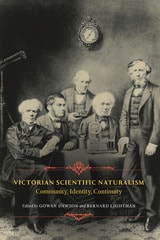
Victorian Scientific Naturalism
Community, Identity, ContinuityEdited by Gowan Dawson and Bernard Lightman
University of Chicago Press, 2014
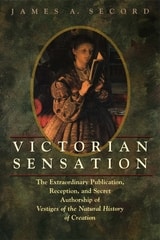
Victorian Sensation
The Extraordinary Publication, Reception, and Secret Authorship of Vestiges of the Natural History of CreationJames A. Secord
University of Chicago Press, 2000
In a pioneering cultural history, James A. Secord uses the story of Vestiges to create a panoramic portrait of life in the early industrial era from the perspective of its readers. We join apprentices in a factory town as they debate the consequences of an evolutionary ancestry. We listen as Prince Albert reads aloud to Queen Victoria from a book that preachers denounced as blasphemy vomited from the mouth of Satan. And we watch as Charles Darwin turns its pages in the flea-ridden British Museum library, fearful for the fate of his own unpublished theory of evolution. Using secret letters, Secord reveals how Vestiges was written and how the anonymity of its author was maintained for forty years. He also takes us behind the scenes to a bustling world of publishers, printers, and booksellers to show how the furor over the book reflected the emerging industrial economy of print.
Beautifully written and based on painstaking research, Victorian Sensation offers a new approach to literary history, the history of reading, and the history of science. Profusely illustrated and full of fascinating stories, it is the most comprehensive account of the making and reception of a book (other than the Bible) ever attempted.
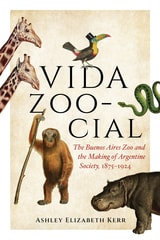
Vida Zoo-cial
The Buenos Aires Zoo and the Making of Argentine Society, 1875–1924Ashley Elizabeth Kerr
Vanderbilt University Press, 2025
Premio al Mejor Libro en Humanidades, Latin American Studies Association, Nineteenth-Century Section, 2026
In late nineteenth- and early twentieth‑century Buenos Aires, elites attempted to tackle growing poverty and social problems with a suite of social, educational, and medical reforms, hoping to make the city and larger nation more “modern” and “progressive” on the world stage. Known as the “social question,” this turn-of-the-century preoccupation with the future of the city and nation was undergirded by a larger set of social Darwinist beliefs about the biological and racial inferiority of immigrants and the working class, linking them to higher susceptibility to alcoholism, sexual deviancy, insanity, and disease.
In Vida Zoo-cial, Ashley Elizabeth Kerr argues that the Buenos Aires Zoo and its many animal species were an important tool in attempts to remake Argentinian society. Elites used the zoo’s physical spaces, programming, and visual and literary representations of its animals to try to educate and “improve” the masses, especially immigrants and the poor, but stopped short of supporting more radical social transformations. Drawing upon extensive archival research from the zoo’s archive, including correspondence, municipal reports, receipts, and employment records, as well as a range of literary and popular culture sources, Kerr records these efforts, which included enlisting lionesses as object lessons in proper motherhood and elephants as model immigrants. Although some projects were successful, Kerr also documents the many ways others went awry when the zoo's animals and the humans who came to see them failed to cooperate.
Vida Zoo-cial is not only a story about how the poor and working class resisted elite efforts for social reform founded upon racialized beliefs and pseudoscience, but also one that challenges readers to rethink the relationship between humans and non‑humans.
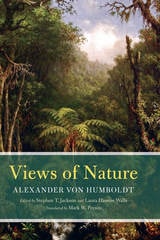
Views of Nature
Alexander von Humboldt
University of Chicago Press, 2014
Views of Nature, or Ansichten der Natur, was Humboldt’s best-known and most influential work—and his personal favorite. While the essays that comprise it are themselves remarkable as innovative, early pieces of nature writing—they were cited by Thoreau as a model for his own work—the book’s extensive endnotes incorporate some of Humboldt’s most beautiful prose and mature thinking on vegetation structure, its origins in climate patterns, and its implications for the arts. Written for both a literary and a scientific audience, Views of Nature was translated into English (twice), Spanish, and French in the nineteenth century, and it was read widely in Europe and the Americas. But in contrast to many of Humboldt’s more technical works, Views of Nature has been unavailable in English for more than one hundred years. Largely neglected in the United States during the twentieth century, Humboldt’s contributions to the humanities and the sciences are now undergoing a revival to which this new translation will be a critical contribution.
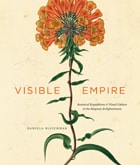
Visible Empire
Botanical Expeditions and Visual Culture in the Hispanic EnlightenmentDaniela Bleichmar
University of Chicago Press, 2012
Between 1777 and 1816, botanical expeditions crisscrossed the vast Spanish empire in an ambitious project to survey the flora of much of the Americas, the Caribbean, and the Philippines. While these voyages produced written texts and compiled collections of specimens, they dedicated an overwhelming proportion of their resources and energy to the creation of visual materials. European and American naturalists and artists collaborated to manufacture a staggering total of more than 12,000 botanical illustrations. Yet these images have remained largely overlooked—until now.
In this lavishly illustrated volume, Daniela Bleichmar gives this archive its due, finding in these botanical images a window into the worlds of Enlightenment science, visual culture, and empire. Through innovative interdisciplinary scholarship that bridges the histories of science, visual culture, and the Hispanic world, Bleichmar uses these images to trace two related histories: the little-known history of scientific expeditions in the Hispanic Enlightenment and the history of visual evidence in both science and administration in the early modern Spanish empire. As Bleichmar shows, in the Spanish empire visual epistemology operated not only in scientific contexts but also as part of an imperial apparatus that had a long-established tradition of deploying visual evidence for administrative purposes.
Visions of Cell Biology
Reflections Inspired by Cowdry's "General Cytology"Edited by Karl S. Matlin, Jane Maienschein, and Manfred D. Laubichler
University of Chicago Press, 2017
Despite extraordinary advances in describing both the structure and function of cells, cell biology tends to be overshadowed by molecular biology, a field that developed contemporaneously. This book remedies that unjust disparity through an investigation of cell biology’s evolution and its role in pushing forward the boundaries of biological understanding. Contributors show that modern concepts of cell organization, mechanistic explanations, epigenetics, molecular thinking, and even computational approaches all can be placed on the continuum of cell studies from cytology to cell biology and beyond. The first book in the series Convening Science: Discovery at the Marine Biological Laboratory, Visions of Cell Biology sheds new light on a century of cellular discovery.
Voices from the Ape House
Beth Armstrong
The Ohio State University Press, 2020
Through anecdotal stories, readers get a glimpse into the fascinating lives of gorillas—the familiar gentleness of mothers and fathers toward their infants, power plays and social climbing, the unruly nature of teenagers, the capacity for humor, and the shared sadness by group members as they mourn the death of one of their own. In the end, Armstrong’s conflict with captivity and her lifelong fondness for these animals helped shape a zoo program dedicated to gorilla conservation.
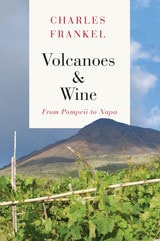
Volcanoes and Wine
From Pompeii to NapaCharles Frankel
University of Chicago Press, 2019
Traveling across regions wellknown to wine lovers like Sicily, Oregon, and California, as well as the less familiar places, such as the Canary Islands, Frankel gives an in-depth account of famous volcanoes and the wines that spring from their idiosyncratic soils. From Santorini’s vineyards of rocky pumice dating back to a four-thousand-year-old eruption to grapes growing in craters dug in the earth of the Canary Islands, from Vesuvius’s famous Lacryma Christi to the ambitious new generation of wine growers reviving the traditional grapes of Mount Etna, Frankel takes us across the stunning and dangerous world of volcanic wines. He details each volcano’s most famous eruptions, the grapes that grow in its soils, and the people who make their homes on its slopes, adapting to an ever-menacing landscape. In addition to introducing the history and geology of these volcanoes, Frankel's book serves as a travel guide, offering a host of tips ranging from prominent vineyards to visit to scenic hikes in each location.
This illuminating guide will be indispensable for wine lovers looking to learn more about volcanic terroirs, as well as anyone curious about how cultural heritage can survive and thrive in the shadow of geological danger.
Voracious Science and Vulnerable Animals
A Primate Scientist's Ethical JourneyJohn P. Gluck
University of Chicago Press, 2016
Gluck begins by taking us inside the laboratory of Harry F. Harlow at the University of Wisconsin, where Gluck worked as a graduate student in the 1960s. Harlow’s primate lab became famous for his behavioral experiments in maternal deprivation and social isolation of rhesus macaques. Though trained as a behavioral scientist, Gluck finds himself unable to overlook the intense psychological and physical damage these experiments wrought on the macaques. Gluck’s sobering and moving account reveals how in this and other labs, including his own, he came to grapple with the uncomfortable justifications that many researchers were offering for their work. As his sense of conflict grows, we’re right alongside him, developing a deep empathy for the often smart and always vulnerable animals used for these experiments.
At a time of unprecedented recognition of the intellectual cognition and emotional intelligence of animals, Voracious Science and Vulnerable Animals is a powerful appeal for our respect and compassion for those creatures who have unwillingly dedicated their lives to science. Through the words of someone who has inflicted pain in the name of science and come to abhor it, it’s important to know what has led this far to progress and where further inroads in animal research ethics are needed.
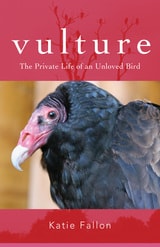
Vulture
The Private Life of an Unloved BirdKatie Fallon
Brandeis University Press, 2020
Few animals have a worse reputation than the vulture. But is it deserved? With Vulture, Katie Fallon offers an irresistible argument to the contrary, tracing a year in the life of a typical North American turkey vulture. Turkey vultures, also known as buzzards, are the most widely distributed and abundant scavenging birds of prey on the planet, found from central Canada to the southern tip of Argentina and nearly everywhere in between. Deftly drawing on the most up-to-date scientific papers and articles and weaving those in with interviews with world-renowned raptor and vulture experts and her own compelling natural history writing, Fallon examines all aspects of the bird’s natural history: breeding, incubating eggs, raising chicks, migrating, and roosting. The result is an intimate portrait of an underappreciated bird—one you’ll never look at in the same way again.