Results by title
1488 books match the query 'Media Studies' and 15 start with v
Vector Media
Leonardo Impett
University of Minnesota Press, 2026
Dispelling the notion of “generative” AI
Neural networks are designed to dissolve all media into the vector space—a universal space of commensurability. In Vector Media, Leonardo Impett and Fabian Offert parse theories of automatic vision to trace contemporary artificial intelligence’s technical ideology of epistemic reduction, where sensory data is turned into abstracted forms of meaning. Under this regime, bias is not just a question of what is represented but of the logic of representation itself. Drawing on Phil Agre’s notion of a critical technical practice, Vector Media reveals how artificial intelligence systems embed new epistemologies of media beneath the surface of their architectures.
Analyzing the techniques underpinning large multimodal artificial intelligence models like DALL-E, Midjourney, Flux, or Stable Diffusion, Impett and Offert offer the concept of neural exchange value: the value cultural artifacts acquire not through meaning or context but through their capacity to function as vectors. In such a system, commensurability becomes a condition of existence: what matters is not what something is but that it can be embedded. Rather than focusing solely on datasets, Vector Media proposes a critical study of vector spaces—and the machine cultures they produce—as a necessary complement to prevailing approaches in AI critique.
Retail e-book files for this title are screen-reader friendly with images accompanied by short alt text and/or extended descriptions.
Very Special Episodes
Televising Industrial and Social ChangeJonathan Cohn
Rutgers University Press, 2021
Vidding
A HistoryFrancesca Coppa
University of Michigan Press, 2022
Vidding: A History emphasizes vidding as a critical, feminist form of fan practice. Working outward from interviews, VHS liner notes, convention programs, and mailing list archives, Coppa offers a rich history of vidding communities as they evolved from the 1970s through to the present. Built with the classroom in mind, the open-access electronic version of this book includes over one-hundred vids and an appendix that includes additional close readings of vids.

Videogames and Art
Second EditionEdited by Andy Clarke and Grethe Mitchell
Intellect Books, 2013
Together, the contributions position videogame art as an interdisciplinary mix of digital technologies and the traditional art forms. Of particular interest in this volume are machinima, game console artwork, politically oriented videogame art, and the production of digital art. This new and revised edition features an extended critical introduction from the editors and updated interviews with the foremost artists in the field. Rounding out the book is a critique of the commercial videogame industry comprising essays on the current quality and originality of videogames.
Vietnam and Other American Fantasies
H. Bruce Franklin
University of Massachusetts Press, 2000
There is now fairly widespread acknowledgment that the Vietnam War shattered many of the traditional narratives central to formerly prevailing vision of the United States and its history. Some people regret this and seek to restore old narratives that they consider essential to a unifying national identity, but their mighty efforts are unlikely to put Humpty Dumpty together again. Others see this shattering as a liberation from dangerous illusions, a wake-up call that forced millions of Americans toward more truthful and beneficial narratives about American history and culture. There is a third view, one that has gained considerable influence in intellectual circles, that sees any “master narrative” or “meta-narrative”—or, for that matter, any coherently structured narrative—as a socially constructed fantasy that radically falsifies the fragmentary, conflicted, and de-centered character of social experience. Although in this book the author does not engage in overt arguments about narrative theory, he does operate from a theoretical position that highly values narratives, especially coherently structures narratives—including some forms of fantasy—as crucial to comprehending, within our human limits, human reality.
Viewing African Cinema in the Twenty-First Century
Art Films and the Nollywood Video RevolutionMahir Saul
Ohio University Press, 2010
African cinema in the 1960s originated mainly from Francophone countries. It resembled the art cinema of contemporary Europe and relied on support from the French film industry and the French state. Beginning in 1969 the biennial Festival panafricain du cinéma et de la télévision de Ouagadougou (FESPACO), held in Burkina Faso, became the major showcase for these films. But since the early 1990s, a new phenomenon has come to dominate the African cinema world: mass-marketed films shot on less expensive video cameras. These “Nollywood” films, so named because many originate in southern Nigeria, are a thriving industry dominating the world of African cinema.
Viewing African Cinema in the Twenty-first Century is the first book to bring together a set of essays offering a comparison of these two main African cinema modes.
Contributors: Ralph A. Austen and Mahir Şaul, Jonathan Haynes, Onookome Okome, Birgit Meyer, Abdalla Uba Adamu, Matthias Krings, Vincent Bouchard, Laura Fair, Jane Bryce, Peter Rist, Stefan Sereda, Lindsey Green-Simms, and Cornelius Moore
Vilém Flusser
An IntroductionAnke Finger
University of Minnesota Press, 2010
An accessible and thorough introduction to Flusser’s thought, this book reveals his engagement with a wide array of disciplines, from communication studies, posthuman philosophy, media studies, and history to art and art history, migrant studies, anthropology, and film studies. The first to connect Flusser’s entire oeuvre, this volume shows how his works on media theory are just one part of a greater mosaic of writings that bring to the fore cultural and cognitive changes concerning all of us in the twenty-first century.
A theorist deeply influenced by his experiences as a privileged citizen of Prague, a Jew pursued by the Nazis, a European emigrant, a Brazilian immigrant, and a survivor keenly interested and invested in history and memory, Vilém Flusser was an outsider in a staunchly hierarchical and disciplined academic world.
Violence and the Mimetic Unconscious, Volume 2
The Affective HypothesisNidesh Lawtoo
Michigan State University Press, 2023
Violence and the Oedipal Unconscious
vol. 1, The Catharsis HypothesisNidesh Lawtoo
Michigan State University Press, 2023
Virtually Latinx
Identities in the Age of Social MediaUrayoán Noel
University of Texas Press, 2026
Examining how Latinx identity reimagines and connects communities through social media.
The very idea of Latinidad flattens identities, subsuming diverse peoples under a single racialized framework useful for corporate and political marketing. But it is not only ethnic identity that Latinidad tends to erase. In the first-ever study of Latinx social media, Urayoán Noel shows how historically marginalized Latinxs—including Black, Trans, undocumented, and disabled people—have used digital platforms to challenge hegemonic Latinidad and to build alternatives communities.
Incorporating elements of history, ethnography, and performance studies, Virtually Latinx traces the evolution of Latinx social media and blogging since the early 1990s, focusing on creative movements and vocabularies emerging and consolidating online. From Chicano/LatinoNet, Latina Lista, and Remezcla, to activists and performers on TikTok, online creators and platforms have spurred modes of art and activism that counter both Latinidad’s essentialized body politics and Big Tech’s domination of the information sphere. In dialogue with scholars of media, virtuality, and identity, Noel theorizes how hashtags like #Afrolatina, #Latinx, and #Latine have not only facilitated online exchange but also nurtured new knowledge formations surrounding Black, feminist, undocuqueer, Trans, and disability poetics and politics.
Visions of Beirut
The Urban Life of Media InfrastructureHatim El-Hibri
Duke University Press, 2021
Visual Occupations
Violence and Visibility in a Conflict ZoneGil Z. Hochberg
Duke University Press, 2015
Visualising Facebook
A Comparative PerspectiveDaniel Miller and Jolynna Sinanan
University College London, 2017
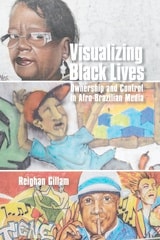
Visualizing Black Lives
Ownership and Control in Afro-Brazilian MediaReighan Gillam
University of Illinois Press, 2022
An eye-opening union of analysis and fieldwork, Visualizing Black Lives examines the alternative and activist Black media and the people creating it in today's Brazil.

Voice Over
The Making of Black RadioWilliam Barlow
Temple University Press, 1998
Barlow, whose voice has been heard on WPFW (Washington, D.C.) for many years, brings an insider's knowledge to this account of black radio as a predominantly local and still powerful medium. Many of the broadcasters he profiles -- Jack Cooper, Paul Robeson, Richard Durham, Cathy Hughes, Al Benson, Georgie Woods, Peggy Mitchell, Hal Jackson, Jocko Henderson, Mary Mason, Wesley South, Martha Jean "the Queen" Steinberg, to name a few -- became not only celebrities but also respected members of their communities. Atlanta's Jack "the Rapper" Gibson, for instance, tells how he literally shared his microphone with Rev. Martin Luther King Jr. to announce meetings and rally listeners around a key issue. By showing the extent to which so many black broadcasters achieved the status of trusted and influential community leaders, Barlow acknowledges that their grassroots activism was an indispensable and often overlooked part of the ongoing African American civil rights movement.
Voice Over also addresses black radio's broadly significant role in entertainment and shifting race relations. Until the rock and roll revolution, audiences had largely been segregated. The African American personality jocks who introduced white teens to rhythm and blues were a revelation; their wild style and personas and the music they played changed broadcasting while it enthralled a multiracial audience. Although the stations that introduced the enormously popular music were identified as black, virtually none was black-owned or managed. The broadcasters who distanced themselves from music industry perks and payoffs proposed an ambitious agenda for change. This little-known story sets the stage for how the proliferation of black-owned stations and networks occurred and for Barlow's assessment of the instability of today's black radio scene.
Written for a broad spectrum of readers -- from nostalgic fans of Jocko and Georgie Woods to loyal listeners of surviving stations and media watchers committed to diversity in broadcasting -- Voice Over tells the whole story of the making of black radio.