683 books match the query 'Middle East' and 4 start with v
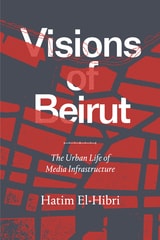
cover of Visions of Beirut: The Urban Life of Media Infrastructure

Visions of Beirut

The Urban Life of Media Infrastructure

Hatim El-Hibri

Duke University Press, 2021
In Visions of Beirut Hatim El-Hibri explores how the creation and circulation of images have shaped the urban spaces and cultural imaginaries of Beirut. Drawing on fieldwork and texts ranging from maps, urban plans, and aerial photographs to live television and drone-camera footage, El-Hibri traces how the technologies and media infrastructure that visualize the city are used to consolidate or destabilize regimes of power. Throughout the twentieth century, colonial, economic, and military mapping projects helped produce and govern Beirut's spaces. In the 1990s, the imagery of its post-civil war downtown reconstruction cast Beirut as a site of financial investment in ways that obscured its ongoing crises. During and following the 2006 Israel/Hizbullah war, Hizbullah's use of live television broadcasts of fighting and protests along with its construction of a war memorial museum at a former secret military bunker demonstrate the tension between visualizing space and the practices of concealment. Outlining how Beirut's urban space and public life intertwine with images and infrastructure, El-Hibri interrogates how media embody and exacerbate the region's political fault lines.
[more]
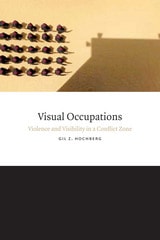
cover of Visual Occupations: Violence and Visibility in a Conflict Zone

Visual Occupations

Violence and Visibility in a Conflict Zone

Gil Z. Hochberg

Duke University Press, 2015
In Visual Occupations Gil Z. Hochberg shows how the Israeli Occupation of Palestine is driven by the unequal access to visual rights, or the right to control what can be seen, how, and from which position. Israel maintains this unequal balance by erasing the history and denying the existence of Palestinians, and by carefully concealing its own militarization. Israeli surveillance of Palestinians, combined with the militarized gaze of Israeli soldiers at places like roadside checkpoints, also serve as tools of dominance. Hochberg analyzes various works by Palestinian and Israeli artists, among them Elia Suleiman, Rula Halawani, Sharif Waked, Ari Folman, and Larry Abramson, whose films, art, and photography challenge the inequity of visual rights by altering, queering, and manipulating dominant modes of representing the conflict. These artists' creation of new ways of seeing—such as the refusal of Palestinian filmmakers and photographers to show Palestinian suffering or the Israeli artists' exposure of state manipulated Israeli blindness —offers a crucial gateway, Hochberg suggests, for overcoming and undoing Israel's militarized dominance and political oppression of Palestinians.
[more]
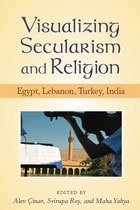
cover of Visualizing Secularism and Religion: Egypt, Lebanon, Turkey, India

Visualizing Secularism and Religion

Egypt, Lebanon, Turkey, India

Alev Cinar, Srirupa Roy and Maha Yahya, Editors

University of Michigan Press, 2012

Over the past two decades secular polities across the globe have witnessed an increasing turn to religion-based political movements, such as the rise of political Islam and Hindu nationalism, which have been fueling new and alternative notions of nationhood and national ideologies. The rise of such movements has initiated widespread debates over the meaning, efficacy, and normative worth of secularism. Visualizing Secularism and Religion examines the constitutive role of religion in the formation of secular-national public spheres in the Middle East and South Asia, arguing that in order to establish secularism as the dominant national ideology of countries such as Turkey, Lebanon, and India, the discourses, practices, and institutions of secular nation-building include rather than exclude religion as a presence within the public sphere. The contributors examine three fields---urban space and architecture, media, and public rituals such as parades, processions, and commemorative festivals---with a view to exploring how the relation between secularism, religion, and nationalism is displayed and performed. This approach demands a reconceptualization of secularism as an array of contextually specific practices, ideologies, subjectivities, and "performances" rather than as simply an abstract legal bundle of rights and policies.
[more]
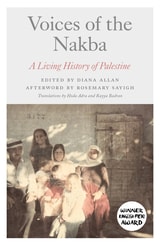
cover of Voices of the Nakba: A Living History of Palestine

Voices of the Nakba

A Living History of Palestine

Diana Allan

Pluto Press, 2021

***Winner of an English PEN Award 2021***

During the 1948 war more than 750,000 Palestinian Arabs fled or were violently expelled from their homes by Zionist militias. The legacy of the Nakba - which translates to ‘disaster’ or ‘catastrophe’ - lays bare the violence of the ongoing Palestinian plight.

Voices of the Nakba collects the stories of first-generation Palestinian refugees in Lebanon, documenting a watershed moment in the history of the modern Middle East through the voices of the people who lived through it.

The interviews, with commentary from leading scholars of Palestine and the Middle East, offer a vivid journey into the history, politics and culture of Palestine, defining Palestinian popular memory on its own terms in all its plurality and complexity.

[more]