Results by title
2335 books match the query 'Modern' and 19 start with v
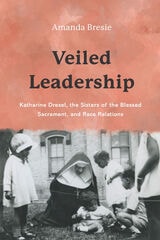
Veiled Leadership
Katharine Drexel, The Sisters of the Blessed Sacrament, and Race RelationsAmanda Bresie
Catholic University of America Press, 2023
Vendulka
Flight to FreedomOndrej Kundra
Karolinum Press, 2021
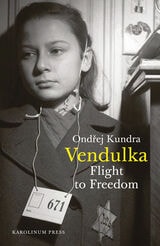
Famed Czech photographer Jan Lukas snapped an offhand portrait of twelve-year-old Vendulka Vogl in March 1943. A friend of the Vogls, Lukas was saying goodbye to the family, who were soon to leave Prague for a concentration camp. The photograph almost didn’t see the light of day—Lukas knew that if the Nazis found it on him, he could wind up in the camps as well—but the image was eventually developed and came to symbolize the Holocaust and humanize its victims. Seventy years after this famous picture was taken, investigative journalist Ondřej Kundra discovered that, despite all odds, Vendulka Vogl had survived the camps of Terezín, Auschwitz, and Christianstadt, and was in fact still alive and living in the United States. Kundra persuaded her to tell the remarkable story surrounding the photograph: her survival, her later decision to flee the Communist regime for America, and how she later reconnected with Jan Lukas, maintaining a lifelong friendship.
Vogl’s thrillingly moving story, Kundra’s sharp and engaging writing, and Lukas’s striking photography all combine to make Vendulka an inspiring investigation into the horrors of totalitarianism and the redemptive beauty of friendship.
Vices, Virtues, and Consequences
Essays in Moral and Political PhilosophyPeter Simpson
Catholic University of America Press, 2019
Victorian Alchemy
Science, Magic and Ancient EgyptEleanor Dobson
University College London, 2022
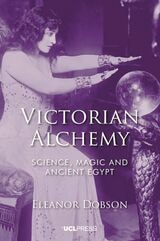
With its material remnants paradoxically symbolizing both antiquity and modernity to Victorian audiences, ancient Egypt was at once evocative of ancient magical power and of cutting-edge science, a tension that might be productively conceived of as “alchemical.” Examining literature and other cultural forms including art, photography, and early film, Eleanor Dobson herein traces the myriad ways in which the Victorian fascination with ancient Egypt evoked the entwined forces of magic and science, providing more than a mere setting for Orientalist fantasies and nightmares. From imaging technologies and astronomy to investigations into the electromagnetic spectrum and the human mind itself, this book demonstrates how conceptions of modernity were inextricably bound up in the contemporary reception of the ancient world, illustrating how such ideas took root and flourished in the Victorian era and persist to this day.
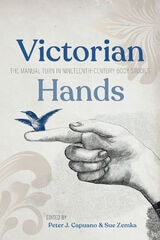
Victorian Hands
The Manual Turn in Nineteenth-Century Body StudiesEdited by Peter J. Capuano and Sue Zemka
The Ohio State University Press, 2020
Contributors
James Eli Adams, Karen Bourrier, Aviva Briefel, Peter J. Capuano, Jonathan Cheng, Kate Flint, Pamela K. Gilbert, Tamara Ketabgian, J. Hillis Miller, Deborah Denenholz Morse, Daniel A. Novak, Julianne Smith, Herbert F. Tucker, and Sue Zemka
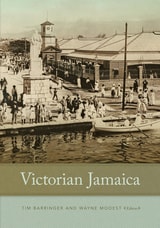
Victorian Jamaica
Timothy Barringer and Wayne Modest, editors
Duke University Press, 2018
Contributors. Anna Arabindan-Kesson, Tim Barringer, Anthony Bogues, David Boxer, Patrick Bryan, Steeve O. Buckridge, Julian Cresser, John M. Cross, Petrina Dacres, Belinda Edmondson, Nadia Ellis, Gillian Forrester, Catherine Hall, Gad Heuman, Rivke Jaffe, O'Neil Lawrence, Erica Moiah James, Jan Marsh, Wayne Modest, Daniel T. Neely, Mark Nesbitt, Diana Paton, Elizabeth Pigou-Dennis, Veerle Poupeye, Jennifer Raab, James Robertson, Shani Roper, Faith Smith, Nicole Smythe-Johnson, Dianne M. Stewart, Krista A. Thompson
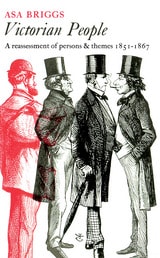
Victorian People
A Reassessment of Persons and Themes, 1851-67Asa Briggs
University of Chicago Press, 1975
"For expounding this theme, this interaction of event and personality, Mr. Briggs is abundantly and happily endowed. He is always readable, often amusing, never facetious. He is widely read and widely interested. He has a sound historic judgment, and an unfailing sense for what is significant in the historic sequence and what is merely topical. . . . Above all, he is in sympathy with the age of which he is writing."—Times Literary Supplement
Victorian Relativity
Radical Thought and Scientific DiscoveryChristopher Herbert
University of Chicago Press, 2001
Christopher Herbert shows that the idea of relativity produced revolutionary changes in one field after another in the nineteenth century. Surveying a long line of thinkers including Herbert Spencer, Charles Darwin, Alexander Bain, W. K. Clifford, W. S. Jevons, Karl Pearson, James Frazer, and Einstein himself, Victorian Relativity argues that the early relativity movement was bound closely to motives of political and cultural reform and, in particular, to radical critiques of the ideology of authoritarianism. Recuperating relativity from those who treat it as synonymous with nihilism, Herbert portrays it as the basis of some of our crucial intellectual and ethical traditions.
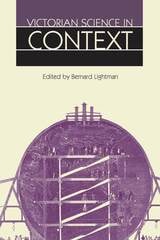
Victorian Science in Context
Edited by Bernard Lightman
University of Chicago Press, 1997
Victorian Science in Context captures the essence of this fascination, charting the many ways in which science influenced and was influenced by the larger Victorian culture. Contributions from leading scholars in history, literature, and the history of science explore questions such as: What did science mean to the Victorians? For whom was Victorian science written? What ideological messages did it convey? The contributors show how practical concerns interacted with contextual issues to mold Victorian science—which in turn shaped much of the relationship between modern science and culture.
Violent Sensations
Sex, Crime, and Utopia in Vienna and Berlin, 1860-1914Scott Spector
University of Chicago Press, 2016
In Violent Sensations, Scott Spector explores how the protagonists of these stories—people at society’s margins—were given new identities defined by the groundbreaking sciences of psychiatry, sexology, and criminology, and how this expert knowledge was then transmitted to an eager public by journalists covering court cases and police investigations. The book analyzes these sexual and criminal subjects on three levels: first, the expertise of scientists, doctors, lawyers, and scholars; second, the sensationalism of newspaper scandal and pulp fiction; and, third, the subjective ways that the figures themselves came to understand who they were. Throughout, Spector answers important questions about how fantasies of extreme depravity and bestiality figure into the central European self-image of cities as centers of progressive civilization, as well as the ways in which the sciences of social control emerged alongside the burgeoning emancipation of women and homosexuals.
Virginia Woolf’s Mythic Method
Amy C. Smith
The Ohio State University Press, 2022
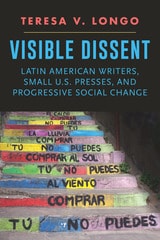
Visible Dissent
Latin American Writers, Small U.S. Presses, and Progressive Social ChangeTeresa V. Longo
University of Iowa Press, 2018
As Teresa Longo’s groundbreaking examination reveals, North America’s dissident literature has its roots in the Latin American literary tradition. From Pablo Neruda’s Canto General to Eduardo Galeano’s Open Veins of Latin America to Gabriel García Márquez’s One Hundred Years of Solitude—among others—contemporary writers throughout the Americas have forced us to reconsider the United States’s relationship with Latin America, and more broadly with the Global South. Highlighting the importance of reading and re-reading the Latin American canon in the United States, Longo finds that literature can be an instrument of progressive social change, and argues that small literary presses—City Lights, Curbstone, and Seven Stories—have made that dissent visible in the United States. In the book’s final two chapters on the Robert F. Kennedy Center’s Speak Truth to Power initiative and the publication of Marc Falkoff’s Poems from Guantánamo, the author turns our attention further outward, probing the role poetry, theater, and photography play in global human rights work.
Locating the work of artists and writers alongside that of scholars and legal advocates, Visible Dissent not only unveils the staying-power of committed writing, it honors the cross-currents and the on-the-ground implications of humane political engagement.
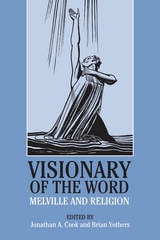
Visionary of the Word
Melville and ReligionEdited by Jonathan A. Cook and Brian Yothers
Northwestern University Press, 2017
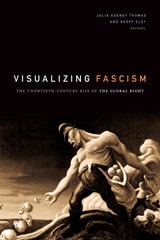
Visualizing Fascism
The Twentieth-Century Rise of the Global RightJulia Adeney Thomas and Geoff Eley, editors
Duke University Press, 2020
Contributors. Nadya Bair, Paul D. Barclay, Ruth Ben-Ghiat, Maggie Clinton, Geoff Eley, Lutz Koepnick, Ethan Mark, Bertrand Metton, Lorena Rizzo, Julia Adeney Thomas, Claire Zimmerman
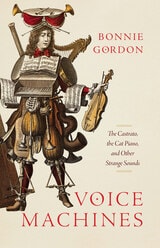
Voice Machines
The Castrato, the Cat Piano, and Other Strange SoundsBonnie Gordon
University of Chicago Press, 2023
Italian courts and churches began employing castrato singers in the late sixteenth century. By the eighteenth century, the singers occupied a celebrity status on the operatic stage. Constructed through surgical alteration and further modified by rigorous training, castrati inhabited human bodies that had been “mechanized” to produce sounds in ways that unmechanized bodies could not. The voices of these technologically enhanced singers, with their unique timbre, range, and strength, contributed to a dramatic expansion of musical vocabulary and prompted new ways of imagining sound, the body, and personhood.
Connecting sometimes bizarre snippets of history, this multi-disciplinary book moves backward and forward in time, deliberately troubling the meaning of concepts like “technology” and “human.” Voice Machines attends to the ways that early modern encounters and inventions—including settler colonialism, emergent racialized worldviews, the printing press, gunpowder, and the telescope—participated in making castrati. In Bonnie Gordon’s revealing study, castrati serve as a critical provocation to ask questions about the voice, the limits of the body, and the stories historians tell.
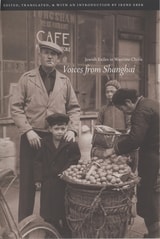
Voices from Shanghai
Jewish Exiles in Wartime ChinaEdited by Irene Eber
University of Chicago Press, 2008
When Hitler came to power and the German army began to sweep through Europe, almost 20,000 Jewish refugees fled to Shanghai. A remarkable collection of the letters, diary entries, poems, and short stories composed by these refugees in the years after they landed in China, Voices from Shanghai fills a gap in our historical understanding of what happened to so many Jews who were forced to board the first ship bound for anywhere.
Once they arrived, the refugees learned to navigate the various languages, belief systems, and ethnic traditions they encountered in an already booming international city, and faced challenges within their own community based on disparities in socioeconomic status, levels of religious observance, urban or rural origin, and philosophical differences. Recovered from archives, private collections, and now-defunct newspapers, these fascinating accounts make their English-languge debut in this volume. A rich new take on Holocaust literature, Voices from Shanghai reveals how refugees attempted to pursue a life of creativity despite the hardships of exile.

Voices from the "Jungle"
Stories from the Calais Refugee CampCalais Writers
Pluto Press, 2017
In this moving collection of individual testimonies, Calais refugees speak directly in powerful and vivid stories, offering their memories up with stunning honesty. They tell of their childhood dreams and struggles for education; the genocides, wars, and persecution that drove them from home; the simultaneous terror and strength that filled their extraordinary journeys; the realities of living in the Calais refugee camp; and their deepest hopes for the future.
Through their stories, these refugees paint a picture of a different kind of Jungle—a powerful sense of community that has grown despite evictions and attacks and a solidarity that crosses national and religious boundaries. Interspersed with photos taken by the camp's inhabitants, taught by award-winning photographers Gideon Mendel and Crispin Hughes, original artwork by inhabitants, and powerful poems, Voices from the “Jungle” must be read by anyone seeking to understand the human consequences of our current world crisis.
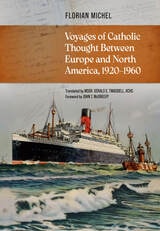
Voyages of Catholic Thought to North America
Intellectual Networks and Cultural Exchanges Between Europe, Canada, and the United States, 1920-1950Florian Michel
Catholic University of America Press, 2026
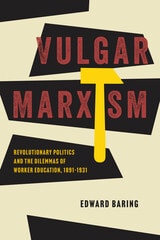
Vulgar Marxism
Revolutionary Politics and the Dilemmas of Worker Education, 1891–1931Edward Baring
University of Chicago Press, 2025
For the past hundred years, “vulgar Marxism” has been the go-to insult among socialist and communist intellectuals, a shorthand for the ways Marxist theory could go wrong. But why would thinkers advocating for working-class emancipation use “vulgarity” as an epithet?
In Vulgar Marxism, Edward Baring seeks an answer by delving into debates over Marxism in the first decades of the twentieth century. He shows that this common phrase wasn’t aimed primarily at popular understandings of Marx. Rather, it was used to attack intellectuals for failing to teach Marx’s theory to the working masses correctly. His history of “vulgar Marxism” homes in on the project of mass worker education at a time when the project was both widely pursued and fiercely contested.
Worker education offered a mechanism through which Marxist theory was meant to promote large-scale social and political change, and it drew on a massive infrastructure of schools, publishing houses, and educational bureaus that stretched across Europe and reached millions. By centering this project, Baring radically recasts the history of Marxism from the Second International to World War II. He challenges classic oppositions between “economistic” and “cultural” versions of Marxism; rereads many of the most significant Marxist theorists of the time, including Karl Kautsky, Rosa Luxemburg, Georg Lukács, and Antonio Gramsci; and offers new resources for understanding how Marxist ideas transformed as they traveled around Europe and then spread throughout the world.