Results by title
618 books match the query 'Motion pictures' and 8 start with v
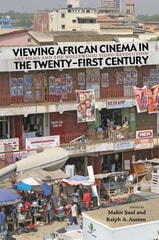
Viewing African Cinema in the Twenty-First Century
Art Films and the Nollywood Video RevolutionMahir Saul
Ohio University Press, 2010
African cinema in the 1960s originated mainly from Francophone countries. It resembled the art cinema of contemporary Europe and relied on support from the French film industry and the French state. Beginning in 1969 the biennial Festival panafricain du cinéma et de la télévision de Ouagadougou (FESPACO), held in Burkina Faso, became the major showcase for these films. But since the early 1990s, a new phenomenon has come to dominate the African cinema world: mass-marketed films shot on less expensive video cameras. These “Nollywood” films, so named because many originate in southern Nigeria, are a thriving industry dominating the world of African cinema.
Viewing African Cinema in the Twenty-first Century is the first book to bring together a set of essays offering a comparison of these two main African cinema modes.
Contributors: Ralph A. Austen and Mahir Şaul, Jonathan Haynes, Onookome Okome, Birgit Meyer, Abdalla Uba Adamu, Matthias Krings, Vincent Bouchard, Laura Fair, Jane Bryce, Peter Rist, Stefan Sereda, Lindsey Green-Simms, and Cornelius Moore
Viewing Positions
Ways of Seeing FilmWilliams, Linda
Rutgers University Press, 1994
Viewing Positions
Ways of Seeing FilmWilliams, Linda
Rutgers University Press, 1994
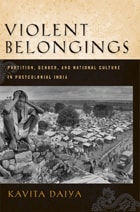
Violent Belongings
Partition, Gender, and National Culture in Postcolonial IndiaKavita Daiya
Temple University Press, 2008
In addition to challenging the official narratives of independence and Partition, these narratives challenge our contemporary understanding of gender and ethnicity in history and politics. Violent Belongings argues that both male and female bodies, and heterosexual coupledom, became symbols of the nation in public life. In the newly independent Indian nation both men and women were transformed into ideal citizens or troubling bodies, immigrants or refugees, depending on whether they were ethnically Hindu, Muslim, Jewish or Sikh. The divisions set in motion during Partition continue into our own time and account for ethnic violence in South Asia.
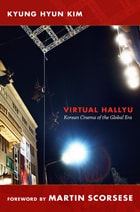
Virtual Hallyu
Korean Cinema of the Global EraKyung Hyun Kim
Duke University Press, 2011
In the late 1990s, South Korean film and other cultural products, broadly known as hallyu (Korean wave), gained unprecedented international popularity. Korean films earned an all-time high of $60.3 million in Japan in 2005, and they outperformed their Hollywood competitors at Korean box offices. In Virtual Hallyu, Kyung Hyun Kim reflects on the precariousness of Korean cinema’s success over the past decade. Arguing that state film policies and socioeconomic factors cannot fully explain cinema’s true potentiality, Kim draws on Deleuze’s concept of the virtual—according to which past and present and truth and falsehood coexist—to analyze the temporal anxieties and cinematic ironies embedded in screen figures such as a made-in-the-USA aquatic monster (The Host), a postmodern Chosun-era wizard (Jeon Woo-chi), a schizo man-child (Oasis), a weepy North Korean terrorist (Typhoon), a salary man turned vengeful fighting machine (Oldboy), and a sick nationalist (the repatriated colonial-era film Spring of Korean Peninsula). Kim maintains that the full significance of hallyu can only be understood by exposing the implicit and explicit ideologies of protonationalism and capitalism that, along with Korea’s ambiguous post-democratization and neoliberalism, are etched against the celluloid surfaces.
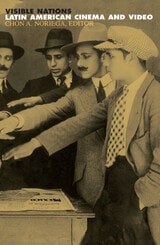
Visible Nations
Latin American Cinema and VideoChon A. Noriega
University of Minnesota Press, 2000
Rewrites Latin American film from the perspective of nationhood.
In the current "global" moment, the study of Latin American cinema has become insistently national—a phenomenon fully explored in this collection of essays by some of the most interesting and innovative scholars of media and Latin American culture working today.
The contributors to Visible Nations consider different national film and video histories in Latin America since the silent period. From the perspectives of feminism, psychoanalysis, new historicism, and reception theory, among others, they consider the styles through which—and the ends toward which—the nation has been represented, desired, and contested in films, film industries, and alternative video work in Mexico, Chile, Venezuela, Brazil, Colombia, and Cuba. The result is nothing less than a rewriting of Latin American film history. Contributors: Patricia Aufderheide, American U; Charles Ramírez Berg, U of Texas at Austin; Gilberto Moises Blasini; Julianne Burton-Carvajal, U of California, Santa Cruz; Seth Fein, Georgia State U; Claire F. Fox, Stanford U; Brian Goldfarb, U of Rochester; Ilene S. Goldman; Monica Hulsbus; Ana M. López, Tulane U; Kathleen Newman, U of Iowa; Laura Podalsky, Bowling Green State U; Harmony H. Wu.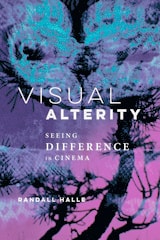
Visual Alterity
Seeing Difference in CinemaRandall Halle
University of Illinois Press, 2021
Using cinema to explore the visual aspects of alterity, Randall Halle analyzes how we become cognizant of each other and how we perceive and judge another person in a visual field. Halle draws on insights from philosophy and recent developments in cognitive and neuroscience to argue that there is no pure "natural" sight. We always see in a particular way, from a particular vantage point, and through a specific apparatus, and Halle shows how human beings have used cinema to experiment with the apparatus of seeing for over a century. Visual alterity goes beyond seeing difference to being conscious of how one sees difference. Investigating the process allows us to move from mere perception to apperception, or conscious perception.
Innovative and insightful, Visual Alterity merges film theory with philosophy and cutting-edge science to propose new ways of perceiving and knowing.
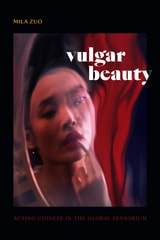
Vulgar Beauty
Acting Chinese in the Global SensoriumMila Zuo
Duke University Press, 2022