Results by title
754 books match the query 'Native American Studies' and 4 start with v
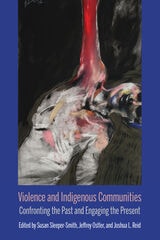
Violence and Indigenous Communities
Confronting the Past and Engaging the PresentEdited by Susan Sleeper-Smith, Jeffrey Ostler, and Joshua L. Reid
Northwestern University Press, 2021
In contrast to past studies that focus narrowly on war and massacre, treat Native peoples as victims, and consign violence safely to the past, this interdisciplinary collection of essays opens up important new perspectives. While recognizing the long history of genocidal violence against Indigenous peoples, the contributors emphasize the agency of individuals and communities in genocide’s aftermath and provide historical and contemporary examples of activism, resistance, identity formation, historical memory, resilience, and healing. The collection also expands the scope of violence by examining the eyewitness testimony of women and children who survived violence, the role of Indigenous self-determination and governance in inciting violence against women, and settler colonialism’s promotion of cultural erasure and environmental destruction.
By including contributions on Indigenous peoples in the United States, Canada, the Pacific, Greenland, Sápmi, and Latin America, the volume breaks down nation-state and European imperial boundaries to show the value of global Indigenous frameworks. Connecting the past to the present, this book confronts violence as an ongoing problem and identifies projects that mitigate and push back against it.
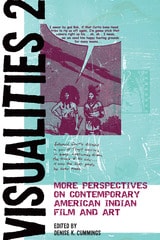
Visualities 2
More Perspectives on Contemporary American Indian Film and ArtDenise K. Cummings
Michigan State University Press, 2019
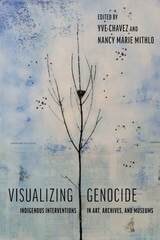
Visualizing Genocide
Indigenous Interventions in Art, Archives, and MuseumsEdited by Yve Chavez and Nancy Marie Mithlo; Foreword by Charlene Villaseñor Black
University of Arizona Press, 2022
Rather than dwelling simply in celebratory appraisals of Indigenous survival, this unprecedented volume tracks how massacres, disease, removals, abrogated treaties, religious intolerance, theft of land, and relocation are conceived by contemporary academics and artists. Contributors address indigeneity in the United States, Norway, Canada, Australia, and the Caribbean in scholarly essays, poems, and artist narratives. Missions, cemeteries, archives, exhibitions, photography, printmaking, painting, installations, performance, music, and museums are documented by fourteen authors from a variety of disciplines and illustrated with forty-three original artworks.
The authors offer honest critique, but in so doing they give hopeful and concrete strategies for the future. This powerful collection of voices employs Indigenous epistemologies and decolonial strategies, providing essential perspectives on art and visual culture.
Contributors
T. Christopher Aplin
Emily Arthur
Marwin Begaye
Charlene Villaseñor Black
Yve Chavez
Iris Colburn
Ellen Fernandez-Sacco
Stephen Gilchrist
John Hitchcock
Michelle J. Lanteri
Jérémie McGowan
Nancy Marie Mithlo
Anne May Olli
Emily Voelker
Richard Ray Whitman
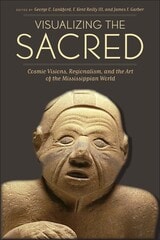
Visualizing the Sacred
Cosmic Visions, Regionalism, and the Art of the Mississippian WorldEdited by George E. Lankford, F. Kent Reilly III, and James F. Garber
University of Texas Press, 2011
The prehistoric native peoples of the Mississippi River Valley and other areas of the Eastern Woodlands of the United States shared a complex set of symbols and motifs that constituted one of the greatest artistic traditions of the pre-Columbian Americas. Traditionally known as the Southeastern Ceremonial Complex, these artifacts of copper, shell, stone, clay, and wood were the subject of the groundbreaking 2007 book Ancient Objects and Sacred Realms: Interpretations of Mississippian Iconography, which presented a major reconstruction of the rituals, cosmology, ideology, and political structures of the Mississippian peoples.
Visualizing the Sacred advances the study of Mississippian iconography by delving into the regional variations within what is now known as the Mississippian Iconographic Interaction Sphere (MIIS). Bringing archaeological, ethnographic, ethnohistoric, and iconographic perspectives to the analysis of Mississippian art, contributors from several disciplines discuss variations in symbols and motifs among major sites and regions across a wide span of time and also consider what visual symbols reveal about elite status in diverse political environments. These findings represent the first formal identification of style regions within the Mississippian Iconographic Interaction Sphere and call for a new understanding of the MIIS as a network of localized, yet interrelated religious systems that experienced both continuity and change over time.