Results by title
91 books match the query 'Nordic Countries' and 3 start with v
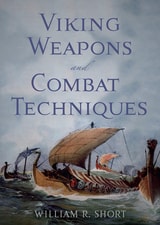
Viking Weapons and Combat Techniques
William R. Short
Westholme Publishing, 2009
A source of enduring fascination, the Vikings are the most famous raiders of medieval Europe. Despite the exciting and compelling descriptions in the Icelandic sagas and other contemporary accounts that have fueled this interest, we know comparatively little about Viking age arms and armor as compared to weapons from other historical periods. We know even less about how the weapons were used. While the sagas provide few specific combat details, the stories are invaluable. They were written by authors familiar with the use of weapons for an audience that, likewise, knew how to use them. Critically, the sagas describe how these weapons were wielded not by kings or gods, but by ordinary men, as part of their everyday lives. Viking Weapons and Combat Techniques provides an introduction to the arms and armor of the people who lived in Northern Europe during the Viking age, roughly the years 793–1066. Using a variety of available sources, including medieval martial arts treatises, and copiously illustrated with images of historical artifacts, battle sites, and demonstrations of modern replicas of Viking weapons, the author and his colleagues at Hurstwic (a Viking-age living history organization) and at the Higgins Armory Sword Guild have reconstructed the combat techniques of the Viking age and what is known about the defensive and offensive weapons of the time in general. Throughout, the author corrects some popular misconceptions about Viking warriors and warfare, such as the belief that their combat techniques were crude and blunt rather than sophisticated. In addition, the book provides an overview of Viking history and culture, focusing on the importance of weapons to the society as well as the Vikings’ lasting impact on Europe through their expeditions of trade and exploration.
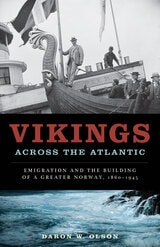
Vikings across the Atlantic
Emigration and the Building of a Greater Norway, 1860-1945Daron W. Olson
University of Minnesota Press, 2013
Around the year 1000 a Viking ship landed on the Atlantic coast of what would one day be North America. Nearly a millennium later, on June 7, 1945, Norway’s King Haakon VII returned from exile under guard of the American Ninety-ninth—or “Viking”—Battalion. In Vikings across the Atlantic, Daron W. Olson reveals how these two moments form narrative poles for the vision of a Greater Norway that expanded the boundaries of the Norwegian nation.
Looking at matters of religion, literature, media, and ethnicity, Olson explores how Norwegian Americans’ myths about themselves changed over time in relation to a broader Anglo-American culture, while at the same time influencing and being influenced by the burgeoning national culture of their homeland. Beginning in the 1920s, homeland Norwegian identity-makers framed the concept of the Greater Norway, which viewed the Norwegian nation as having two halves: Norwegians who resided in the homeland and those who had emigrated from Norway, especially those in America. Far from being merely symbolic, this idea, Olson shows, was actually tested by the ordeal of World War II, when Norwegians the world over demonstrated their willingness to sacrifice and even die for the Greater Norway.
In its transnational approach, Olson’s book brings a new perspective to immigrant studies and theories of nationalism; Vikings across the Atlantic depicts the nation as a larger community in which membership is constructed or imagined, a status of belonging defined not by physical proximity but through qualities such as culture and shared traditions.

Visions and Victims
Art Melodrama in the Films of Carl Th. DreyerAmanda Doxtater
University of Wisconsin Press, 2024
Amanda Doxtater offers a necessary corrective to this narrative of his bifurcated career. Close readings of Dreyer’s Nordisk films alongside his mature work reveal a stylistic throughline Doxtater terms “art melodrama,” a form combining the ambiguity, stylization, and consciousness of art cinema with the heightened emotional expressivity and dramatic embodiments characteristic of melodrama. She argues that Dreyer’s major artistic concerns known from his later work—pathos, authenticity, the embodiment of psychological duress, and so on—find their first expression in his Nordisk melodramas, complicating our understanding not only of his later films but also of his early works, and even our understanding of the melodramatic mode in general. Indeed, extending well beyond the career of a singular director, this book challenges assumptions about the relationship between “low-brow” melodrama and “high-brow” art cinema.