Results by title
103 books match the query 'Philosophy, Modern' and 2 start with v

Violence in Modern Philosophy
Piotr Hoffman
University of Chicago Press, 1989
Following on the arguments adumbrated in his previous works, Piotr Hoffman here argues that the notion of and concern with violence are not limited to political philosophy but in fact form the essential component of philosophy in general. The acute awareness of the ever-present possibility of violence, Hoffman claims, filters into and informs ontology and epistemology in ways that require careful analysis.
In his previous book, Doubt, Time, Violence, Hoffman explored the theme of violence in relation to Descartes' problematic of doubt and Heidegger's work on temporality. The pivotal notion deriving from that investigation is the notion of the other as the ultimate limit of one's powers. In effect, Hoffman argues, our practical mastery of the natural environment still leaves intact the limitation of human agents by each other. In a violent environment, the other emerges as an insurmountable obstacle to one's aims and purposes or as an inescapable danger which one is powerless to hold at bay. The other is thus the focus of an ultimate resistance to one's powers.
The special status of the other, as Hoffman articulates it, is at the root of several key notions around which modern philosophy has built its problematic. Arguing here that when the theme of violence is taken into account many conceptual tensions and puzzles receive satisfying solutions, Hoffman traces the theme through the issue of things versus properties; through Kant's treatment of causality, necessity, and freedom in the Critique of Pure Reason; and through the early parts of Hegel's Logic. The result is a complete reorientation and reinterpretation of these important texts.
Violence in Modern Philosophy offers patient and careful textual clarification in light of Hoffman's central thesis regarding the other as ultimate limit. With a high level of originality, he shows that the theme of violence is the hidden impulse behind much of modern philosophy. Hoffman's unique stress on the constitutive importance of violence also offers a challenge to the dominant "compatibilist" tradition in moral and political theory. Of great interest to all philosophers, this work will also provide fresh insights to anthropologists and all those in the social sciences and humanities who occupy themselves with the general theory of culture.
[more]
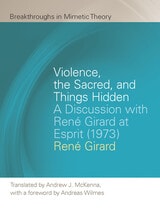
Violence, the Sacred, and Things Hidden
A Discussion with René Girard at Esprit (1973)René Girard
Michigan State University Press, 2022
Never before translated in English, this 1973 discussion between René Girard (1923–2015) and other prominent scholars represents one of the most significant breakthroughs in mimetic theory. Organized by the French journal Esprit, the conversation was an opportunity for Girard to debate with his interlocutors the theories he expounded in Violence and the Sacred (1972). These scholars prompted him to reconsider the book’s strictly sociological interpretation of religion, highlighting the misrecognition of violent scapegoating at its origins and in its myths and ritual practices, by addressing the relation between his critique of primitive or archaic religion and the role of Judeo-Christianity. The ensuing discussion opened up an entirely new and admittedly startling phase of his thinking, where he deployed an epistemology rooted in Biblical revelation, which he viewed as an ongoing deconstruction of sacrificial practices. In this text, he vindicates for the very first time the anthropological relevance of Judeo-Christian scriptures. The 1973 discussion thus marks a new and decisive step in Girard’s intellectual journey, making this volume a critical document for understanding the transition period between Violence and the Sacred and Things Hidden Since the Foundation of the World (1978).
[more]