Results by title
1148 books match the query 'Political Ideologies' and 11 start with v
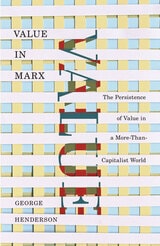
Value in Marx
The Persistence of Value in a More-Than-Capitalist WorldGeorge Henderson
University of Minnesota Press, 2013
Long prone to dogmatic disagreement, the question of value in Marx’s thought—what value is, the purpose it serves, its application to real-world capitalism—requires renewal if Marx’s work is to remain vibrant. In Value in Marx, George Henderson offers a lucid rereading of Marx that strips value of its turgid theoretical reduction and reframes it as an investigation into the tensions between social relations and forms as they are rather than as what they could otherwise become.
Drawing on Marx’s Capital and Grundrisse, Henderson shows how these volumes do not harbor a single theory of value that equates value to capital. Instead, these books experimentally compose and recompose value for a world that is more than capitalist. At stake is how Marx conceives of human freedom, of balanced social arrangements, and of control over the things people produce. Henderson finds that the limits on social becoming, including the tendency toward alienated existence, haunt Marx even as he looks beyond the critique of capital to an emancipated society to come.
Can these limits be confronted in a creative, even joyful, way? Can they become aspects of what we desire, rather than being silenced and denied? As long as we persist in interpreting value broadly, following it as an active and not a shut-down, predetermined feature of Marx’s texts, Henderson ultimately views Marx as responding positively to these challenges and employing value as a powerful tool of the political imaginary.

Varieties of Liberalism in Central America
Nation-States as Works in ProgressBy Forrest D. Colburn and Arturo Cruz S.
University of Texas Press, 2007
Why do some countries progress while others stagnate? Why does adversity strengthen some countries and weaken others? Indeed, in this era of unprecedented movement of people, goods, and ideas, just what constitutes a nation-state? Forrest Colburn and Arturo Cruz suggest how fundamental these questions are through an exploration of the evolution of Guatemala, El Salvador, Honduras, Nicaragua, and Costa Rica over the last quarter of a century, a period of intriguing, often confounding, paradoxes in Central America's development.
Offering an elegant defense of empiricism, Colburn and Cruz explore the roles of geography and political choice in constructing nations and states. Countries are shown to be unique: there are a daunting number of variables. There is causality, but not the kind that can be revealed in the laboratory or on the blackboard. Liberalism—today defined as democracy and unfettered markets—may be in vogue, but it has no inherent determinants. Democracy and market economies, when welded to the messy realities of individual countries, are compatible with many different outcomes. The world is more pluralistic in both causes and effects than either academic theories or political rhetoric suggest.
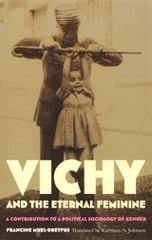
Vichy and the Eternal Feminine
A Contribution to a Political Sociology of GenderFrancine Muel-Dreyfus
Duke University Press, 2001
Drawing on an extensive body of legislative, religious, educational, medical, and literary texts, Muel-Dreyfus examines how the Vichy regime brutally resurrected the gender politics that had been rejected during France’s social struggles in the 1930s. Strikingly, she reveals how this resurrection in turn fed into racial politics: childless women, for instance, and those who had abortions were construed—like Jews—as threats to France’s racial “purity.” With its atendant patterns of social inclusion and exclusion that were deeply rooted in the political and cultural history of the Third Republic, Muel-Dreyfus claims, a pervasive range of gendered metaphors helped to structure the very laws and policies of the Vichy regime.
The French language edition of this book was published in 1996 to wide acclaim. Contributing to theories about the role of gender in political philosophy, to the cultural anthropology of symbolic representation, and to our understanding of the history of fascism, Vichy and the Eternal Feminine will appeal to French, European, and twentieth-century historians; students and scholars of gender and racial studies; political scientists; and anthropologists.

Victor Arnautoff and the Politics of Art
Robert W. Cherny
University of Illinois Press, 2017

Violent Histories, Livable Futures
Forging the Power of the PeopleEric King Watts
Michigan State University Press, 2026
Our political landscape is crowded with competing voices—claims, demands, grievances, and even acts of violence—all made in the name of some idea of “the people.” This powerful concept has been wielded both to assert democratic sovereignty and to justify exclusion and control. Violent Histories, Livable Futures unpacks this complex dynamic through compelling historical case studies, spanning sub-Saharan Africa in the 1950s, post–World War II Guatemala, and the United States in the aftermath of George Floyd’s murder. By tracing how societies have contended over which people matter and which do not, this book offers a deeply relevant exploration of power, representation, and the struggle for justice, all in pursuit of a more livable future.
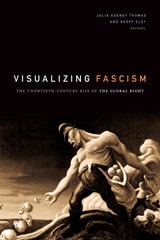
Visualizing Fascism
The Twentieth-Century Rise of the Global RightJulia Adeney Thomas and Geoff Eley, editors
Duke University Press, 2020
Contributors. Nadya Bair, Paul D. Barclay, Ruth Ben-Ghiat, Maggie Clinton, Geoff Eley, Lutz Koepnick, Ethan Mark, Bertrand Metton, Lorena Rizzo, Julia Adeney Thomas, Claire Zimmerman

Voices From the Other Side
An Oral History of Terrorism Against CubaKeith Bolender
Pluto Press, 2010
Keith Bolender brings to bear the enormous impact that terrorism has had on Cuba’s civilian population, with over 1,000 documented incidents resulting in more than 3,000 deaths and 2,000 injuries. Bolender allows the victims to articulate the atrocities the Cuban people have suffered - which largely originate from Cuban counter-revolutionaries based in the US, often with the active help of the CIA.
Voices From The Other Side includes first-person interviews with more than 75 Cuban citizens who have been victims of these terrorist acts, or have had family members or close friends die from the attacks. It is a unique resource for activists, journalists and students interested in Cuba's torrid relationship with the US.

Voices and Votes Teacher's Guide
How Democracy Works in Wisconsin TGJon Kasparek and Bobbie Malone
Wisconsin Historical Society Press, 2006
Voices and Votes: How Democracy Works in Wisconsin; Teacher's Guide and Student Materials features several activities for each chapter to engage students in a more in-depth exploration of the book. These activities, designed for both individual and small groups, demand the use of higher-level thinking skills while integrating a wide range of learning styles, and all have culminating components that can be used for assessment. The guide also features easily reproducible student pages, including maps, charts, and interesting illustrations.

Voices and Votes
How Democracy Works in WisconsinJon Kasparek
Wisconsin Historical Society Press, 2006
Voices & Votes: How Democracy Works in Wisconsin invites upper elementary school students to explore the intersection of American civics and Wisconsin history. This sixth and final book in the New Badger History series introduces students to the basic structures of American democracy, state government, and Wisconsin's road to statehood. The first seven chapters help students grasp how the three branches of government function at the federal, state, local, and tribal levels, while tying these structural notions to Wisconsin history. Students will learn that citizens' voices and votes help government evolve to meet ever-changing societal needs. The last chapter emphasizes how young people can actively engage in their communities to bring about positive change.
Voices of Dissent
An EssayRomila Thapar
Seagull Books, 2020
People have argued since time immemorial. Disagreement is a part of life, of human experience. But we now live in times when any form of protest in India is marked as anti-Indian and met with arguments that the very concept of dissent was imported into India from the West. As Romila Thapar explores in her timely historical essay, however, dissent has a long history in the subcontinent, even if its forms have evolved through the centuries.
In Voices of Dissent: An Essay, Thapar looks at the articulation of nonviolent dissent and relates it to various pivotal moments throughout India’s history. Beginning with Vedic times, she takes us from the second to the first millennium BCE, to the emergence of groups that were jointly called the Shramanas—the Jainas, Buddhists, and Ajivikas. Going forward in time, she also explores the views of the Bhakti sants and others of the fifteenth and sixteenth centuries and brings us to a major moment of dissent that helped to establish a free and democratic India: Mahatma Gandhi’s satyagraha. Then Thapar places in context the recent peaceful protests against India’s new, controversial citizenship law, maintaining that dissent in our time must be opposed to injustice and supportive of democratic rights so that society may change for the better.
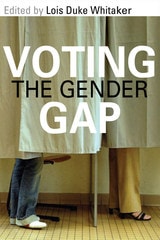
Voting the Gender Gap
Edited by Lois Duke Whitaker
University of Illinois Press, 2007
This book concentrates on the gender gap in voting--the difference in the proportion of women and men voting for the same candidate. Evident in every presidential election since 1980, this polling phenomenon reached a high of 11 percentage points in the 1996 election. The contributors discuss the history, complexity, and ways of analyzing the gender gap; the gender gap in relation to partisanship; motherhood, ethnicity, and the impact of parental status on the gender gap; and the gender gap in races involving female candidates. Voting the Gender Gap analyzes trends in voting while probing how women's political empowerment and gender affect American politics and the electoral process.
Contributors are Susan J. Carroll, Erin Cassese, Cal Clark, Janet M. Clark, M. Margaret Conway, Kathleen A. Dolan, Laurel Elder, Kathleen A. Frankovic, Steven Greene, Leonie Huddy, Mary-Kate Lizotte, Barbara Norrander, Margie Omero, and Lois Duke Whitaker.