Results by title
191 books match the query 'Politics and literature' and 3 start with v
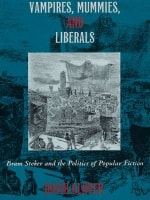
Vampires, Mummies and Liberals
Bram Stoker and the Politics of Popular FictionDavid Glover
Duke University Press, 1996
Glover’s efforts reveal a writer who was more wide-ranging and politically engaged than his current reputation suggests. An Irish Protestant and nationalist, Stoker nonetheless drew his political inspiration from English liberalism at a time of impending crisis, and the tradition’s contradictions and uncertainties haunt his work. At the heart of Stoker’s writing Glover exposes a preoccupation with those sciences and pseudo-sciences—from physiognomy and phrenology to eugenics and sexology—that seemed to cast doubt on the liberal faith in progress. He argues that Dracula should be read as a text torn between the stances of the colonizer and the colonized, unable to accept or reject the racialized images of backwardness that dogged debates about Irish nationhood. As it tracks the phantasmatic form given to questions of character and individuality, race and production, sexuality and gender, across the body of Stoker’s writing, Vampires, Mummies, and Liberals draws a fascinating portrait of an extraordinary transitional figure.
Combining psychoanalysis and cultural theory with detailed historical research, this book will be of interest to scholars of Victorian and Irish fiction and to those concerned with cultural studies and popular culture.
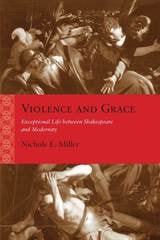
Violence and Grace
Exceptional Life between Shakespeare and ModernityNichole E. Miller
Northwestern University Press, 2014
In Violence and Grace, Nichole Miller establishes a conceptual link between early modern English drama and twentieth-century political theology, both of which emerge from the experience of political crisis. Miller’s analyses accordingly undertake to retrieve for political theology the relations between gender, sexuality, and the political aesthetics of violence on the early modern stage, addressing the plays of Marlowe, Middleton, and especially Shakespeare. In doing so, she expands our understanding of drama’s continuing theoretical impact.
Vladimir Nabokov and the Poetics of Liberalism
Dana Dragunoiu
Northwestern University Press, 2011
Showing the particular influence of the thought of Kant and Berkeley, she focuses on what she calls Nabokov’s “most deceptively apolitical novels”: The Gift, Lolita, Pale Fire, and Ada. In bringing to them a more extensive context than previous Nabokov scholars, Dragunoiu argues that their treatment of various moral and political subjects can be more clearly understood in the light of ideas inherited by Nabokov from his father and his father’s generation.