Results by title
471 books match the query 'Power' and 5 start with v
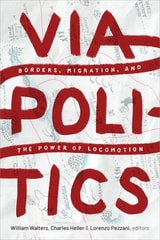
Viapolitics
Borders, Migration, and the Power of LocomotionWilliam Walters, Charles Heller, and Lorenzo Pezzani, editors
Duke University Press, 2021
Contributors. Ethan Blue, Maribel Casas-Cortes, Julie Y. Chu, Sebastian Cobarrubias, Glenda Garelli, Charles Heller, Sabine Hess, Bernd Kasparek, Clara Lecadet, Johan Lindquist, Renisa Mawani, Lorenzo Pezzani, Ranabir Samaddar, Amaha Senu, Martina Tazzioli, William Walters

Violent Affections
Queer Sexuality, Techniques of Power, and Law in RussiaAlexander Sasha Kondakov
University College London, 2022
Passed in 2013, Russia’s “gay propaganda” law cemented the nation’s anti-LGBTQ sentiment into legal rhetoric that has since emboldened countless instances of violence against queer people. Based on an analysis of over three hundred criminal cases of anti-queer violence in Russia before and after the introduction of the law, Violent Affections shows how violent acts are framed in emotional language by perpetrators during their criminal trials, thus uncovering the techniques of power that work to translate emotions into violence against queer people. Utilizing an original methodology of studying legal memes, this book argues that individual affective states are directly connected to the political and legislative violence aimed at policing queer lives. Alexander Sasha Kondakov expands upon two sets of interdisciplinary literature–queer theory and affect theory–in order to conceptualize what is referred to as neo-disciplinary power. The book traces how affections circulate from body to body as a kind of virus, eventually enabling the turn from a memetic response to violent action.

Violent Histories, Livable Futures
Forging the Power of the PeopleEric King Watts
Michigan State University Press, 2026
Our political landscape is crowded with competing voices—claims, demands, grievances, and even acts of violence—all made in the name of some idea of “the people.” This powerful concept has been wielded both to assert democratic sovereignty and to justify exclusion and control. Violent Histories, Livable Futures unpacks this complex dynamic through compelling historical case studies, spanning sub-Saharan Africa in the 1950s, post–World War II Guatemala, and the United States in the aftermath of George Floyd’s murder. By tracing how societies have contended over which people matter and which do not, this book offers a deeply relevant exploration of power, representation, and the struggle for justice, all in pursuit of a more livable future.
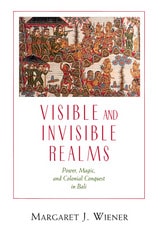
Visible and Invisible Realms
Power, Magic, and Colonial Conquest in BaliMargaret J. Wiener
University of Chicago Press, 1995
Wiener challenges colonial and academic claims that Klungkung had no "real" power and argues that such claims enabled colonial domination. By focusing on Balinese discourses she makes clear the choices open to Balinese, both at the time of the Dutch conquest and in its narration. At the same time, she shows how these discourses, which revolve around magical weapons acquired from invisible agents such as gods, spirits, and ancestors, offer an alternative understanding of Klungkung's power.
Moving between Balinese and Dutch narratives and between past and present, Wiener critiques colonial accounts by recounting Balinese memories and interpretations. Her attention to history and local situations illuminates the ways in which colonialism and orientalist scholarship have obscured the power of indigenous rulers and shows how Klungkung, once Bali's paramount realm, was relegated to a peripheral corner of the Indonesian nation-state. Both as a fascinating story and as a rich example of interdisciplinary scholarship, this book will interest students of colonialism, anthropology, history, religion, and Southeast Asia.
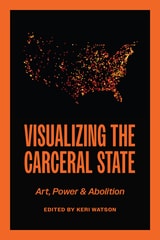
Visualizing the Carceral State
Art, Power, and AbolitionKeri Watson
University of Arkansas Press, 2027
Visualizing the Carceral State: Art, Power, and Abolition explores how visual culture has shaped, justified, and contested systems of incarceration. Bringing together leading scholars in art history and related fields, this interdisciplinary volume examines the images, objects, and spaces that have made the carceral state visible—in everything from prison architecture and colonial exhibitions to photography, print culture, and contemporary art. Across thirteen essays, contributors investigate how visual forms have helped construct public understandings of punishment, race, empire, and state authority. Thoughtfully edited by Keri Watson, Visualizing the Carceral State highlights cultural producers who have challenged these systems, offering alternative ways of seeing incarceration and imagining its abolition. Moving from the nineteenth century to the present and across multiple geopolitical contexts, this volume traces the visual languages through which carceral power operates and the creative practices that resist it. By situating art and visual culture at the center of debates about mass incarceration, Visualizing the Carceral State opens new avenues for thinking about the relationship between aesthetics, politics, and justice.