Results by title
753 books match the query 'Race' and 4 start with v

Vetting for Passion
Race, Gender, and Inequalities in the Veterinary ProfessionAdilia E. E. James
Temple University Press, 2027
Despite calls from industry associations for a diverse workforce to meet a changing client base, racial and gendered occupational segregation persists in the veterinary profession. As of 2018, nearly 90% of veterinarians identify as White and more than 70% are women. Adilia James explains the causes and effects of this growing and alarming trend in Vetting for Passion.
James interviews aspiring and employed veterinarians about why marginalized groups are, ironically, not making equitable progress in an elite labor market that encourages diversity and inclusion policies. She shows how cultural and structural barriers exclude people of color from the profession and how relationships with animals are used as racialization tools. People of color are also hindered by factors such as social and lived experiences, the debt-to-income ratio, and an uncomfortable working environment.
Additionally, James finds that hiring managers, veterinary schools, and mentors rely on “constrained choice narratives” to justify their assumption that only White women are likely to appreciate the unique benefits of a career in veterinary medicine, leading these gatekeepers to excuse their opportunity hoarding as benevolent.
Vetting for Passion offers a critical case study of a profession whose associations, colleges, and workplaces justify and perpetuate a culture of racial exclusion.

Viewers in Distress
Race, Gender, Religion, and Avant-Garde Performance at the Turn of the Twenty-First CenturyStefka G. Mihaylova
University of Michigan Press, 2023
Honorable Mention: American Society for Theatre Research Barnard Hewitt Award | November 8, 2024
Conventional notions of avant-garde art suggest innovative artists rebelling against artistic convention and social propriety, shocking unwilling audiences into new ways of seeing and living. Viewers in Distress tells a different story. Beginning in the tumultuous 1990s, after the fall of the Berlin Wall and in the wake of the Los Angeles riots, rebellious spectators in American and British theaters broke with theater decorum and voiced their radical interpretations of shows that were not meant to be radical. In doing so, audiences tried to understand the complex racial, gender, and religious politics of their times, while insisting that liberal societies fulfill their promise of dignity for all. Stefka Mihaylova argues that such non-conforming viewing amounts to an avant-garde of its own: a bold reimagining of how we live together and tell stories of our lives together, aimed to achieve liberalism’s promise. In telling this story, she analyzes the production and reception politics of works by Susan-Lori Parks, Sarah Kane, Forced Entertainment, Gurpreet Kaur Bhatti, and Young Jean Lee, as well as non-theatrical controversies such as the conflict over Halloween costumes at Yale in 2015. At the core of spectators’ discontent, this book suggests, is an effort to figure out how to get along with people different from ourselves in the diverse U.S. and British societies in which we live.
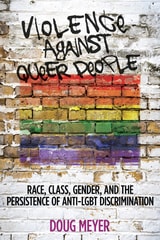
Violence against Queer People
Race, Class, Gender, and the Persistence of Anti-LGBT DiscriminationMeyer, Doug
Rutgers University Press, 2015
Selected as one of “The Best of the Best from the University Presses: Books You Should Know About” at the 2016 ALA Annual Conference
Violence against lesbians and gay men has increasingly captured media and scholarly attention. But these reports tend to focus on one segment of the LGBT community—white, middle class men—and largely ignore that part of the community that arguably suffers a larger share of the violence—racial minorities, the poor, and women. In Violence against Queer People, sociologist Doug Meyer offers the first investigation of anti-queer violence that focuses on the role played by race, class, and gender.
Drawing on interviews with forty-seven victims of violence, Meyer shows that LGBT people encounter significantly different forms of violence—and perceive that violence quite differently—based on their race, class, and gender. His research highlights the extent to which other forms of discrimination—including racism and sexism—shape LGBT people’s experience of abuse. He reports, for instance, that lesbian and transgender women often described violent incidents in which a sexual or a misogynistic component was introduced, and that LGBT people of color sometimes weren’t sure if anti-queer violence was based solely on their sexuality or whether racism or sexism had also played a role. Meyer observes that given the many differences in how anti-queer violence is experienced, the present media focus on white, middle-class victims greatly oversimplifies and distorts the nature of anti-queer violence. In fact, attempts to reduce anti-queer violence that ignore race, class, and gender run the risk of helping only the most privileged gay subjects.
Many feel that the struggle for gay rights has largely been accomplished and the tide of history has swung in favor of LGBT equality. Violence against Queer People, on the contrary, argues that the lives of many LGBT people—particularly the most vulnerable—have improved very little, if at all, over the past thirty years.
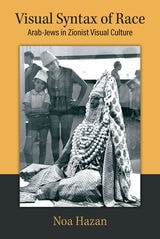
Visual Syntax of Race
Arab-Jews in Zionist Visual CultureNoa Hazan
University of Michigan Press, 2022
Analyzing the visual syntax and display rhetoric applied in newspaper photos, national historical albums, and museum exhibitions, Noa Hazan shows that although racial thought was and still is verbally suppressed in Israel, it is vividly present in its nonverbal official and public visual sphere. The racist perspective of newspaper editors, book publishers, photographers, and museum curators were morally justified in its time by such patronizing ideals as realistic news coverage or the salvation of Jewish heritage assets. Although their perspectives played a dominant role in establishing a visual syntax of race in Israel, they were not seen as racially discriminating at the time. The racist motifs and actions are revealed here by colligating multiple cases into a coherent narrative in retrospect.
This book points to a direct influence of the anti-Semitic discourse in Europe toward Mizrahim in Israel, highlighting the shared visual stereotypes used in both Europe and the fledgling state of Israel. Engraved in their body, these cultural traits were depicted and understood as racial-biological qualities and were visually manipulated to silo Ashkenazim and Mizrahim in Israel as distinct racial types.