Results by title
598 books match the query 'Religious' and 8 start with v
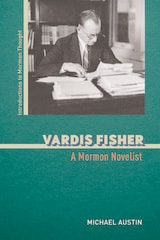
Vardis Fisher
A Mormon NovelistMichael Austin
University of Illinois Press, 2021
Engrossing and enlightening, Vardis Fisher illuminates the acclaimed author's impact on Mormon culture, American letters, and the literary tradition of the American West.
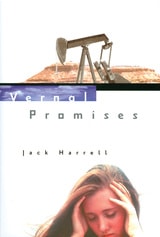
Vernal Promises
Jack Harrell
Signature Books, 2003
“This is a brilliant novel, written with language that crackles. The relationships are treated with force and poignancy. The power of the story is its authenticity and the character’s compelling conversion. He begins as a boy who refuses to accept responsibility, becomes the husband who longs for freedom, and at last the man who feels God’s grace in spite of himself and the self-destructive path that has beckoned to him with a siren’s allure. This brings a voice to Mormon literature that is clearly worth honoring.” —Marilyn Brown, author of The Wine Dark Sea of Grass
Vespers
Lewty, Jane
University of Iowa Press, 2026
Often called “evening prayer,” vespers is held around sunset. Its purpose: to give thanks for the day and offer a sacrifice of praise to God. In Jane Lewty’s Vespers, she superimposes the tropes of the Christian ritual onto a very different type of sacrifice—that of making art.
Through nightly devotion, the speaker of these poems maps ritual until it degrades: the speaker as an obedient robot, a scribe-concubine, a centaur wearing skates, a poet seeking virtuosity and dexterity. Vespers asks: What if writing prompts are a bad idea? What if one could become addicted to the incremental process? Is it possible to walk away from an addiction without suffering and trauma?
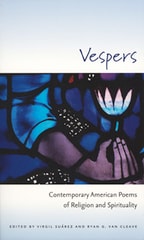
Vespers
Contemporary American Poems of Religion and SpiritualityVirgil Suarez
University of Iowa Press, 2003
At the heart of human existence lie fundamental questions that are pondered by philosophers, theologians, poets and thoughtful people from all walks of life. What is the meaning of life? Who or what is a divine being? How can a benevolent deity justify human suffering? Such questions are especially relevant to our lives in the current climate of American society. In Vespers: American Poems of Religion and Spirituality, editors Virgil Suárez and Ryan G. Van Cleave offer the reading world a timely anthology of powerful and passionate poems that cut to the heart of our contemporary theological and spiritual underpinnings.
Featuring fifty of today's most respected American poets, including Pulitzer Prize winners Stephen Dunn and Carolyn Kizer, Vespers allows us to witness and understand the challenging ideas and philosophies surrounding religion and spirituality. Through these poems, we can come to a better understanding of who, what, and why we are.
From deathbed spirituals to initiation songs, transformative ballads to transcendent sonnets, poets of myriad backgrounds—Native American, African American, Asian American, Latino, Protestant, Buddhist, Catholic, Jewish—echo the thoughts, concerns, and fears that linger in our souls. Their poems help us realize that we are not alone, that we're never truly alone, that even in the face of darkness the world is vibrant, beautiful, joyous.
More than a creative exploration of theological concerns—Vespers is a roadmap of where we've been, where we are, and where we are heading in terms of our spiritual and religious existence. It will keep you company, good company, whatever your religious or spiritual background.
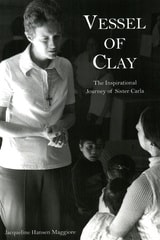
Vessel of Clay
The Inspirational Journey of Sister CarlaJacqueline Hansen Maggiore
University of Scranton Press, 2010
Jacqueline Hansen Maggiore presents in this volume the biography of her lifelong friend Carol Piette, known throughout Chile and El Salvador as Sister Carla. Drawing from the memories of those who knew her and excerpts from her letters and diaries, Vessel of Clay chronicles Sister Carla’s extraordinary life, highlighting her dedication to the poor of Latin America but also revealing her struggles with self-doubt and emotional frailty. Vessel of Clay will appeal to both lay and religious readers interested in peace and social justice, spiritual formation and development, women’s issues, liberation theology, and mission service.
Violence, the Sacred, and Things Hidden
A Discussion with René Girard at Esprit (1973)René Girard
Michigan State University Press, 2022

Voices of the Magi
Enchanted Journeys in Southeast BrazilSuzel Reily
University of Chicago Press, 2002
Focusing on urban folias, Suzel Ana Reily shows how participants use the ritual journeys and musical performances of the folias to create sacred spheres distinct from, yet intimately related to, their everyday world. Reily calls this practice "enchantment" and argues that it allows the folia communities to temporarily make the social ideals of mutual reciprocity and equality embodied in their religious beliefs a reality. The contrast between their ritual experiences and the daily lives of these impoverished workers, in turn, reinforces the religious convictions of these devotees of the music of the Magi.
Vyšší Brod 42
A Unique Music Source from Pre-Hussite BohemiaLenka Hlávková, Jan Ciglbauer, and Pavel Kodýtek
Karolinum Press, 2025
Manuscript 42 from the Cistercian monastery in Vyšší Brod (Hohenfurth), Czech Republic, compiled in 1410, today represents one of the most important music sources from medieval Bohemia, providing insight into the rich and varied liturgical and devotional repertory circulating in Central Europe just before the outbreak of the Hussite Wars in 1419. The manuscript’s collection of monophonic and polyphonic songs, one of the oldest ones in Europe, serves as a starting point for studies of the Latin mensural cantio, an important late medieval music form and cultural phenomenon.
In Vyšší Brod 42, three extensive studies explore various aspects of the manuscript and its contents. In the first, Jan Ciglbauer examines its creation process and the involvement of various scribes in noting down new texts and melodies. In the second, Hana Vlhová-Wörner delves into the variety of late medieval chant compositions contained within it and the relationship of this truly novel repertory to the formalized Cistercian liturgy. The last chapter, co-authored by Lenka Hlávková and Pavel Kodýtek, scrutinizes the manuscript’s remarkable collection of spiritual songs and identifies their inscription as “snapshots” of a vivid oral tradition.
Together, these three studies bring a new perspective on musical life in Cistercian monasteries in Central Europe in the late Middle Ages, a topic that has received very little exploration until now.