Results by title
123 books match the query 'Religious life' and 3 start with v
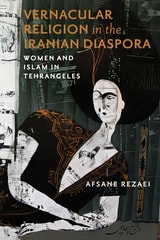
Vernacular Religion in the Iranian Diaspora
Women and Islam in TehrangelesAfsane Rezaei
University of Wisconsin Press, 2026
With nearly half a million Iranian Americans living in and around Los Angeles, Southern California is home to more Iranians than anywhere outside Iran itself. Although many community members identify as secular, stereotypes characterize Iranian Americans, like other populations from Muslim-majority countries, as pejoratively religious and culturally suspect. For Iranian American women who do practice Islam, navigating their religious, ethnic, and political identities, on both personal and communal levels, is complex and fraught, influenced not only by racialized discourses but also by intra-community narratives that equate Islamic practice with the authoritarian state in Iran.
Folklorist Afsane Rezaei applies theories of vernacular religion to explore how these women shape their religious identities in this particularly delicate diasporic context, how they engage with external imaginaries in their practices and narratives, and how they develop a sense of agency over their religious identification. For many, Islamic religiosity in the diaspora is an integrated and embodied aspect of folklife, closely tied to the sense of self, social networks, and communal identity, and is negotiated and reimagined in everyday, improvised, and sometimes contradictory ways. Rezaei’s detailed, respectful ethnography reaches beyond the binary of piety and resistance and offers new and nuanced understandings of Iranian American lived religion.
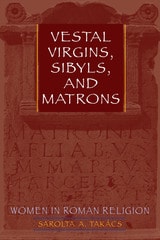
Vestal Virgins, Sibyls, and Matrons
Women in Roman ReligionBy Sarolta A. Takács
University of Texas Press, 2007
Roman women were the procreators and nurturers of life, both in the domestic world of the family and in the larger sphere of the state. Although deterred from participating in most aspects of public life, women played an essential role in public religious ceremonies, taking part in rituals designed to ensure the fecundity and success of the agricultural cycle on which Roman society depended. Thus religion is a key area for understanding the contributions of women to Roman society and their importance beyond their homes and families.
In this book, Sarolta A. Takács offers a sweeping overview of Roman women's roles and functions in religion and, by extension, in Rome's history and culture from the republic through the empire. She begins with the religious calendar and the various festivals in which women played a significant role. She then examines major female deities and cults, including the Sibyl, Mater Magna, Isis, and the Vestal Virgins, to show how conservative Roman society adopted and integrated Greek culture into its mythic history, artistic expressions, and religion. Takács's discussion of the Bona Dea Festival of 62 BCE and of the Bacchantes, female worshippers of the god Bacchus or Dionysus, reveals how women could also jeopardize Rome's existence by stepping out of their assigned roles. Takács's examination of the provincial female flaminate and the Matres/Matronae demonstrates how women served to bind imperial Rome and its provinces into a cohesive society.
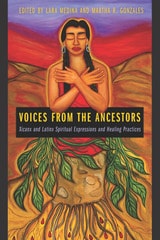
Voices from the Ancestors
Xicanx and Latinx Spiritual Expressions and Healing PracticesEdited by Lara Medina and Martha R. Gonzales
University of Arizona Press, 2019
This wisdom is based on the authors’ oral traditions, research, intuitions, and lived experiences—wisdom inspired by, and created from, personal trajectories on the path to spiritual conocimiento, or inner spiritual inquiry. This conocimiento has reemerged over the last fifty years as efforts to decolonize lives, minds, spirits, and bodies have advanced. Yet this knowledge goes back many generations to the time when the ancestors understood their interconnectedness with each other, with nature, and with the sacred cosmic forces—a time when the human body was a microcosm of the universe.
Reclaiming and reconstructing spirituality based on non-Western epistemologies is central to the process of decolonization, particularly in these fraught times. The wisdom offered here appears in a variety of forms—in reflective essays, poetry, prayers, specific guidelines for healing practices, communal rituals, and visual art, all meant to address life transitions and how to live holistically and with a spiritual consciousness for the challenges of the twenty-first century.