Results by title
397 books match the query 'Rome' and 8 start with v
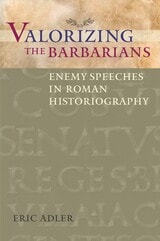
Valorizing the Barbarians
Enemy Speeches in Roman HistoriographyBy Eric Adler
University of Texas Press, 2011
With the growth of postcolonial theory in recent decades, scholarly views of Roman imperialism and colonialism have been evolving and shifting. Much recent discussion of the topic has centered on the ways in which ancient Roman historians consciously or unconsciously denigrated non-Romans. Similarly, contemporary scholars have downplayed Roman elite anxiety about their empire's expansion.
In this groundbreaking new work, Eric Adler explores the degree to which ancient historians of Rome were capable of valorizing foreigners and presenting criticisms of their own society. By examining speeches put into the mouths of barbarian leaders by a variety of writers, he investigates how critical of the empire these historians could be.
Adler examines pairs of speeches purportedly delivered by non-Roman leaders so that the contrast between them might elucidate each writer's sense of imperialism. Analyses of Sallust's and Trogus's treatments of the Eastern ruler Mithradates, Polybius's and Livy's speeches from Carthage's Hannibal, and Tacitus's and Cassius Dio's accounts of the oratory of the Celtic warrior queen Boudica form the core of this study. Adler supplements these with examinations of speeches from other characters, as well as contextual narrative from the historians. Throughout, Adler wrestles with broader issues of Roman imperialism and historiography, including administrative greed and corruption in the provinces, the treatment of gender and sexuality, and ethnic stereotyping.
Vandals to Visigoths
Rural Settlement Patterns in Early Medieval SpainKaren Eva Carr
University of Michigan Press, 2002
Vandals to Visigoths uses archaeological survey data as a springboard to a theoretical discussion of rural survival strategies in the non-industrial world and the ways in which these strategies are affected by government actions. Carr draws on historical, archaeological, and ethnographic comparanda to conclude that the larger, more powerful Roman government was more advantageous for the rural poor than the weaker Vandal and Visigothic regimes. Though Carr agrees that the lives of the rural people and the free slaves were miserable, she shows through her data and theory that they became even more wretched after the decline of the empire.
Vandals to Visigoths will appeal to historians of Rome, as well as of Early Medieval Europe and Spain. Anthropologists, economists, and political scientists who study Late Antiquity and the medieval period will also be interested, as it discusses the broader implications of the role of government in the lives of early medieval Spain's subjects.
Karen Eva Carr is Associate Professor of History, Portland State University.
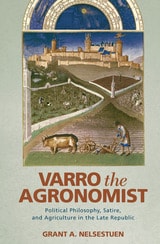
Varro the Agronomist
Political Philosophy, Satire, and Agriculture in the Late RepublicGrant A. Nelsestuen
The Ohio State University Press, 2015
On one level, Varro’s treatise presents an innovative account of the Roman farm, which rationalizes new agricultural and pastoral opportunities for contemporary elite owners of large-scale estates. But on another level, this bold agronomical vision associates the farm’s different spheres with distinct areas under Roman control, thereby allegorizing Rome’s empire on the model of a farm. Nelsestuen argues that Varro’s treatise thus provides his contemporaries with a model for governing the Roman state, anticipates Augustus’ subsequent transformation of Roman dominion into a coherent territorial state, and offers an ancient theory of imperialism.
Shedding new light on the only completely extant work of a much-celebrated but ill-understood figure, Varro the Agronomist has much to offer to those interested in Latin literature—especially, Cicero and Vergil—as well as on the political dimensions of intellectual life in first-century bce Rome, ancient imperialism, and Roman political philosophy.
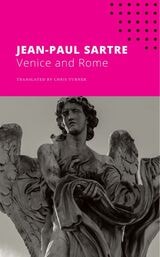
Venice and Rome
Jean-Paul Sartre
Seagull Books, 2021
Iconic French novelist, playwright, and essayist Jean-Paul Sartre is widely recognized as one of the most important philosophers of the twentieth century, and his work has remained relevant and thought-provoking through the decades. The Seagull Sartre Library now presents some of his most incisive philosophical, cultural, and literary critical essays in twelve newly designed and affordable editions.
“Venice speaks to us; this false witness’s voice, shrill at times, whispering at others, broken by silences, is its voice.” In these three moving short pieces, we discover Sartre as a master stylist, lyrically describing his time in two bewitching eternal cities—Venice and Rome. “Antiquity,” Sartre writes, “is alive in Rome, with a hate-filled, magical life.”
Vergil's Aeneid and the Roman Self
Subject and Nation in Literary DiscourseYasmin Syed
University of Michigan Press, 2005
Now in Paper!
As the most widely read Roman poem in antiquity, the Aeneid was indelibly burned into the memories of generations of Roman school children. In this book, author Yasmin Syed analyzes the formative influence the poem exerted on its broad audience of educated Romans. Syed analyzes Roman pedagogy and reading practices as well as ancient beliefs about the powerful influence of poetry. Her study considers these cultural components together with the aspects of identity that define the Aeneid’s characters. By doing so, Syed shows how Vergil’s ancient audiences saw themselves—their experiences, goals, and values—reflected in the poem and guided by it. In particular, Syed’s treatment of gender and ethnicity brings to light the key role of Vergil’s poem in the formation of Romanness.
Vergil, Philodemus, and the Augustans
Edited by David Armstrong, Jeffrey Fish, Patricia A. Johnston, and Marilyn B. Skinner
University of Texas Press, 2003
The Epicurean teacher and poet Philodemus of Gadara (c. 110-c. 40/35 BC) exercised significant literary and philosophical influence on Roman writers of the Augustan Age, most notably the poets Vergil and Horace. Yet a modern appreciation for Philodemus' place in Roman intellectual history has had to wait on the decipherment of the charred remains of Philodemus' library, which was buried in Herculaneum by the eruption of Vesuvius in 79 AD. As improved texts and translations of Philodemus' writings have become available since the 1970s, scholars have taken a keen interest in his relations with leading Latin poets.
The essays in this book, derived from papers presented at the First International Symposium on Philodemus, Vergil, and the Augustans held in 2000, offer a new baseline for understanding the effect of Philodemus and Epicureanism on both the thought and poetic practices of Vergil, Horace, and other Augustan writers. Sixteen leading scholars trace his influence on Vergil's early writings, the Eclogues and the Georgics, and on the Aeneid, as well as on the writings of Horace and others. The volume editors also provide a substantial introduction to Philodemus' philosophical ideas for all classicists seeking a fuller understanding of this pivotal figure.
Vestal Virgins, Sibyls, and Matrons
Women in Roman ReligionBy Sarolta A. Takács
University of Texas Press, 2007
Roman women were the procreators and nurturers of life, both in the domestic world of the family and in the larger sphere of the state. Although deterred from participating in most aspects of public life, women played an essential role in public religious ceremonies, taking part in rituals designed to ensure the fecundity and success of the agricultural cycle on which Roman society depended. Thus religion is a key area for understanding the contributions of women to Roman society and their importance beyond their homes and families.
In this book, Sarolta A. Takács offers a sweeping overview of Roman women's roles and functions in religion and, by extension, in Rome's history and culture from the republic through the empire. She begins with the religious calendar and the various festivals in which women played a significant role. She then examines major female deities and cults, including the Sibyl, Mater Magna, Isis, and the Vestal Virgins, to show how conservative Roman society adopted and integrated Greek culture into its mythic history, artistic expressions, and religion. Takács's discussion of the Bona Dea Festival of 62 BCE and of the Bacchantes, female worshippers of the god Bacchus or Dionysus, reveals how women could also jeopardize Rome's existence by stepping out of their assigned roles. Takács's examination of the provincial female flaminate and the Matres/Matronae demonstrates how women served to bind imperial Rome and its provinces into a cohesive society.
Virgil and Joyce
Nationalism and Imperialism in the <i>Aeneid</i> and <i>Ulysses</i>Randall J. Pogorzelski
University of Wisconsin Press, 2016
Joyce wrote Ulysses during the Irish War of Independence, when militants, politicians, and intellectuals were attempting to create a new Irish nation. Virgil wrote the Aeneid when, in the wake of decades of civil war, Augustus was founding what we now call the Roman Empire. Randall Pogorzelski applies modern theories of nationalism, intertextuality, and reception studies to illuminate how both writers confronted issues of nationalism, colonialism, political violence, and freedom during times of crisis.