Results by title
424 books match the query 'Russian & Soviet' and 6 start with v
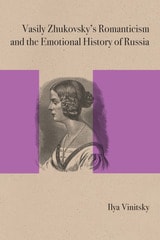
Vasily Zhukovsky's Romanticism and the Emotional History of Russia
Ilya Vinitsky
Northwestern University Press, 2015
The first major study in English of Vasily Zhukovsky (1783–1852)—poet, translator of German romantic verse, and mentor of Pushkin—this book brings overdue attention to an important figure in Russian literary and cultural history. Vinitsky’s “psychological biography” argues that Zhukovsky very consciously set out to create for himself an emotional life reflecting his unique brand of romanticism, different from what we associate with Pushkin or poets such as Byron or Wordsworth. For Zhukovsky, ideal love was harmonious, built on a mystical foundation of spiritual kinship. Vinitsky shows how Zhukovksy played a pivotal role in the evolution of ideas central to Russia’s literary and cultural identity from the end of the eighteenth century into the decades following the Napoleonic Wars.
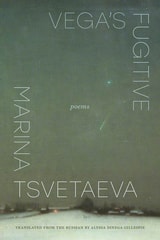
Vega’s Fugitive
PoemsMarina Tsvetaeva, Alyssa Dinega Gillespie
Northwestern University Press, 2027
An incandescent new collected translation of virtuosic Russian poet Marina Tsvetaeva
Marina Tsvetaeva needs no introduction—a poetic genius, she is one of the most gifted and original poets in the Russian literary canon. All the verse genres Tsvetaeva employed, including lyric poems, poetic cycles, and long narrative poems, are represented here, in Vega’s Fugitive, translated by award-winning translator and Tsvetaeva scholar Alyssa Dinega Gillespie. Tsvetaeva’s poems, some never-before translated, appear in potent English versions that are both highly faithful to the originals and lyrical in their own right. As a result, Tsvetaeva’s verse—with its driving rhythms, striking sound plays, and searing insights—is reborn in a new language and new constellations of meaning. These poems dive fearlessly into themes of place, time, and distance; the female body; the poet’s fate; desire and longing; grief, loss, and immortality. Vega’s Fugitive makes Tsvetaeva’s masterful work not just accessible, but unforgettable for English-language readers around the world.
Versification and Authorship Attribution
Petr Plechác
Karolinum Press, 2022
The technique known as contemporary stylometry uses different methods, including machine learning, to discover a poem’s author based on features like the frequencies of words and character n-grams. However, there is one potential textual fingerprint stylometry tends to ignore: versification, or the very making of language into verse. Using poetic texts in three different languages (Czech, German, and Spanish), Petr Plecháč asks whether versification features like rhythm patterns and types of rhyme can help determine authorship. He then tests his findings on two unsolved literary mysteries. In the first, Plecháč distinguishes the parts of the Elizabethan verse play The Two Noble Kinsmen written by William Shakespeare from those written by his coauthor, John Fletcher. In the second, he seeks to solve a case of suspected forgery: how authentic was a group of poems first published as the work of the nineteenth-century Russian author Gavriil Stepanovich Batenkov? This book of poetic investigation should appeal to literary sleuths the world over.
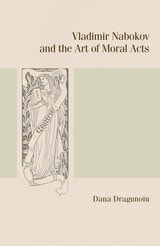
Vladimir Nabokov and the Art of Moral Acts
Dana Dragunoiu
Northwestern University Press, 2022
This book shows how ethics and aesthetics interact in the works of one of the most celebrated literary stylists of the twentieth century: the Russian American novelist Vladimir Nabokov. Dana Dragunoiu reads Nabokov’s fictional worlds as battlegrounds between an autonomous will and heteronomous passions, demonstrating Nabokov’s insistence that genuinely moral acts occur when the will triumphs over the passions by answering the call of duty.
Dragunoiu puts Nabokov’s novels into dialogue with the work of writers such as Alexander Pushkin, William Shakespeare, Leo Tolstoy, and Marcel Proust; with Kantian moral philosophy; with the institution of the modern duel of honor; and with the European traditions of chivalric literature that Nabokov studied as an undergraduate at Cambridge University. This configuration of literary influences and philosophical contexts allows Dragunoiu to advance an original and provocative argument about the formation, career, and legacies of an author who viewed moral activity as an art, and for whom artistic and moral acts served as testaments to the freedom of the will.
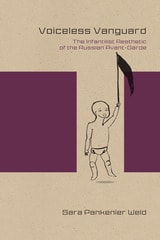
Voiceless Vanguard
The Infantilist Aesthetic of the Russian Avant-GardeSara Pankenier Weld
Northwestern University Press, 2014
Voiceless Vanguard: The Infantilist Aesthetic of the Russian Avant-Garde offers a new approach to the Russian avant-garde. It argues that central writers, artists, and theorists of the avant-garde self-consciously used an infantile aesthetic, as inspired by children’s art, language, perspective, and logic, to accomplish the artistic renewal they were seeking in literature, theory, and art. It treats the influence of children’s drawings on the Neo-Primitivist art of Mikhail Larionov, the role of children’s language in the Cubo-Futurist poetics of Aleksei Kruchenykh, the role of the naive perspective in the Formalist theory of Viktor Shklovsky, and the place of children’s logic and lore in Daniil Kharms’s absurdist writings for children and adults. This interdisciplinary and cultural study not only illuminates a rich period in Russian culture but also offers implications for modernism in a wider Western context, where similar principles apply.
Václav Havel’s Meanings
His Key Words and Their LegacyEdited by David Danaher and Kieran Williams
Karolinum Press, 2022
No one in Czech politics or culture could match the international stature of Václav Havel at the time of his death in 2011. In the years since his passing, his legacy has only grown, as developments in the Czech Republic and elsewhere around the world continue to show the importance of his work and writing against a range of political and social ills, from autocratic brutality to messianic populism.
This book looks squarely at the heart of Havel’s legacy: the rich corpus of texts he left behind. It analyzes the meanings of key concepts in Havel’s core vocabulary: truth, power, civilsociety, home, appeal, indifference, hotspot, theatre, prison, and responsibility. Where do these concepts appear in Havel’s oeuvre? What part do they play in his larger intellectual project? How might we understand Havel’s focus on these concepts as a centerpiece of his contribution to contemporary thought? How does Havel’s particular perspective on the meaning of these concepts speak to us in the here and now? The ten contributors use a variety of methodological tools to examine the meaning of these concepts, drawing on a diversity of disciplines: political science and political philosophy, historical and cultural analysis, discourse/textual analysis, and linguistic-corpus analysis.