Results by title
74 books match the query 'Russian literature' and 2 start with v

Vasily Zhukovsky's Romanticism and the Emotional History of Russia
Ilya Vinitsky
Northwestern University Press, 2015
The first major study in English of Vasily Zhukovsky (1783–1852)—poet, translator of German romantic verse, and mentor of Pushkin—this book brings overdue attention to an important figure in Russian literary and cultural history. Vinitsky’s “psychological biography” argues that Zhukovsky very consciously set out to create for himself an emotional life reflecting his unique brand of romanticism, different from what we associate with Pushkin or poets such as Byron or Wordsworth. For Zhukovsky, ideal love was harmonious, built on a mystical foundation of spiritual kinship. Vinitsky shows how Zhukovksy played a pivotal role in the evolution of ideas central to Russia’s literary and cultural identity from the end of the eighteenth century into the decades following the Napoleonic Wars.
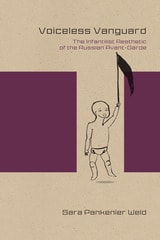
Voiceless Vanguard
The Infantilist Aesthetic of the Russian Avant-GardeSara Pankenier Weld
Northwestern University Press, 2014
Voiceless Vanguard: The Infantilist Aesthetic of the Russian Avant-Garde offers a new approach to the Russian avant-garde. It argues that central writers, artists, and theorists of the avant-garde self-consciously used an infantile aesthetic, as inspired by children’s art, language, perspective, and logic, to accomplish the artistic renewal they were seeking in literature, theory, and art. It treats the influence of children’s drawings on the Neo-Primitivist art of Mikhail Larionov, the role of children’s language in the Cubo-Futurist poetics of Aleksei Kruchenykh, the role of the naive perspective in the Formalist theory of Viktor Shklovsky, and the place of children’s logic and lore in Daniil Kharms’s absurdist writings for children and adults. This interdisciplinary and cultural study not only illuminates a rich period in Russian culture but also offers implications for modernism in a wider Western context, where similar principles apply.