Results by title
206 books match the query 'Study & Teaching' and 3 start with v

Vision and Textuality
Stephen Melville and Bill Readings, eds.
Duke University Press, 1995
With essays by Rosalind Krauss, Hal Foster, Norman Bryson, Victor Burgin, Martin Jay, Louis Marin, Thomas Crow, Griselda Pollock, and others, the volume is organized into sections devoted to the discipline of art history, the implications of semiotics, the new cultural history of art, and the impact of psychoanalysis. The works discussed in these essays range from Rembrandt’s Danae to Jorge Immendorf’s Café Deutschland, from Vauxhall Gardens to Max Ernst, and from the Imagines of Philostratus to William Godwin’s novel Caleb Williams. Each section is preceded by a short introduction that offers further contexts for considering the essays that follow, while the editors’ general introduction presents an overall exploration of the relation between vision and textuality in a variety of both institutional and theoretical contexts. Among other issues, it examines the relevance of aesthetics, the current concern with modernism and postmodernism, and the possible development of new disciplinary formations in the humanities.
Contributors. Mieke Bal, John Bender, Norman Bryson, Victor Burgin, Thomas Crow, Peter de Bolla, Hal Foster, Michael Holly, Martin Jay, Rosalind Krauss, Françoise Lucbert, Louis Martin, Stephen Melville, Griselda Pollock, Bill Readings, Irit Rogoff, Bennet Schaber, John Tagg
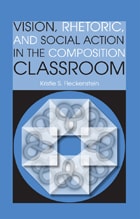
Vision, Rhetoric, and Social Action in the Composition Classroom
Kristie S. Fleckenstein
Southern Illinois University Press, 2009
In this innovative volume, Kristie S. Fleckenstein explores how the intersection of vision, rhetoric, and writing pedagogy in the classroom can help students become compassionate citizens who participate in the world as they become more critically aware of the world. Fleckenstein argues that all social action—behavior designed to increase human dignity, value, and quality of life—depends on a person’s repertoire of visual and rhetorical habits. To develop this repertoire in students, the author advocates the incorporation of visual habits—or ways of seeing—into a language-based pedagogical approach in the writing classroom. According to Fleckenstein, interweaving the visual and rhetorical in composition pedagogy enables students to more readily perceive the need for change, while arming them with the abilities and desire to enact it.
The author addresses social action from the perspective of three visual habits: spectacle, which fosters disengagement; animation, or fusing body with meaning; and antinomy, which invites the invention of new realities. Fleckenstein then examines the ways in which particular visual habits interact with rhetorical habits and with classroom methods, resulting in the emergence of various forms of social action. To enhance the understanding of the concepts she discusses, the author represents the intertwining relationships of vision, rhetoric, and writing pedagogy graphically as what she calls symbiotic knots. In tracing the modes of social action privileged by a visual habit and a teacher’s pedagogical choices, Fleckenstein attends particularly to the experiences of students who have been traditionally barred from participation in the public sphere because of gender, race, or class. The book culminates in a call for visually and rhetorically robust writing pedagogies.
In Vision, Rhetoric, and Social Action in the Composition Classroom, Fleckenstein combines classic methods of rhetorical teaching with fresh perspectives to provide a unique guide for initiating important improvements in teaching social action. The result is a remarkable volume that empowers teachers to best inspire students to take part in their world at that most crucial moment when they are discovering it.
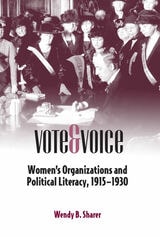
Vote and Voice
Women's Organizations and Political Literacy, 1915-1930Wendy B. Sharer
Southern Illinois University Press, 2007
Vote and Voice is the first book-length study to address the writing and speaking practices of members of women’s political organizations in the decade after the suffrage movement. During those years, women still did not have power within deliberative and administrative organs of politics, despite their recent enfranchisement. Because they were largely absent from diplomatic circles and political parties, post-suffrage women’s organizations developed rhetorical practices of public discourse to push for reform within traditional politics.
Vote and Voice is historically significant as well as pedagogically beneficial for instructors who connect rhetorical education with public participation by integrating writing and speaking skills into a curriculum that aims to prepare educated students and active citizens.