Results by title
660 books match the query 'Texas' and 6 start with v
Vascular Plants of Texas
A Comprehensive Checklist Including Synonymy, Bibliography, and IndexBy Stanley D. Jones, Joseph K. Wipff, and Paul M. Montgomery
University of Texas Press, 1997
Everyone with a professional interest in the flora of Texas will welcome this checklist of the vascular plants. This comprehensive list also includes crops, persistent perennials, and naturalized plants and encompasses over 1,000 changes to the previous (Hatch, 1990) checklist. The authors have arranged this checklist phylogenetically by classes following the Cronquist system.
Several features make this checklist especially useful. Chief among them is the relative synonymy (name history). An extensive index makes current classification and correct nomenclature readily accessible, while the botanical bibliography is the most extensive ever compiled for Texas. The authors also note which plants have been listed as threatened or endangered by the Texas Organization of Endangered Species, which are designated as Federal Noxious Weeds, and which have been chosen as state tree, flower, fruit, etc. by the Texas Legislature.

Vengeance Is Mine
The Scandalous Love Triangle That Triggered the Boyce-Sneed FeudBill Neal
University of North Texas Press, 2011

Venomous Snakes of Texas
A Field GuideBy Andrew H. Price
University of Texas Press, 2009
Texas has about one hundred twenty native species and subspecies of snakes, fifteen of which are venomous. Since 1950, Texans have turned to the Poisonous Snakes of Texas pamphlet series published by the Texas Parks and Wildlife Department for help in identifying these snakes and for expert advice on preventing and treating snakebite. Venomous Snakes of Texas, a thoroughly revised and updated edition of Poisonous Snakes, carries on this tradition as a one-stop, all-you-need-to-know guide to Texas's rattlesnakes, copperheads, cottonmouths, and coral snakes.
In this authoritative field guide, you'll find:
- Full-color photographs and a county-by-county distribution map for each species.
- Each species' common and scientific name, description, look-alikes, and a summary sketch of its habitat, behavior, reproduction, venom characteristics, predator-prey relationships, and fossil record.
- Up-to-date advice on recognizing venomous snakes and preventing and treating snakebite, both at home and in the field.
- A glossary of terms and an extensive bibliography.
A special feature of this guide is an expanded treatment of the ecological and evolutionary context in which venomous snakes live, which supports Price's goal "to lessen the hatred and fear and to increase the understanding, the respect, and even the appreciation with which venomous snakes should be regarded."
Violence in the Hill Country
The Texas Frontier in the Civil War EraBy Nicholas Keefauver Roland
University of Texas Press, 2021
2022 Ramirez Family Award for Most Significant Scholarly Book, Texas Institute of Letters
An in-depth history of the Civil War in the Texas Hill Country, this book examines patterns of violence on the Texas frontier to illuminate white Americans’ cultural and political priorities in the nineteenth century.
In the nineteenth century, Texas’s advancing western frontier was the site of one of America’s longest conflicts between white settlers and native peoples. The Texas Hill Country functioned as a kind of borderland within the larger borderland of Texas itself, a vast and fluid area where, during the Civil War, the slaveholding South and the nominally free-labor West collided. As in many borderlands, Nicholas Roland argues, the Hill Country was marked by violence, as one set of peoples, states, and systems eventually displaced others.
In this painstakingly researched book, Roland analyzes patterns of violence in the Texas Hill Country to examine the cultural and political priorities of white settlers and their interaction with the century-defining process of national integration and state-building in the Civil War era. He traces the role of violence in the region from the eve of the Civil War, through secession and the Indian wars, and into Reconstruction. Revealing a bitter history of warfare, criminality, divided communities, political violence, vengeance killings, and economic struggle, Roland positions the Texas Hill Country as emblematic of the Southwest of its time.
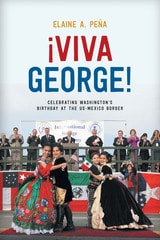
Viva George!
Celebrating Washington's Birthday at the US-Mexico BorderBy Elaine A. Peña
University of Texas Press, 2020
For 120 years, residents of the cross-border community of Laredo/Nuevo Laredo have celebrated George Washington's birthday together, and this account reveals the essential political work of a time-honored civic tradition.
Since 1898, residents of Laredo, Texas, and Nuevo Laredo, Tamaulipas, have reached across the US-Mexico border to celebrate George Washington's birthday. The celebration can last a whole month, with parade goers reveling in American and Mexican symbols; George Washington saluting; and “Pocahontas” riding on horseback. An international bridge ceremony, the heart and soul of the festivities, features children from both sides of the border marching toward each other to link the cities with an embrace. ¡Viva George! offers an ethnography and a history of this celebration, which emerges as both symbol and substance of cross-border community life. Anthropologist and Laredo native Elaine A. Peña shows how generations of border officials, civil society organizers, and everyday people have used the bridge ritual to protect shared economic and security interests as well as negotiate tensions amid natural disasters, drug-war violence, and immigration debates. Drawing on previously unknown sources and extensive fieldwork, Peña finds that border enactments like Washington's birthday are more than goodwill gestures. From the Rio Grande to the 38th Parallel, they do the meaningful political work that partisan polemics cannot.

Voice Lessons
By Alice Embree
University of Texas Press, 2021
Voice Lessons explores the rich personal and political terrain of Alice Embree, a 1960s activist and convert to the women’s liberation movement of the 1970s, bringing a woman’s perspective to a transformational time in US history. This riveting memoir traces the author’s roots in segregated Austin and her participation in efforts to integrate the University of Texas. It follows her antiwar activism from a vigil in front of President Lyndon Johnson’s ranch in 1965 to a massive protest after the shootings at Kent State in 1970. Embree’s activism brought her and the Students for a Democratic Society into conflict with Frank Erwin, the powerful chairman of the UT Board of Regents, and inspired a campus free speech movement. She recounts her experiences living in New York during the tumultuous years of 1968 and 1969, including the Columbia University strike and the Woodstock music festival. She also tells about protesting at the Chicago Democratic Convention, her interactions with Yippies and poets, and her travels to Chile, Cuba, and Mexico. Embree highlights the radical roots of the women’s liberation movement in Austin and the audacious women’s community that challenged gender roles, fought for reproductive justice, and inspired a lifetime of activism.