Results by title
967 books match the query 'Theater' and 14 start with v
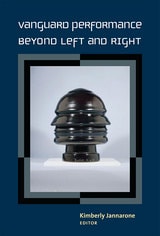
Vanguard Performance Beyond Left and Right
Kimberly Jannarone, Editor
University of Michigan Press, 2015
Vasari on Theatre
Thomas A. Pallen
Southern Illinois University Press, 1999
In the process of creating the massive work that eventually became Lives of the Most Eminent Painters, Sculptors, and Architects, painter and scholar Giorgio Vasari (1511–1574) spent much of the mid-sixteenth century traveling throughout Italy, meeting Renaissance artists and writing about their lives and works.
From this imposing source, Thomas A. Pallen has created a compendium of theatrical references augmented by related modern Italian scholarship. Vasari's Lives—daunting because of its sheer magnitude—has remained relatively obscure to English-speaking theatre historians. To introduce the numerous scenographic references of this great work to the English-speaking audience, Pallen provides new translations of all relevant passages, as well as a table of cross-references to the principal editions of Vasari in both English and Italian. And because Vasari often omitted important information, Pallen annotates the text, providing important names, places, and historical background.
Essentially, Pallen divides Vasari's work into four categories: triumphs and pageantry, ingegni for mystery plays and festivals, theatrical scenery, and miscellanea and lacunae. Although triumphs and pageantry were not directly theatrical, they were executed by many of the same artists who worked on theatrical productions and either used or introduced many Renaissance Italian theatrical techniques. The works described here range from tableaux vivants and other forms of street decoration to fireworks displays.
While Vasari did not personally know the work of either Filippo Brunelleschi or Francesco d'Angelo (called Cecca), he discusses their inventions for staging mystery plays and street festivals; indeed, Pallen shows how the work of these two artists paved the way for all later Renaissance scenography.
Pallen then deals with Vasari's references to and descriptions of the theatrical scenery and lighting effects of his time and the artists who created them. In accordance with the schema developed by Elena Povoledo, Pallen leads the reader through the evolution of scenographic thought and practice from the elementary work of Girolamo Genga to the advanced settings created by Vasari himself.
Vaudeville Humor
The Collected Jokes, Routines, and Skits of Ed LowryEdited with an Introduction by Paul M. Levitt
Southern Illinois University Press, 2006
Vaudeville Humor: The Collected Jokes, Routines, and Skits of Ed Lowry contains vaudeville jokes, skits, and routines from the first three decades of the twentieth century originally compiled by comedian Ed Lowry (1896–1983). Although occasionally found in bits and pieces in anthologies and in some period dramatic comedies, vaudeville humor has never before been available in one collection—performers rarely if ever kept a record of their jokes and routines. Fortunately, Ed Lowry was an inveterate collector. He kept copious notebooks of jokes and routines that he not only commissioned but also stole from other comics, clipped from newspapers, and copied from now defunct popular magazines of the day.
Editor Paul M. Levitt has reorganized the material into categories that preserve some of the flavor of Lowry’s scrapbooks yet provide for finer distinctions. Part one, “Jokes,” is organized by subject matter and cataloged by genre, dialects, and wordplay. From “Accidents” to “Work,” this exhaustive catalog of humor features over one thousand jokes with topics that range from city slickers and country hicks through midgets and old maids to Swedes and tattoos. Part two, “MC Material: Biz, Jokes, Routines, and Skits” is germane to the job of master of ceremonies, routines, and skits. It features topics from fractured fairy tales to stuttering. Part three, an appendix, “Ed Lowry Laffter,”reproduces a privately published collection that is now a rare collector’s item.
“Although some of the jokes can undoubtedly be found in other places,” explains Levitt in his introduction, “I know of no source as rich as this one for the twenties and thirties, a period so abundant in humor that for years afterward it fueled radio, cinema, and television.”
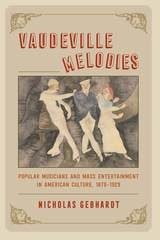
Vaudeville Melodies
Popular Musicians and Mass Entertainment in American Culture, 1870-1929Nicholas Gebhardt
University of Chicago Press, 2017
In Vaudeville Melodies, Nicholas Gebhardt introduces us to the performers, managers, and audiences who turned disjointed variety show acts into a phenomenally successful business. First introduced in the late nineteenth century, by 1915 vaudeville was being performed across the globe, incorporating thousands of performers from every branch of show business. Its astronomical success relied on a huge network of theatres, each part of a circuit and administered from centralized booking offices. Gebhardt shows us how vaudeville transformed relationships among performers, managers, and audiences, and argues that these changes affected popular music culture in ways we are still seeing today. Drawing on firsthand accounts, Gebhardt explores the practices by which vaudeville performers came to understand what it meant to entertain an audience, the conditions in which they worked, the institutions they relied upon, and the values they imagined were essential to their success.
Verdi's Theater
Creating Drama through MusicGilles de Van
University of Chicago Press, 1998
Although melodrama tends to dominate Verdi's early work and musical drama his later, both aesthetics are woven into all his operas: musical drama is already present in Ernani (1844), and melodrama is still present in Otello (1887). Indeed, much of the interest and originality of Verdi's operas lies in his adherence to both these contradictory systems, allowing the composer/dramatist to be simultaneously classical and modern, traditionalist and innovator.

Verdi’s Aida
The History of an Opera in Letters and DocumentsTranslated by Hans Busch
University of Minnesota Press, 1978
Verdi's Aida was first published in 1978. Minnesota Archive Editions uses digital technology to make long-unavailable books once again accessible, and are published unaltered from the original University of Minnesota Press editions.
Viewers in Distress
Race, Gender, Religion, and Avant-Garde Performance at the Turn of the Twenty-First CenturyStefka G. Mihaylova
University of Michigan Press, 2023
Honorable Mention: American Society for Theatre Research Barnard Hewitt Award | November 8, 2024
Conventional notions of avant-garde art suggest innovative artists rebelling against artistic convention and social propriety, shocking unwilling audiences into new ways of seeing and living. Viewers in Distress tells a different story. Beginning in the tumultuous 1990s, after the fall of the Berlin Wall and in the wake of the Los Angeles riots, rebellious spectators in American and British theaters broke with theater decorum and voiced their radical interpretations of shows that were not meant to be radical. In doing so, audiences tried to understand the complex racial, gender, and religious politics of their times, while insisting that liberal societies fulfill their promise of dignity for all. Stefka Mihaylova argues that such non-conforming viewing amounts to an avant-garde of its own: a bold reimagining of how we live together and tell stories of our lives together, aimed to achieve liberalism’s promise. In telling this story, she analyzes the production and reception politics of works by Susan-Lori Parks, Sarah Kane, Forced Entertainment, Gurpreet Kaur Bhatti, and Young Jean Lee, as well as non-theatrical controversies such as the conflict over Halloween costumes at Yale in 2015. At the core of spectators’ discontent, this book suggests, is an effort to figure out how to get along with people different from ourselves in the diverse U.S. and British societies in which we live.
Vignettes of the Deaf Character and Other Plays
Willy Conley
Gallaudet University Press, 2009
After spending three years in The National Theatre of the Deaf performing plays by hearing authors featuring hearing characters, Willy Conley realized that he wanted to write plays with deaf, hard-of- hearing, and hearing characters created from the Deaf perspective. Vignettes of the Deaf Character and Other Plays presents the result of his desire in twelve masterful plays.
“I write for the eye, always searching for live, mobile, provocative images that would fill and illuminate the entire stage space with the complexities, the pathos, and the humor involved when deaf and hearing cultures merge or collide,” writes Conley in his introduction. His plays depict a wide range of Deaf characters, including two brothers locked in a tragic rivalry familiar to families of all backgrounds; the broadly comedic Deaf Guide and hearing Techie interspersing laughs with cultural lessons in their Museum of Signs for People with Communication Disorders; Everyone searching for her Good Deeds as she faces imminent Death in an updating of the classic morality play, plus many others. These works explore a broad palette of circumstances with and without hearing characters, allowing Deaf characters to interact minus the direct influence that the dominant culture might exert. Vignettes of the Deaf Character and Other Plays presents the drama and passion of a master playwright who, through his perceptions, reveals facets of the Deaf character in all of us.
Violence and Grace
Exceptional Life between Shakespeare and ModernityNichole E. Miller
Northwestern University Press, 2014
In Violence and Grace, Nichole Miller establishes a conceptual link between early modern English drama and twentieth-century political theology, both of which emerge from the experience of political crisis. Miller’s analyses accordingly undertake to retrieve for political theology the relations between gender, sexuality, and the political aesthetics of violence on the early modern stage, addressing the plays of Marlowe, Middleton, and especially Shakespeare. In doing so, she expands our understanding of drama’s continuing theoretical impact.
Viral Performance
Contagious Theaters from Modernism to the Digital AgeMiriam Felton-Dansky
Northwestern University Press, 2018
Viral performance practices testify to the age-old—and ever renewed—instinct that when people gather, something spreads. Performance, an art form requiring and relying on live contact, renders such spreading visible, raises its stakes, and encodes it in theatrical form. The artists explored here rarely disseminate their ideas or gestures as directly as a viral marketer or a political movement would; rather, they undermine simplified forms of contagion while holding dialogue with the philosophical and popular discourses, old and new, that have surrounded viral culture.
Viral Performance argues that the concept of the viral is historically deeper than immediate associations with the contemporary digital landscape might suggest, and far more intimately linked to live performance

Viscous Performances
The Persistence of Creative Resistances in Neoliberal ChileMaría José Contreras Lorenzini
Duke University Press, 2026
Vision and Stagecraft in Sophocles
David Seale
University of Chicago Press, 1982
Von Balthasar & the Option for the Poor
Theodramatics in the Light of Liberation TheologyTodd Walatka
Catholic University of America Press, 2017
Vows, Veils, and Masks
The Performance of Marriage in the Plays of Eugene O'NeillBeth Wynstra
University of Iowa Press, 2023
Weaving in artifacts like advice columns, advertisements, theatrical reviews, and even the lived experiences of the actors who brought O’Neill’s wife characters to life, Beth Wynstra points to new ways of seeing and empathizing with those who are betrothed and new possibilities for reading marriage in literary and dramatic works. She suggests that the various ways women were, and still are, expected to divert from their true ambitions, desires, and selves in the service of appropriate wifely behavior is a detrimental performance and one at the crux of O’Neill’s marital tragedies. This book invites more inclusive and nuanced ways of thinking about the choices married characters must make and the roles they play, both on and off the stage.