Results by title
527 books match the query 'Translations into English' and 6 start with v

Visions Of Excess
Selected Writings, 1927-1939Georges Bataille
University of Minnesota Press, 1985
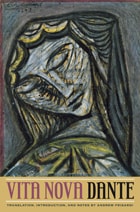
Vita Nova
Dante Alighieri, translated by Andrew Frisardi
Northwestern University Press, 2012
Receipient, 2013 Guggenheim Fellowship
Dante’s Vita Nova (circa 1292–1295) depicts the joys and sorrows, the discoveries and conflicts of Dante’s early love for Beatrice—who would achieve later and even greater fame in Commedia—starting with his first sighting of her and culminating in his prevision of Beatrice among the beatified in heaven. Award-winning translator and poet Andrew Frisardi channels the vigor and nuance of Dante’s first masterpiece for a modern audience.
The “little book,” as Dante calls it, consists of thirty-one lyric poems—mostly sonnets—embedded in a prose narrative, which both recounts an apparently autobiographical set of events also evoked in the poems and offers analysis of the poems’ construction in the medieval critical tradition of divisio textus, or division of the text. Dante selected poetry he had written before age twenty-eight or so and wrote the prose to shape it into a story. The poems anthologize Dante’s growth as a poet, from the influence of his earliest mentors to the stylistic and thematic breakthroughs of his poetic coming-of-age.
The interplay of poetry and prose in Vita Nova, along with the further distinction in the latter between autobiography and critical divisioni, presents a particular challenge for any translator. Frisardi faithfully voices the complex meter and rhyme schemes of the poetry while capturing the tone of each of the prose styles. His introduction and in-depth annotations provide additional context for the twenty-first-century reader.

Voices from Madagascar Voix de Madagascar
An Anthology of Contemporary Francophone Literature/Anthologie de littérature francophone contemporaineJacques Bourgeacq
Ohio University Press, 2001
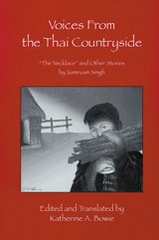
Voices from the Thai Countryside
Samruam Singh
University of Wisconsin Press, 2008
Set in northern Thailand during the mid-1970s, the stories in this collection capture a period of dramatic social and economic change. Amidst a setting of marketplaces and paddyfields, lemon trees and leaf-roofed houses, these vignettes offer revealing insights into the daily lives of ordinary villagers and hillspeople struggling to survive.
Voices of Change in the Spanish American Theater
An AnthologyEdited and translated by William I. Oliver
University of Texas Press, 1971
The aim of this anthology is to present a selection of plays that are representative of a fresh spirit and of societal pressures and changes in Spanish American culture. The plays shun the earlier realistic, sentimental, and melodramatic conventions of Spanish American theater. Instead, they reflect the tenor of the dramatic imagination of the mid-to-late twentieth century—an imagination that sought new forms and ways of expressing a new awareness of the Spanish American dilemma.
In selecting these plays, William I. Oliver looked for more than mere illustrations of these changes. As a practicing director and playwright, he sought works that are effective on the stage as well as on the page. As an editor and translator, he sought works “that could be translated culturally as well as linguistically.” The six plays in this varied and vigorous anthology are the measure of his success.
The plays included are The Day They Let the Lions Loose, by Emilio Carballido (Mexico); The Camp, by Griselda Gambaro (Argentina); The Library, by Carlos Maggi (Uruguay); In the Right Hand of God the Father, by Enrique Buenaventura (Colombia); The Mulatto’s Orgy, by Luisa Josefina Hernández (Mexico); and Viña: Three Beach Plays, by Sergio Vodánovic (Chile).
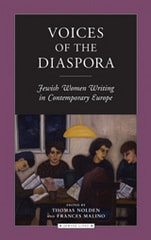
Voices of the Diaspora
Jewish Women Writing in Contemporary EuropeThomas Nolden
Northwestern University Press, 2005
At the same time, these writers address themes specific to their national contexts. Berlin-born Barbara Honigmann questions the possibility of Jewish life in the country responsible for the "final solution." Maghreb-born Marlène Amar and Reina Roffé address the experiences of displacement and emancipation as Sephardic women in Western, post-colonial societies. Clara Sereni describes how Jews in post-Fascist Italy reemerged with a self-assertiveness that troubled a society that had found comfort in amnesia. Ludmila Ulitskaya portrays a Jewish girlhood on the eve of Stalin's death empowered by the religious traditions of Jewish resistance.
From the unique perspective of women's literary voices, this volume reveals to English-speaking readers the extraordinary vivacity and diversity of European Jewry, and introduces them to a new generation of women writers.