Results by title
141 books match the query 'Turkey' and 3 start with v

Valor
StoriesMurathan Mungan, translated from the Turkish by Aron Aji and David Gramling
Northwestern University Press, 2022
Among Murathan Mungan’s signature works, Cenk Hikâyeleri (Valor: Stories) has long been considered a milestone of twentieth-century Turkish literature. The six short stories in the collection reflect the author’s multiethnic background (which includes Kurdish, Arab, and Turkish heritage) and represent his lush poetics, literary breadth, and sociopolitical commitments.
Valor reimagines Shahmaran, a mythical half‑human, half‑snake figure that commonly appears in the folklore of Turkey’s southeastern provinces. Legend interweaves with the contemporary realities of ethnicity, religious dogma, gender, and sexuality. Uncovering hidden narratives within a rich and complicated culture, Mungan’s stories depict self-realization and sexual awakening as they showcase one of Turkey’s most popular literary voices.

Violent Intimacies
The Trans Everyday and the Making of an Urban WorldAsli Zengin
Duke University Press, 2024
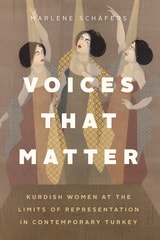
Voices That Matter
Kurdish Women at the Limits of Representation in Contemporary TurkeyMarlene Schäfers
University of Chicago Press, 2023
A fine-grained ethnography exploring the sociopolitical power of Kurdish women’s voices in contemporary Turkey.
“Raise your voice!” and “Speak up!” are familiar refrains that assume, all too easily, that gaining voice will lead to empowerment, healing, and inclusion for marginalized subjects. Marlene Schäfers’s Voices That Matter reveals where such assumptions fall short, demonstrating that “raising one’s voice” is no straightforward path to emancipation but fraught with anxieties, dilemmas, and contradictions. In its attention to the voice as form, this book examines not only what voices say but also how they do so, focusing on Kurdish contexts where oral genres have a long, rich legacy. Examining the social labor that voices carry out as they sound, speak, and resonate, Schäfers shows that where new vocal practices arise, they produce new selves and practices of social relations. In Turkey, recent decades have seen Kurdish voices gain increasing moral and political value as metaphors of representation and resistance. Women’s voices, in particular, are understood as potent means to withstand patriarchal restrictions and political oppression. By ethnographically tracing the transformations in how Kurdish women relate to and employ their voices as a result of these shifts, Schäfers illustrates how contemporary politics foster not only new hopes and desires but also create novel vulnerabilities as they valorize, elicit, and discipline voice in the name of empowerment and liberation.