Results by title
923 books match the query 'Urban' and 9 start with v
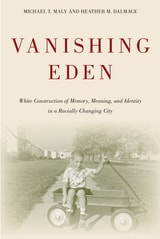
Vanishing Eden
White Construction of Memory, Meaning, and Identity in a Racially Changing CityMichael Maly
Temple University Press, 2015
For many whites, desegregation initially felt like an attack on their community. But how has the process of racial change affected whites’ understanding of community and race? In Vanishing Eden, Michael Maly and Heather Dalmage provide an intriguing analysis of the experiences and memories of whites who lived in Chicago neighborhoods experiencing racial change during the 1950s through the 1980s. They pay particular attention to examining how young people made sense of what was occurring, and how this experience impacted their lives.
Using a blend of urban studies and whiteness studies, the authors examine how racial solidarity and whiteness were created and maintained—often in subtle and unreflective ways. Vanishing Eden also considers how race is central to the ways social institutions such as housing, education, and employment function. Surveying the shifting social, economic, and racial contexts, the authors explore how race and class at local and national levels shaped the organizing strategies of those whites who chose to stay as racial borders began to change.
Venice
A Contested Bohemia in Los AngelesAndrew Deener
University of Chicago Press, 2012
Vice Patrol
Cops, Courts, and the Struggle over Urban Gay Life before StonewallAnna Lvovsky
University of Chicago Press, 2021
In Vice Patrol, Anna Lvovsky chronicles this painful story, tracing the tactics used to criminalize, profile, and suppress gay life from the 1930s through the 1960s, and the surprising controversies those tactics often inspired in court. Lvovsky shows that the vice squads’ campaigns stood at the center of live debates about not only the law’s treatment of queer people, but also the limits of ethical policing, the authority of experts, and the nature of sexual difference itself—debates that had often unexpected effects on the gay community’s rights and freedoms. Examining those battles, Vice Patrol enriches understandings of the regulation of queer life in the twentieth century and disputes about police power that continue today.

Vice Patrol
Cops, Courts, and the Struggle over Urban Gay Life before StonewallAnna Lvovsky
University of Chicago Press, 2021
In the mid-twentieth century, gay life flourished in American cities even as the state repression of queer communities reached its peak. Liquor investigators infiltrated and shut down gay-friendly bars. Plainclothes decoys enticed men in parks and clubs. Vice officers surveilled public bathrooms through peepholes and two-way mirrors.
In Vice Patrol, Anna Lvovsky chronicles this painful story, tracing the tactics used to criminalize, profile, and suppress gay life from the 1930s through the 1960s, and the surprising controversies those tactics often inspired in court. Lvovsky shows that the vice squads’ campaigns stood at the center of live debates about not only the law’s treatment of queer people, but also the limits of ethical policing, the authority of experts, and the nature of sexual difference itself—debates that had often unexpected effects on the gay community’s rights and freedoms. Examining those battles, Vice Patrol enriches understandings of the regulation of queer life in the twentieth century and disputes about police power that continue today.
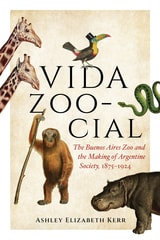
Vida Zoo-cial
The Buenos Aires Zoo and the Making of Argentine Society, 1875–1924Ashley Elizabeth Kerr
Vanderbilt University Press, 2025
Premio al Mejor Libro en Humanidades, Latin American Studies Association, Nineteenth-Century Section, 2026
In late nineteenth- and early twentieth‑century Buenos Aires, elites attempted to tackle growing poverty and social problems with a suite of social, educational, and medical reforms, hoping to make the city and larger nation more “modern” and “progressive” on the world stage. Known as the “social question,” this turn-of-the-century preoccupation with the future of the city and nation was undergirded by a larger set of social Darwinist beliefs about the biological and racial inferiority of immigrants and the working class, linking them to higher susceptibility to alcoholism, sexual deviancy, insanity, and disease.
In Vida Zoo-cial, Ashley Elizabeth Kerr argues that the Buenos Aires Zoo and its many animal species were an important tool in attempts to remake Argentinian society. Elites used the zoo’s physical spaces, programming, and visual and literary representations of its animals to try to educate and “improve” the masses, especially immigrants and the poor, but stopped short of supporting more radical social transformations. Drawing upon extensive archival research from the zoo’s archive, including correspondence, municipal reports, receipts, and employment records, as well as a range of literary and popular culture sources, Kerr records these efforts, which included enlisting lionesses as object lessons in proper motherhood and elephants as model immigrants. Although some projects were successful, Kerr also documents the many ways others went awry when the zoo's animals and the humans who came to see them failed to cooperate.
Vida Zoo-cial is not only a story about how the poor and working class resisted elite efforts for social reform founded upon racialized beliefs and pseudoscience, but also one that challenges readers to rethink the relationship between humans and non‑humans.
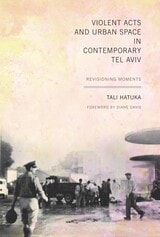
Violent Acts and Urban Space in Contemporary Tel Aviv
Revisioning MomentsBy Tali Hatuka
University of Texas Press, 2010
Violent acts over the past fifteen years have profoundly altered civil rituals, cultural identity, and the meaning of place in Tel Aviv. Three events in particular have shed light on the global rule of urban space in the struggle for territory, resources, and power: the assassination of Prime Minister Rabin in 1995 in the city council square; the suicidal bombing at the Dolphinarium Discothèque along the shoreline in 2001; and bombings in the Neve Shaanan neighborhood in 2003.
Tali Hatuka uses an interdisciplinary framework of urban theory and sociopolitical theory to shed light on the discourse regarding violent events to include an analysis of the physical space where these events take place. She exposes the complex relationships among local groups, the state, and the city, challenging the national discourse by offering a fresh interpretation of contesting forces and their effect on the urban environment.
Perhaps the most valuable contribution of this book is its critical assessment of the current Israeli reality, which is affected by violent events that continually alter the everyday life of its citizens. Although these events have been widely publicized by the media, there is scant literature focusing on their impact on the urban spaces where people live and meet. In addition, Hatuka shows how sociopolitical events become crucial defining moments in contemporary lived experience, allowing us to examine universal questions about the way democracy, ideology, and memory are manifested in the city.
Violent Utopia
Dispossession and Black Restoration in TulsaJovan Scott Lewis
Duke University Press, 2022
Visions of Beirut
The Urban Life of Media InfrastructureHatim El-Hibri
Duke University Press, 2021
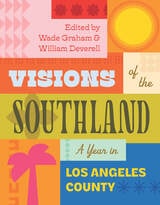
Visions of the Southland
A Year in Los Angeles CountyEdited by Wade Graham and William Deverell
University of Chicago Press, 2026
Experience a year in Los Angeles County, in all its glitter and grit, through a unique anthology that pairs essays by acclaimed writers and historians with custom maps.
When many of us picture Los Angeles, we’re actually thinking of LA County. Home to roughly ten million people, the county alone is more populous than forty-two US states. Its eighty-eight cities include places made famous by Hollywood glamor and California dreaming—Beverly Hills, Malibu, and Santa Monica—but also working-class municipalities and the self-explanatory City of Industry. With a territory that includes the Pacific coastline, mountain ranges, and the high Mojave Desert, the county’s landscapes have been touched by earthquakes, droughts, and, of course, devastating fires. LA County is a place of extremes: progress and injustice, innovation and stagnation.
Visions of the Southland collects essays by writers, journalists, and historians to create a nuanced portrait of LA that’s grounded in the county itself—its sites, structures, and stories. Contributors—including Gustavo Arellano, Keri Blakinger, Lynell George, Christopher Hawthorne, Michael Hiltzik, Greg Hise, Carolina Miranda, Becky Nicolaides, Susan Straight, and David L. Ulin—delve into LA’s infamous air pollution, movie ranches, prisons, aqueducts, urban forests, SoCal Bohemianism, and more. A custom map by Ezra Rawitsch enriches each piece and grounds the reader in specific locations throughout the county. Unfolding over the course of a year, the book traces the rhythms of politics, sports, weather, and wildlife across this sprawling and enigmatic place.
Sweeping in its scope and gorgeous in its design, Visions of the Southland will delight Angelenos, history buffs, urbanists, and map enthusiasts alike.