Results by title
80 books match the query 'Vietnam War' and 8 start with v
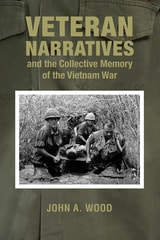
Veteran Narratives and the Collective Memory of the Vietnam War
John A. Wood
Ohio University Press, 2016
In the decades since the Vietnam War, veteran memoirs have influenced Americans’ understanding of the conflict. Yet few historians or literary scholars have scrutinized how the genre has shaped the nation’s collective memory of the war and its aftermath. Instead, veterans’ accounts are mined for colorful quotes and then dropped from public discourse; are accepted as factual sources with little attention to how memory, no matter how authentic, can diverge from events; or are not contextualized in terms of the race, gender, or class of the narrators.
Veteran Narratives and the Collective Memory of the Vietnam War is a landmark study of the cultural heritage of the war in Vietnam as presented through the experience of its American participants. Crossing disciplinary borders in ways rarely attempted by historians, John A. Wood unearths truths embedded in the memoirists’ treatments of combat, the Vietnamese people, race relations in the United States military, male-female relationships in the war zone, and veterans’ postwar troubles. He also examines the publishing industry’s influence on collective memory, discussing, for example, the tendency of publishers and reviewers to privilege memoirs critical of the war. Veteran Narratives is a significant and original addition to the literature on Vietnam veterans and the conflict as a whole.
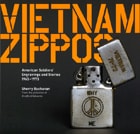
Vietnam Zippos
American Soldiers' Engravings and Stories (1965-1973)Edited by Sherry Buchanan
University of Chicago Press, 2007
—from an engraving on a Vietnam-era Zippo lighter
In 1965, journalist Morley Safer followed the United States Marines on a search and destroy mission into Cam Ne. When the Marines he accompanied reached the village, they ordered the civilians there to evacuate their homes—grass huts whose thatched roofs they set ablaze with Zippo lighters. Safer’s report on the event soon aired on CBS and was among the first to paint a harrowing portrait of the War in Vietnam. LBJ responded to the segment furiously, accusing Safer of having “shat on the American flag.” For the first time since World War II, American boys in uniform had been portrayed as murderers instead of liberators. Our perception of the war—and the Zippo lighter—would never be the same.
But as this stunning book attests, the Zippo was far more than an instrument of death and destruction. For the American soldiers who wielded them, they were a vital form of social protest as well. Vietnam Zippos showcases the engravings made by U.S. soldiers on their lighters during the height of the conflict, from 1965 to 1973. In a real-life version of the psychedelic war portrayed in Francis Ford Coppola’s Apocalypse Now, Sherry Buchanan tells the fascinating story of how the humble Zippo became a talisman and companion for American GIs during their tours of duty. Through a dazzling array of images, we see how Zippo lighters were used during the war, and we discover how they served as a canvas for both personal and political expression during the Age of Aquarius, engraved with etchings of peace signs and marijuana leaves and slogans steeped in all the rock lyrics, sound bites, combat slang, and antiwar mottos of the time.
Death from Above. Napalm Sticks to Kids. I Love You Mom, From a Lonely Paratrooper. The engravings gathered in this copiously illustrated volume are at once searing, caustic, and moving, running the full emotional spectrum with both sardonic reflections—I Love the Fucking Army and the Army Loves Fucking Me—and poignant maxims—When the Power of Love Overcomes the Love of Power, the World Will Know Peace. Part pop art and part military artifact, they collectively capture the large moods of the sixties and the darkest days of Vietnam—all through the world of the tiny Zippo.
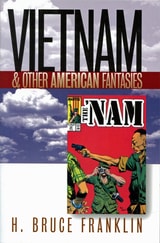
Vietnam and Other American Fantasies
H. Bruce Franklin
University of Massachusetts Press, 2000
There is now fairly widespread acknowledgment that the Vietnam War shattered many of the traditional narratives central to formerly prevailing vision of the United States and its history. Some people regret this and seek to restore old narratives that they consider essential to a unifying national identity, but their mighty efforts are unlikely to put Humpty Dumpty together again. Others see this shattering as a liberation from dangerous illusions, a wake-up call that forced millions of Americans toward more truthful and beneficial narratives about American history and culture. There is a third view, one that has gained considerable influence in intellectual circles, that sees any “master narrative” or “meta-narrative”—or, for that matter, any coherently structured narrative—as a socially constructed fantasy that radically falsifies the fragmentary, conflicted, and de-centered character of social experience. Although in this book the author does not engage in overt arguments about narrative theory, he does operate from a theoretical position that highly values narratives, especially coherently structures narratives—including some forms of fantasy—as crucial to comprehending, within our human limits, human reality.
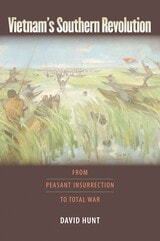
Vietnam's Southern Revolution
From Peasant Insurrection to Total WarDavid Hunt
University of Massachusetts Press, 2009
In Vietnam, the American government vowed to win the “hearts and minds” of the people. On the other side, among those who led and sympathized with the insurgents, the term “people's war” gained a wide currency. Yet while much has been written about those who professed to speak for the Vietnamese population, we know surprisingly little about the everyday life of the peasants who made up the bulk of the country's inhabitants. This book illuminates that subject. Drawing on a wide range of sources, including interviews conducted by the Rand Corporation with informants from My Tho Province in the Mekong Delta, David Hunt brings to light the daily experience of villagers in the midst of war and revolution.
The peasants of southern Vietnam were neither onlookers nor mere victims as fighting raged throughout their country. From the “concerted uprising” in 1959–1960 to the Tet Offensive of 1968, the revolutionary movement they created was in fact the driving force within the war. Known as the “Viet Cong” to their adversaries, the rebels called themselves the “Liberation Front.” They demanded an end to landlordism and an egalitarian distribution of the means of subsistence as well as a democratization of relations between town and countryside, parents and children, men and women. They hoped the Vietnamese people would achieve a fuller sense of their place in the world and of the power they possessed to fashion their own destinies, without reliance on supernatural forces.In the first half of the book, Hunt analyzes this cultural revolution. As fighting spread and became more destructive, especially after the U.S. escalation in 1965, villagers were driven from their homes, the rural infrastructure collapsed, and customary notions of space and time lost purchase on an increasingly chaotic world. In the second half of the book, Hunt shows how peasants, who earlier had aspired to a kind of revolutionary modernism, now found themselves struggling to survive and to cope with the American intruders who poured into My Tho, and how they managed to regroup and spearhead the Tet Offensive that irrevocably altered the course of the war.
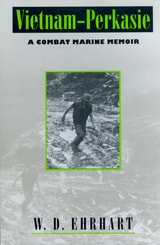
Vietnam-Perkasie
W. D. Ehrhart
University of Massachusetts Press, 1995
In 1982, John Newman, curator of the Vietnam War Literature Collection at Colorado State University, said of W.D. Ehrhart: “As a poet and editor, Bill Ehrhart is clearly one of the major figures in Vietnam War literature.” This autobiographical account of the war, the author's first extended prose work, demonstrates Ehrhart's abilities as a writer of prose as well. Vietnam–Perkasie is grim, comical, disturbing, and accurate. The presentation is novelistic—truly, a “page-turner”—but the events are all real, the atmosphere intensely evocative.
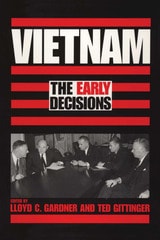
Vietnam
The Early DecisionsEdited by Lloyd C. Gardner and Ted Gittinger
University of Texas Press, 1997
Haunting questions remain about our involvement in Vietnam. Perhaps the most persistent of these is whether President Kennedy would have ended American involvement in Vietnam if he had lived.
For many Americans, Oliver Stone's film JFK left no doubt that before his assassination Kennedy had determined to quit Vietnam. Yet the historical record offers a more complex answer. In this fresh look at the archival evidence, noted scholars take up the challenge to provide us with their conclusions about the early decisions that put the United States on the path to the greatest American tragedy since the Civil War. The tensions and turmoil that accompanied those decisions reveal the American presidency at the center of a storm of conflicting advice.
The book is divided into four sections. Parts one and two delve into the political and military contexts of the early decisions. Part three raises the intriguing questions of Kennedy's and Johnson's roles in the conflict, particularly the thorny issue of whether Kennedy did, in fact, intend to withdraw from Vietnam and whether Johnson reversed that policy. Part four reveals an uncanny parallel between early Soviet policy toward Hanoi and U.S. policy toward Saigon.
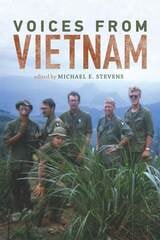
Voices from Vietnam
Michael E. Stevens
Wisconsin Historical Society Press, 1996
An unforgettable collection of 174 letters and diary entries written by 92 wisconsin men and women who served in Vietnam. Includes a journal kept by Menasha native Frederic Flom on cigarette wrappers during his final 16 days of captivity — the only known diary smuggled out by a Vietnam prisoner of war.
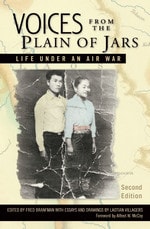
Voices from the Plain of Jars
Life under an Air WarEdited by Fred Branfman with essays and drawings by Laotian villagers; Foreword by Alfred W. McCoy
University of Wisconsin Press, 2013
When first published in 1972, this book was instrumental in exposing the bombing. In this expanded edition, Branfman follows the story forward in time, describing the hardships that Laotians faced after the war when they returned to find their farm fields littered with cluster munitions—explosives that continue to maim and kill today.