Results by title
1441 books match the query 'World' and 10 start with v
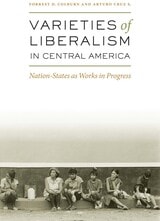
Varieties of Liberalism in Central America
Nation-States as Works in ProgressBy Forrest D. Colburn and Arturo Cruz S.
University of Texas Press, 2007
Why do some countries progress while others stagnate? Why does adversity strengthen some countries and weaken others? Indeed, in this era of unprecedented movement of people, goods, and ideas, just what constitutes a nation-state? Forrest Colburn and Arturo Cruz suggest how fundamental these questions are through an exploration of the evolution of Guatemala, El Salvador, Honduras, Nicaragua, and Costa Rica over the last quarter of a century, a period of intriguing, often confounding, paradoxes in Central America's development.
Offering an elegant defense of empiricism, Colburn and Cruz explore the roles of geography and political choice in constructing nations and states. Countries are shown to be unique: there are a daunting number of variables. There is causality, but not the kind that can be revealed in the laboratory or on the blackboard. Liberalism—today defined as democracy and unfettered markets—may be in vogue, but it has no inherent determinants. Democracy and market economies, when welded to the messy realities of individual countries, are compatible with many different outcomes. The world is more pluralistic in both causes and effects than either academic theories or political rhetoric suggest.
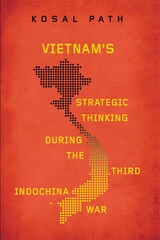
Vietnam's Strategic Thinking during the Third Indochina War
Kosal Path
University of Wisconsin Press, 2023
In contrast to earlier studies, Path traces the moving target of these changing policy priorities, providing a vital addition to existing scholarship on asymmetric wartime decision-making and alliance formation among small states. The result uncovers how this critical period had lasting implications for the ways Vietnam continues to conduct itself on the global stage.
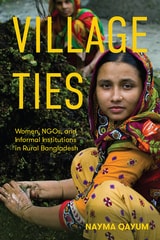
Village Ties
Women, NGOs, and Informal Institutions in Rural BangladeshNayma Qayum
Rutgers University Press, 2022
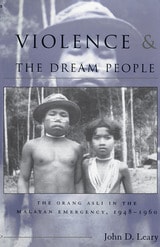
Violence and the Dream People
The Orang Asli in the Malayan Emergency, 1948-1960John D. Leary
Ohio University Press, 1995
Violence and the Dream People is an account of a little-known struggle by the Malayan government and the communist guerrillas, during the 1948-1960 Malayan Emergency, to win the allegiance of the Orang Asli, the indigenous people of the peninsular Malaya. The author argues that the use of force by both sides in their attempts to woo or coerce the jungle dwellers to support one side or the other in the conflict, caused tensions among the Orang Asli that resulted in counter violence against the interlopers and internecine killings in the tribal groups.
This study challenges the depiction of the Orang Asli as naïve innocents, unwittingly manipulated by outsiders for their own purposes. Heavily outnumbered, they looked to their own resources to survive, in the face of relocation, conscription, random bombings, and haphazard killing. Leary argues that they were shrewd enough to recognize the winning side and backed their judgment with force where necessary.
Violence and the Dream People is an important study of a much neglected facet of the Malayan Emergency and of the history of the indigenous peoples of the Malay Peninsula.
Violence of Democracy
Interparty Conflict in South IndiaRuchi Chaturvedi
Duke University Press, 2023
Visions of Transformation
Hegemony, Plurinationality, and Revolution in BoliviaAaron Augsburger
University of Arizona Press, 2025
On a wave of revolutionary upheaval in the early twenty-first century, Evo Morales was swept into state power as Bolivia’s first Indigenous president with a mandate to radically transform the country. The ensuing period, known simply as “el proceso de cambio” (the process of change), has been a tension-filled and contradictory process involving progressive transformations, ambiguous continuities, and outright revolutionary failures. Importantly, the contradictions have been just as much ideological as they are material.
By examining and illuminating the contrasting logics underlying opposing theories of revolutionary change, Visions of Transformation provides an analytical framework through which to understand and interpret the central conflicts and contradictions of Bolivia under Evo Morales and the Movimiento al Socialismo.
Based on nearly two years of immersive fieldwork, Visions of Transformation explores the relation between theoretical production and political practice. Through the contrasting perspectives of hegemony and plurinationality, the book analyzes three specific conjunctural moments—a proposed highway through the TIPNIS, a conflict over representation of the highland Indigenous movement organization CONAMAQ, and the struggle for Indigenous autonomy—to shed light on the primary economic, social, political, and theoretical tensions at the heart of Bolivia’s proceso de cambio.
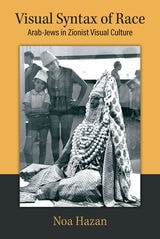
Visual Syntax of Race
Arab-Jews in Zionist Visual CultureNoa Hazan
University of Michigan Press, 2022
Analyzing the visual syntax and display rhetoric applied in newspaper photos, national historical albums, and museum exhibitions, Noa Hazan shows that although racial thought was and still is verbally suppressed in Israel, it is vividly present in its nonverbal official and public visual sphere. The racist perspective of newspaper editors, book publishers, photographers, and museum curators were morally justified in its time by such patronizing ideals as realistic news coverage or the salvation of Jewish heritage assets. Although their perspectives played a dominant role in establishing a visual syntax of race in Israel, they were not seen as racially discriminating at the time. The racist motifs and actions are revealed here by colligating multiple cases into a coherent narrative in retrospect.
This book points to a direct influence of the anti-Semitic discourse in Europe toward Mizrahim in Israel, highlighting the shared visual stereotypes used in both Europe and the fledgling state of Israel. Engraved in their body, these cultural traits were depicted and understood as racial-biological qualities and were visually manipulated to silo Ashkenazim and Mizrahim in Israel as distinct racial types.
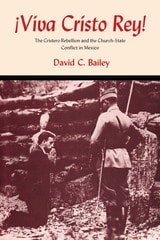
Viva Cristo Rey!
The Cristero Rebellion and the Church-State Conflict in MexicoBy David C. Bailey
University of Texas Press, 1974
Between 1926 and 1929, thousands of Mexicans fought and died in an attempt to overthrow the government of their country. They were the Cristeros, so called because of their battle cry, ¡Viva Cristo Rey!—Long Live Christ the King! The Cristero rebellion and the church-state conflict remain one of the most controversial subjects in Mexican history, and much of the writing on it is emotional polemic. David C. Bailey, basing his study on the most important published and unpublished sources available, strikes a balance between objective reporting and analysis. This book depicts a national calamity in which sincere people followed their convictions to often tragic ends.
The Cristero rebellion climaxed a century of animosity between the Catholic church and the Mexican state, and this background is briefly summarized here. With the coming of the 1910 revolution the hostility intensified. The revolutionists sought to impose severe limitations on the Church, and Catholic anti-revolutionary militancy grew apace. When the government in 1926 decreed strict enforcement of anticlerical legislation, matters reached a crisis. Church authorities suspended public worship throughout Mexico, and Catholics in various parts of the country rose up in arms. There followed almost three years of indecisive guerrilla warfare marked by brutal excesses on both sides. Bailey describes the armed struggle in broad outline but concentrates on the political and diplomatic maneuvering that ultimately decided the issue.
A de facto settlement was brought about in 1929, based on the government’s pledge to allow the Church to perform its spiritual offices under its own internal discipline. The pact was arranged mainly through the intercession of U.S. Ambassador Dwight Morrow. His role in the conflict, as well as that of other Americans who decisively influenced the course of events, receives detailed attention in the study. The position of the Vatican during the conflict and its role in the settlement are also examined in detail.
With the 1929 settlement the clergy returned to the churches, whereupon the Cristeros lost public support and the rebellion collapsed. The spirit of the settlement soon evaporated, more strife followed, and only after another decade did permanent religious peace come to Mexico.
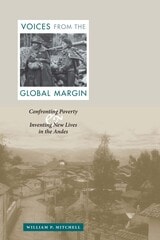
Voices from the Global Margin
Confronting Poverty and Inventing New Lives in the AndesBy William P. Mitchell
University of Texas Press, 2006
2007 — LASA Peru Flora Tristán Book Prize from the Peru Section – Latin American Studies Association
Voices from the Global Margin looks behind the generalities of debates about globalization to explore the personal impact of global forces on the Peruvian poor. In this highly readable ethnography, William Mitchell draws on the narratives of people he has known for forty years, offering deep insight into how they have coped with extreme poverty and rapid population growth—and their creation of new lives and customs in the process. In their own passionate words they describe their struggles to make ends meet, many abandoning rural homes for marginal wages in Lima and the United States. They chronicle their terror during the Shining Path guerrilla war and the government's violent military response. Mitchell's long experience as an anthropologist living with the people he writes about allows him to put the stories in context, helping readers understand the impact of the larger world on individuals and their communities. His book reckons up the human costs of the global economy, urging us to work toward a more just world.
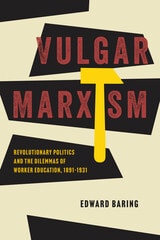
Vulgar Marxism
Revolutionary Politics and the Dilemmas of Worker Education, 1891–1931Edward Baring
University of Chicago Press, 2025
For the past hundred years, “vulgar Marxism” has been the go-to insult among socialist and communist intellectuals, a shorthand for the ways Marxist theory could go wrong. But why would thinkers advocating for working-class emancipation use “vulgarity” as an epithet?
In Vulgar Marxism, Edward Baring seeks an answer by delving into debates over Marxism in the first decades of the twentieth century. He shows that this common phrase wasn’t aimed primarily at popular understandings of Marx. Rather, it was used to attack intellectuals for failing to teach Marx’s theory to the working masses correctly. His history of “vulgar Marxism” homes in on the project of mass worker education at a time when the project was both widely pursued and fiercely contested.
Worker education offered a mechanism through which Marxist theory was meant to promote large-scale social and political change, and it drew on a massive infrastructure of schools, publishing houses, and educational bureaus that stretched across Europe and reached millions. By centering this project, Baring radically recasts the history of Marxism from the Second International to World War II. He challenges classic oppositions between “economistic” and “cultural” versions of Marxism; rereads many of the most significant Marxist theorists of the time, including Karl Kautsky, Rosa Luxemburg, Georg Lukács, and Antonio Gramsci; and offers new resources for understanding how Marxist ideas transformed as they traveled around Europe and then spread throughout the world.