Results by title
295 books match the query 'Zoology' and 4 start with v
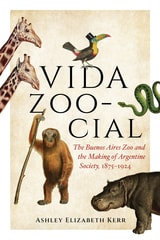
Vida Zoo-cial
The Buenos Aires Zoo and the Making of Argentine Society, 1875–1924Ashley Elizabeth Kerr
Vanderbilt University Press, 2025
Premio al Mejor Libro en Humanidades, Latin American Studies Association, Nineteenth-Century Section, 2026
In late nineteenth- and early twentieth‑century Buenos Aires, elites attempted to tackle growing poverty and social problems with a suite of social, educational, and medical reforms, hoping to make the city and larger nation more “modern” and “progressive” on the world stage. Known as the “social question,” this turn-of-the-century preoccupation with the future of the city and nation was undergirded by a larger set of social Darwinist beliefs about the biological and racial inferiority of immigrants and the working class, linking them to higher susceptibility to alcoholism, sexual deviancy, insanity, and disease.
In Vida Zoo-cial, Ashley Elizabeth Kerr argues that the Buenos Aires Zoo and its many animal species were an important tool in attempts to remake Argentinian society. Elites used the zoo’s physical spaces, programming, and visual and literary representations of its animals to try to educate and “improve” the masses, especially immigrants and the poor, but stopped short of supporting more radical social transformations. Drawing upon extensive archival research from the zoo’s archive, including correspondence, municipal reports, receipts, and employment records, as well as a range of literary and popular culture sources, Kerr records these efforts, which included enlisting lionesses as object lessons in proper motherhood and elephants as model immigrants. Although some projects were successful, Kerr also documents the many ways others went awry when the zoo's animals and the humans who came to see them failed to cooperate.
Vida Zoo-cial is not only a story about how the poor and working class resisted elite efforts for social reform founded upon racialized beliefs and pseudoscience, but also one that challenges readers to rethink the relationship between humans and non‑humans.
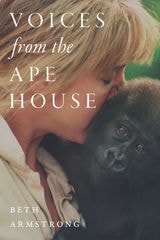
Voices from the Ape House
Beth Armstrong
The Ohio State University Press, 2020
Through anecdotal stories, readers get a glimpse into the fascinating lives of gorillas—the familiar gentleness of mothers and fathers toward their infants, power plays and social climbing, the unruly nature of teenagers, the capacity for humor, and the shared sadness by group members as they mourn the death of one of their own. In the end, Armstrong’s conflict with captivity and her lifelong fondness for these animals helped shape a zoo program dedicated to gorilla conservation.
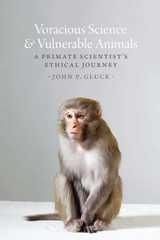
Voracious Science and Vulnerable Animals
A Primate Scientist's Ethical JourneyJohn P. Gluck
University of Chicago Press, 2016
Gluck begins by taking us inside the laboratory of Harry F. Harlow at the University of Wisconsin, where Gluck worked as a graduate student in the 1960s. Harlow’s primate lab became famous for his behavioral experiments in maternal deprivation and social isolation of rhesus macaques. Though trained as a behavioral scientist, Gluck finds himself unable to overlook the intense psychological and physical damage these experiments wrought on the macaques. Gluck’s sobering and moving account reveals how in this and other labs, including his own, he came to grapple with the uncomfortable justifications that many researchers were offering for their work. As his sense of conflict grows, we’re right alongside him, developing a deep empathy for the often smart and always vulnerable animals used for these experiments.
At a time of unprecedented recognition of the intellectual cognition and emotional intelligence of animals, Voracious Science and Vulnerable Animals is a powerful appeal for our respect and compassion for those creatures who have unwillingly dedicated their lives to science. Through the words of someone who has inflicted pain in the name of science and come to abhor it, it’s important to know what has led this far to progress and where further inroads in animal research ethics are needed.
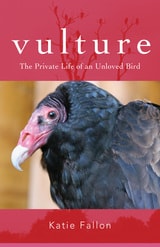
Vulture
The Private Life of an Unloved BirdKatie Fallon
Brandeis University Press, 2020
Few animals have a worse reputation than the vulture. But is it deserved? With Vulture, Katie Fallon offers an irresistible argument to the contrary, tracing a year in the life of a typical North American turkey vulture. Turkey vultures, also known as buzzards, are the most widely distributed and abundant scavenging birds of prey on the planet, found from central Canada to the southern tip of Argentina and nearly everywhere in between. Deftly drawing on the most up-to-date scientific papers and articles and weaving those in with interviews with world-renowned raptor and vulture experts and her own compelling natural history writing, Fallon examines all aspects of the bird’s natural history: breeding, incubating eggs, raising chicks, migrating, and roosting. The result is an intimate portrait of an underappreciated bird—one you’ll never look at in the same way again.