Results by title
5448 books match the query 'History and criticism' and 75 start with v

Vision/Re-Vision
Adapting Contemporary American Fiction To FilmBarbara Tepa Lupack
University of Wisconsin Press, 1996
The essays in Vision/Re-Vision analyze in detail ten popular and important films adapted from contemporary American fiction by women, addressing the ways in which the writers' latent or overt feminist messages are reinterpreted by the filmmakers who bring them to the screen, demonstrating that there is much to praise as well as much to fault in the adaptations and that the process of adaptation itself is instructive rather than destructive, since it enriches understanding about both media.
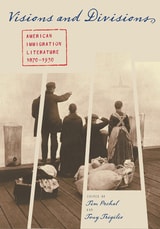
Visions and Divisions
American Immigration Literature, 1870-1930Prchal, Timothy
Rutgers University Press, 2008
From these debates came such novels as Willa Cather’s My Ántonia and Upton Sinclair’s The Jungle. Henry James, Charlotte Perkins Gilman, and Carl Sandburg added to the diversity of viewpoints of native born Americans while equally divergent immigrant perspectives were represented by writers such as Anzia Yezierska, Kahlil Gibran, and Claude McKay. This anthology presents the writing of these authors, among others less well known, to show the many ways literature participated in shaping the face of immigration. The volume also includes an introduction, annotations, a timeline, and historical documents that contextualize the literature.
Visions of Global America and the Future of Critical Reading
Daniel T. O’Hara
The Ohio State University Press, 2009
Visions of Sodom
Religion, Homoerotic Desire, and the End of the World in England, c. 1550-1850H. G. Cocks
University of Chicago Press, 2017
In Visions of Sodom, H. G. Cocks examines the many different ways in which the story of Sodom’s destruction provided a template for understanding homoerotic desire and behaviour in Britain between the Reformation and the nineteenth century. Sodom was not only a marker of sexual sins, but also the epitome of false—usually Catholic—religion, an exemplar of the iniquitous city, a foreshadowing of the world’s fiery end, an epitome of divine and earthly punishment, and an actual place that could be searched for and discovered. Visions of Sodom investigates each of these ways of reading Sodom’s annihilation in the three hundred years after the Reformation. The centrality of scripture to Protestant faith meant that Sodom’s demise provided a powerful origin myth of homoerotic desire and sexual excess, one that persisted across centuries, and retains an apocalyptic echo in the religious fundamentalism of our own time.
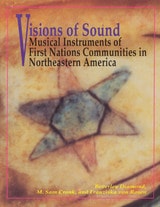
Visions of Sound
Musical Instruments of First Nation Communities in Northeastern AmericaBeverley Diamond, M. Sam Cronk, and Franziska von Rosen
University of Chicago Press, 1995
Featuring over two hundred photographs of instruments, dialogues among the coauthors, numerous interviews with individual music makers, and an appended catalogue of over seven hundred instrument descriptions, this is an important book for all ethnomusicologists and students of Native American culture as well as general readers interested in Native American mythology and religious life.

Visions of Violence
German Avant-Gardes After FascismRichard Langston
Northwestern University Press, 2007
An extreme faction of aesthetic modernity intent on bulldozing contemporary life, the avant-garde has regularly employed visions of violence in their push for societal and cultural renewal. But in the shadow of unparalleled war and genocide, such aesthetic violence lost its force. This book explores the reconfiguration of the avant-garde in response to the violent transformation of European reality. Citing the emergence of independent avant-garde practitioners in the place of the previous collective, Richard Langston considers six individual exemplars of Germany’s post-fascist avant-garde—works that span the last six decades: painter, writer, and filmmaker Peter Weiss’s appropriation of French surrealism in the fifties; writer Dieter Wellershoff’s coterie of “new realists”; artist Wolf Vostell’s mediation and conflation of the experiences of the Auschwitz trials and the Vietnam War; poet and novelist Dieter Brinkmann’s collages from the seventies; the multimedia displacements of Alexander Kluge; and the performative engagements of dramatists Christoph Schlingensief and Rene Pollesch.
Taking stock of the evolution of Germany’s post-fascist avant-gardes, Langston’s book shows how the movement from Weiss to Pollesch exhibits the problems that both modernity and postmodernity pose for an aesthetic engagement of Germany’s violent past.
Visions of War
World War II in Popular Literature and CultureM. Paul Holsinger
University of Wisconsin Press, 1992
Vitality Politics
Health, Debility, and the Limits of Black EmancipationStephen Knadler
University of Michigan Press, 2019

Vladimir's Carrot
Modern Drama and the Modern ImaginationJohn Peter
University of Chicago Press, 1987
For Peter, Beckett's Waiting for Godot makes such a radical break with dramatic tradition that it prompts the question: Is this play the single most important event in the theater since Aeschylus? Or is it the fulfillment of forces at work long before Beckett wrote it? Peter shows how Beckett's work represents a change in the very subject matter of drama, a fundamental revision of concepts of character, plot, and meaning, which in turn requires a new way of responding to drama. Where plays have traditionally engaged audiences in critical and moral dialogue, theater like Beckett's, according to Peter, is closed to questioning; it presents a vision of the world which can only be accepted or rejected. As such, it not only signals a new form of drama, but also posits a fundamentally changed audience.
Peter views this change—essentially, a change of mind—in its wider context. The times and the thought that contribute to the modern imagination are represented here by novels, paintings, and music—works by Wagner, Kafka, Proust, Picasso, and Braque—as well as plays. Peter shows how the depiction of the world by these artists echoes—and is echoed by—the work of modern thinkers such as Schopenhauer, Nietzsche, and Freud.
Vladimir's Carrot will provoke and stimulate readers who find themselves either lost or perfectly at home in "modern" culture.

Vodou Nation
Haitian Art Music and Cultural NationalismMichael Largey
University of Chicago Press, 2006
Around the time of the United States’s occupation of Haiti in 1915, African American composers began to incorporate Vodou-inspired musical idioms to showcase black artistry and protest white oppression. Together with Haitian musicians, these composers helped create what Michael Largey calls the “Vodou Nation,” an ideal vision of Haiti that championed its African-based culture as a bulwark against America’s imperialism. Highlighting the contributions of many Haitian and African American composers who wrote music that brought rhythms and melodies of the Vodou ceremony to local and international audiences, Vodou Nation sheds light on a black cosmopolitan musical tradition that was deeply rooted in Haitian culture and politics.
Vodou Songs in Haitian Creole and English
Benjamin Hebblethwaite
Temple University Press, 2011
Vodou songs constitute the living memory of Haitian Vodou communities, and song texts are key elements to understanding Haitian culture. Vodou songs form a profound religious and cultural heritage that traverses the past and refreshes the present. Offering a one-of-a-kind research tool on Vodou and its cultural roots in Haiti and pre-Haitian regions, Vodou Songs in Haitian Creole and English provides a substantial selection of hard to find or unpublished sacred Vodou songs in a side-by-side bilingual format.
Esteemed scholar Benjamin Hebblethwaite introduces the language, mythology, philosophy, origins, and culture of Vodou through several chapters of source songs plus separate analytical chapters. He guides readers through songs, chants, poems, magical formulae, invocations, prayers, historical texts and interviews, as well as Haitian Creole grammar and original sacred literature. An in-depth dictionary of key Vodou terms and concepts is also provided.
This corpus of songs and the research about them provide a crucial understanding of the meaning of Vodou religion, language, and culture.

Voiceless Vanguard
The Infantilist Aesthetic of the Russian Avant-GardeSara Pankenier Weld
Northwestern University Press, 2014
Voiceless Vanguard: The Infantilist Aesthetic of the Russian Avant-Garde offers a new approach to the Russian avant-garde. It argues that central writers, artists, and theorists of the avant-garde self-consciously used an infantile aesthetic, as inspired by children’s art, language, perspective, and logic, to accomplish the artistic renewal they were seeking in literature, theory, and art. It treats the influence of children’s drawings on the Neo-Primitivist art of Mikhail Larionov, the role of children’s language in the Cubo-Futurist poetics of Aleksei Kruchenykh, the role of the naive perspective in the Formalist theory of Viktor Shklovsky, and the place of children’s logic and lore in Daniil Kharms’s absurdist writings for children and adults. This interdisciplinary and cultural study not only illuminates a rich period in Russian culture but also offers implications for modernism in a wider Western context, where similar principles apply.

Voices Made Flesh
Performing Women'S AutobiographyLynn C. Miller
University of Wisconsin Press, 2003
Fourteen bold, dynamic, and daring women take the stage in this collection of women's lives and stories. Individually and collectively, these writers and performers speak the unspoken and perform the heretofore unperformed.
The first section includes scripts and essays about performances of the lives of Gertrude Stein, Georgia O'Keeffe, Mary Church Terrell, Charlotte Cushman, Anaïs Nin, Calamity Jane, and Mary Martin. The essays consider intriguing interpretive issues that arise when a woman performer represents another woman's life. In the second section, seven performers—Tami Spry, Jacqueline Taylor, Linda Park-Fuller, Joni Jones, Terri Galloway, Linda M. Montano, and Laila Farah—tell their own stories. Ranging from narrrative lectures (sometimes aided by slides and props) to theatrical performances, their works wrest comic and dramatic meaning from a world too often chaotic and painful. Their performances engage issues of sexual orientation, ethnicity, race, loss of parent, disability, life and death, and war and peace. The volume as a whole highlights issues of representation, identity, and staging in autobiographical performance. It examines the links among theory and criticism of women's autobiography, feminist performance theory, and performance practice.
Voices That Matter
Kurdish Women at the Limits of Representation in Contemporary TurkeyMarlene Schäfers
University of Chicago Press, 2023
A fine-grained ethnography exploring the sociopolitical power of Kurdish women’s voices in contemporary Turkey.
“Raise your voice!” and “Speak up!” are familiar refrains that assume, all too easily, that gaining voice will lead to empowerment, healing, and inclusion for marginalized subjects. Marlene Schäfers’s Voices That Matter reveals where such assumptions fall short, demonstrating that “raising one’s voice” is no straightforward path to emancipation but fraught with anxieties, dilemmas, and contradictions. In its attention to the voice as form, this book examines not only what voices say but also how they do so, focusing on Kurdish contexts where oral genres have a long, rich legacy. Examining the social labor that voices carry out as they sound, speak, and resonate, Schäfers shows that where new vocal practices arise, they produce new selves and practices of social relations. In Turkey, recent decades have seen Kurdish voices gain increasing moral and political value as metaphors of representation and resistance. Women’s voices, in particular, are understood as potent means to withstand patriarchal restrictions and political oppression. By ethnographically tracing the transformations in how Kurdish women relate to and employ their voices as a result of these shifts, Schäfers illustrates how contemporary politics foster not only new hopes and desires but also create novel vulnerabilities as they valorize, elicit, and discipline voice in the name of empowerment and liberation.

Voices for the Future
Essays on Major Science Fiction Writers, Volume 1Thomas D. Clareson
University of Wisconsin Press, 1976

Voices from the Thai Countryside
Samruam Singh
University of Wisconsin Press, 2008
Set in northern Thailand during the mid-1970s, the stories in this collection capture a period of dramatic social and economic change. Amidst a setting of marketplaces and paddyfields, lemon trees and leaf-roofed houses, these vignettes offer revealing insights into the daily lives of ordinary villagers and hillspeople struggling to survive.
Voices in the Shadows
Women and Verbal Art in Serbia and BosniaCelia Hawkesworth
Central European University Press, 2000
Women are conspicuously absent from traditional cultural histories of south-east Europe. This book addresses that imbalance by describing the contribution of women to literary culture in the Orthodox/ Ottoman areas of Serbia and Bosnia.
The first complete literary history in relation to women's writing in south-east Europe. The author provides a broad chronological account of this contribution, dividing the book into two main parts; the earlier period up until the eighteenth century concentrates on the projections of gender through the medium of oral tradition and the lives of a handful of educated women in medieval Serbia and the few works of literature they left. Hawkesworth also looks at the written literature produced by women, first in the mid-nineteenth century and then at the turn of the century. The second part focuses on the trials and tribulations that affected feminism and women's literature throughout the twentieth century. The author finishes by highlighting the new women's movement, 1975-1990, a great period for women in Yugoslavia which created a stimulating atmosphere for outstanding pieces of women's journalism, prose and verse, culminating in the creation of new women's studies courses in many universities.
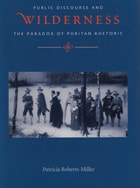
Voices in the Wilderness
Public Discourse and the Paradox of Puritan RhetoricPatricia Roberts-Miller
University of Alabama Press, 1999
Both Jürgen Habermas and Wayne Booth—two of the most influential theorists in the domain of public discourse and good citizenry—argue for an inclusive public deliberation that involves people who are willing to listen to one another, to identify points of agreement and disagreement, and to make good faith attempts to validate any disputed claims. The Puritan voice crying in the wilderness, Roberts-Miller shows, does none of these things. To this individual of conscience engaged in a ceaseless battle of right and wrong against greedy philistines, all inclusion, mediation, and reciprocity are seen as evil, corrupting, and unnecessary. Hence, the voice in the wilderness does not in any real sense participate in public deliberation, only in public pronouncement.
Arguing that our culture’s continuing affection for the ethos of the voice crying in the wilderness is one of our more troubling inheritances from the early American ambivalence to public discourse—including the Puritan denigration of rhetoric—Roberts-Miller contends that the monologic discourse of the Puritans in fact contains within it arguments for dialogism. Thus, the history of rhetoric can provide much richer fields for reimagining discourse than heretofore credited. Roberts-Miller concludes by extending her findings into their practical applications for argumentation in the public sphere and in the composition classroom.
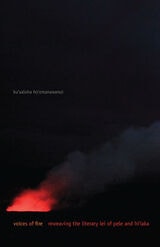
Voices of Fire
Reweaving the Literary Lei of Pele and Hi'iakaku'ualoha ho'omanawanui
University of Minnesota Press, 2014
Stories of the volcano goddess Pele and her youngest sister Hi‘iaka, patron of hula, are most familiar as a form of literary colonialism—first translated by missionary descendants and others, then co-opted by Hollywood and the tourist industry. But far from quaint tales for amusement, the Pele and Hi‘iaka literature published between the 1860s and 1930 carried coded political meaning for the Hawaiian people at a time of great upheaval. Voices of Fire recovers the lost and often-suppressed significance of this literature, restoring it to its primary place in Hawaiian culture.
Ku‘ualoha ho‘omanawanui takes up mo‘olelo (histories, stories, narratives), mele (poetry, songs), oli (chants), and hula (dances) as they were conveyed by dozens of authors over a tumultuous sixty-eight-year period characterized by population collapse, land alienation, economic exploitation, and military occupation. Her examination shows how the Pele and Hi‘iaka legends acted as a framework for a Native sense of community. Freeing the mo‘olelo and mele from colonial stereotypes and misappropriations, Voices of Fire establishes a literary mo‘okū‘auhau, or genealogy, that provides a view of the ancestral literature in its indigenous contexts.
The first book-length analysis of Pele and Hi‘iaka literature written by a Native Hawaiian scholar, Voices of Fire compellingly lays the groundwork for a larger conversation of Native American literary nationalism.

Voices of a People
THE STORY OF YIDDISH FOLKSONGRuth Rubin
University of Illinois Press, 1974
A priceless collection of song texts in Yiddish and English, as well as a selection of tunes Rubin transcribed, this volume brings the Jews' ancient, itinerant culture alive through children's songs, dancing songs, and songs about love and courtship, poverty and work, crime and corruption, immigration, and the dream of a homeland. Rubin's notes and annotations weave each text into the larger story of the Jewish experience.
Noted scholar Mark Slobin provides a new foreword that includes a biographical sketch of Rubin and an assessment of her contributions over a lifetime of collecting, absorbing, and disseminating Yiddish folksong.

Voices of the Magi
Enchanted Journeys in Southeast BrazilSuzel Reily
University of Chicago Press, 2002
Focusing on urban folias, Suzel Ana Reily shows how participants use the ritual journeys and musical performances of the folias to create sacred spheres distinct from, yet intimately related to, their everyday world. Reily calls this practice "enchantment" and argues that it allows the folia communities to temporarily make the social ideals of mutual reciprocity and equality embodied in their religious beliefs a reality. The contrast between their ritual experiences and the daily lives of these impoverished workers, in turn, reinforces the religious convictions of these devotees of the music of the Magi.
Voicing America
Language, Literary Form, and the Origins of the United StatesChristopher Looby
University of Chicago Press, 1996

Voicing the Cinema
Film Music and the Integrated SoundtrackEdited by James Buhler and Hannah Lewis
University of Illinois Press, 2020
The collection is divided into four sections. The first explores historical approaches to technology in the silent film, French cinema during the transition era, the films of the so-called New Hollywood, and the post-production sound business. The second investigates the practice of the singing voice in diverse repertories such as Bergman's films, Eighties teen films, and girls' voices in Brave and Frozen. The third considers the auteuristic voice of the soundtrack in works by Kurosawa, Weir, and others. A last section on narrative and vococentrism moves from The Martian and horror film to the importance of background music and the state of the soundtrack at the end of vococentrism.
Contributors: Julie Brown, James Buhler, Marcia Citron, Eric Dienstfrey, Erik Heine, Julie Hubbert, Hannah Lewis, Brooke McCorkle, Cari McDonnell, David Neumeyer, Nathan Platte, Katie Quanz, Jeff Smith, Janet Staiger, and Robynn Stilwell
Vulgar Genres
Gay Pornographic Writing and Contemporary FictionSteven Ruszczycky
University of Chicago Press, 2021
Long fixated on visual forms, the field of porn studies is overdue for a book-length study of gay pornographic writing. Steven Ruszczycky delivers with an impressively researched work on the ways gay pornographic writing emerged as a distinct genre in the 1960s and went on to shape queer male subjectivity well into the new millennium.
Ranging over four decades, Ruszczycky draws on a large archive of pulp novels and short fiction, lifestyle magazines and journals, reviews, editorial statements, and correspondence. He puts these materials in conversation with works by a number of contemporary writers, including William Carney, Dennis Cooper, Samuel Delany, John Rechy, and Matthew Stadler. While focused on the years 1966 to 2005, Vulgar Genres reveals that the history of gay pornographic writing during this period informs much of what has happened online over the past twenty years, from cruising to the production of digital pornographic texts. The result is a milestone in porn studies and an important contribution to the history of gay life.
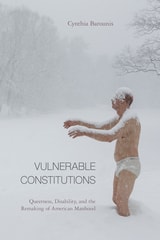
Vulnerable Constitutions
Queerness, Disability, and the Remaking of American ManhoodCynthia Barounis
Temple University Press, 2019
Amputation need not always signify castration; indeed, in Jack London’s fiction, losing a limb becomes part of a process through which queerly gendered men become properly masculinized. In her astute book, Vulnerable Constitutions, Cynthia Barounis explores the way American writers have fashioned alternative—even resistant—epistemologies of queerness, disability, and masculinity. She seeks to understand the way perverse sexuality, physical damage, and bodily contamination have stimulated—rather than created a crisis for—masculine characters in twentieth- and early twenty-first-century literature.
Barounis introduces the concept of “anti-prophylactic citizenship”—a mode of political belonging characterized by vulnerability, receptivity, and risk—to examine counternarratives of American masculinity. Investigating the work of authors including London, William Faulkner, James Baldwin, and Eli Clare, she presents an evolving narrative of medicalized sexuality and anti-prophylactic masculinity. Her literary readings interweave queer theory, disability studies, and the history of medicine to demonstrate how evolving scientific conversations around deviant genders and sexualities gave rise to a new model of national belonging—ultimately rewriting the story of American masculinity as a story of queer-crip rebellion.