Results by title
482 books match the query '17th century' and 18 start with w
Warnings to the Kings and Advice on Restoring Spain
A Bilingual EditionMaría de Guevara
University of Chicago Press, 2007
Guevara’s provocative writings call on Spanish women to bear the responsibility equally with men for restoring Spain’s power in Europe and elsewhere. The collection also includes examples of Guevara’s shorter writings that exemplify her ability to speak on matters of state, network with dignitaries, and govern family affairs. Witty, ironic, and rhetorically sophisticated, Guevara’s essays provide a fresh perspective on the possibilities for women in the public sphere in seventeenth-century Spain.
Watching Vesuvius
A History of Science and Culture in Early Modern ItalySean Cocco
University of Chicago Press, 2012
Whether a Christian Woman Should Be Educated and Other Writings from Her Intellectual Circle
Anna Maria van Schurman
University of Chicago Press, 1998
Gathered here in meticulous translation are Anna Maria van Schurman's defense of women's education, her letters to other learned women, and her own account of her early life, as well as responses to her work from male contemporaries, and rare writings by Schurman's mentor, Voetius. This volume will interest the general reader as well as students of women's, religious, and social history.
Why We Left
Untold Stories and Songs of America's First ImmigrantsJoanna Brooks
University of Minnesota Press, 2024
A grounded, tender, and mournful reckoning with the catastrophes that launched poor, white Anglos into their role as itinerant foot soldiers for modern imperialism—now in paperback with a new preface
Joanna Brooks’s ancestors were among the early waves of emigrants to leave England for North America. For generations, they lived hardscrabble lives, eking out subsistence in one place after another as they continually moved west in search of a better life. Why, Brooks wondered, did her people and countless other poor English subjects abandon their homeland for such unremitting hardship? The question leads her on a journey through an obscure dimension of American history.
Why We Left reveals the violence and dislocation that propelled seventeenth- and eighteenth-century working-class English emigration, presenting a powerful restorying of how we arrived at our present moment of precarity and rootlessness. Following American folk ballads back across the Atlantic to find histories of economic displacement, environmental destruction, and social betrayal at the heart of the early Anglo-American migrant experience, Brooks offers a scholarly and personal account of the intergenerational traumas that shape the history of white Anglos on Turtle Island.
She shares folk ballads such as “Edward,” which reveals the influence of deforestation on the dislocation of early Anglo-American peasant immigrants, and “The House Carpenter’s Wife,” which emphasizes the impact of economic instability and the colonial enterprise on women. From these ballads, tragic and heartrending, Brooks uncovers an archaeology of the worldviews of America’s earliest immigrants. This tenth-anniversary edition includes a new preface and develops a haunting historical perspective on the ancestors we thought we knew.
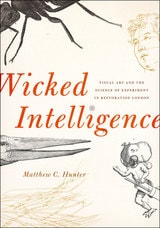
Wicked Intelligence
Visual Art and the Science of Experiment in Restoration LondonMatthew C. Hunter
University of Chicago Press, 2013

Willem de Rooij - Dirk Valkenburg
Karwan Fatah-Black
Amsterdam University Press, 2026
Witch-Hunting in Seventeenth-Century New England
A Documentary History 1638-1693, Second EditionDavid D. Hall
Duke University Press, 2007
Primary sources include court depositions as well as excerpts from the diaries and letters of contemporaries. They cover trials for witchcraft, reports of diabolical possessions, suits of defamation, and reports of preternatural events. Each section is preceded by headnotes that describe the case and its background and refer the reader to important secondary interpretations. In his incisive introduction, David D. Hall addresses a wide range of important issues: witchcraft lore, antagonistic social relationships, the vulnerability of women, religious ideologies, popular and learned understandings of witchcraft and the devil, and the role of the legal system. This volume is an extraordinarily significant resource for the study of gender, village politics, religion, and popular culture in seventeenth-century New England.
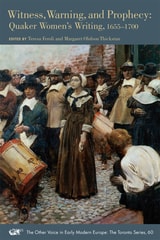
Witness, Warning, and Prophecy
Quaker Women's Writing, 1655-1700Edited by Teresa Feroli and Margaret Olofson Thickstun
Iter Press, 2018
The Other Voice in Early Modern Europe - The Toronto Series: Volume 60
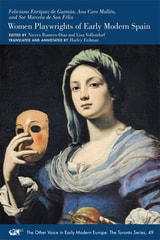
Women Playwrights of Early Modern Spain
Feliciana Enríquez de Guzmán, Ana Caro Mallén, and Sor Marcela de San Félix
Iter Press, 2016
This volume presents ten plays by three leading women playwrights of Spain’s Golden Age. Included are four bawdy and outrageous comic interludes; a full-length comedy involving sorcery, chivalry, and dramatic stage effects; and five short religious plays satirizing daily life in the convent. A critical introduction to the volume positions these women and their works in the world of seventeenth-century Spain.
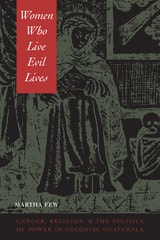
Women Who Live Evil Lives
Gender, Religion, and the Politics of Power in Colonial GuatemalaBy Martha Few
University of Texas Press, 2002
Women Who Live Evil Lives documents the lives and practices of mixed-race, Black, Spanish, and Maya women sorcerers, spell-casters, magical healers, and midwives in the social relations of power in Santiago de Guatemala, the capital of colonial Central America. Men and women from all sectors of society consulted them to intervene in sexual and familial relations and disputes between neighbors and rival shop owners; to counter abusive colonial officials, employers, or husbands; and in cases of inexplicable illness.
Applying historical, anthropological, and gender studies analysis, Martha Few argues that women's local practices of magic, curing, and religion revealed opportunities for women's cultural authority and power in colonial Guatemala. Few draws on archival research conducted in Guatemala, Mexico, and Spain to shed new light on women's critical public roles in Santiago, the cultural and social connections between the capital city and the countryside, and the gender dynamics of power in the ethnic and cultural contestation of Spanish colonial rule in daily life.
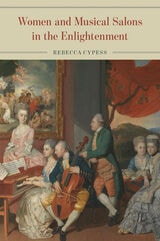
Women and Musical Salons in the Enlightenment
Rebecca Cypess
University of Chicago Press, 2022
In eighteenth-century Europe and America, musical salons—and the women who hosted and made music in them—played a crucial role in shaping their cultural environments. Musical salons served as a testing ground for new styles, genres, and aesthetic ideals, and they acted as a mediating force, bringing together professional musicians and their audiences of patrons, listeners, and performers. For the salonnière, the musical salon offered a space between the public and private spheres that allowed her to exercise cultural agency.
In this book, musicologist and historical keyboardist Rebecca Cypess offers a broad overview of musical salons between 1760 and 1800, placing the figure of the salonnière at its center. Cypess then presents a series of in-depth case studies that meet the salonnière on her own terms. Women such as Anne-Louise Brillon de Jouy in Paris, Marianna Martines in Vienna, Sara Levy in Berlin, Angelica Kauffman in Rome, and Elizabeth Graeme in Philadelphia come to life in multidimensional ways. Crucially, Cypess uses performance as a tool for research, and her interpretations draw on her experience with the instruments and performance practices used in eighteenth-century salons. In this accessible, interdisciplinary book, Cypess explores women’s agency and authorship, reason and sentiment, and the roles of performing, collecting, listening, and conversing in the formation of eighteenth-century musical life.
Women as Translators in Early Modern England
Deborah Uman
University of Delaware Press, 2012
Women as Translators in Early Modern England offers a feminist theory of translation that considers both the practice and representation of translation in works penned by early modern women. It argues for the importance of such a theory in changing how we value women’s work. Because of England’s formal split from the Catholic Church and the concomitant elevation of the written vernacular, the early modern period presents a rich case study for such a theory. This era witnessed not only a keen interest in reviving the literary glories of the past, but also a growing commitment to humanist education, increasing literacy rates among women and laypeople, and emerging articulations of national sentiment. Moreover, the period saw a shift in views of authorship, in what it might mean for individuals to seek fame or profit through writing. Until relatively recently in early modern scholarship, women were understood as excluded from achieving authorial status for a number of reasons—their limited education, the belief that public writing was particularly scandalous for women, and the implicit rule that they should adhere to the holy trinity of “chastity, silence, and obedience.”
While this view has changed significantly, women writers are still understood, however grudgingly, as marginal to the literary culture of the time. Fewer women than men wrote, they wrote less, and their “choice” of genres seems somewhat impoverished; add to this the debate over translation as a potential vehicle of literary expression and we can see why early modern women’s writings are still undervalued. This book looks at how female translators represent themselves and their work, revealing a general pattern in which translation reflects the limitations women faced as writers while simultaneously giving them the opportunity to transcend these limitations. Indeed, translation gave women the chance to assume an authorial role, a role that by legal and cultural standards should have been denied to them, a role that gave them ownership of their words and the chance to achieve profit, fame, status and influence.
Published by University of Delaware Press. Distributed worldwide by Rutgers University Press.
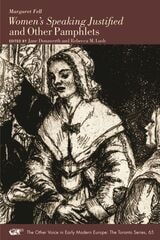
Women's Speaking Justified and Other Pamphlets
Margaret Fell
Iter Press, 2018
The Other Voice in Early Modern Europe - The Toronto Series, volume 65

Women's Voices, Women's Lives
Documents in Early American HistoryUniversity Press of New England, 1998
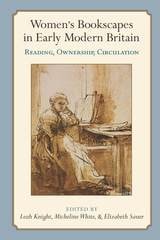
Women’s Bookscapes in Early Modern Britain
Reading, Ownership, CirculationLeah Knight, Micheline White, and Elizabeth Sauer, Editors
University of Michigan Press, 2018
Women in 16th- and 17th-century Britain read, annotated, circulated, inventoried, cherished, criticized, prescribed, and proscribed books in various historically distinctive ways. Yet, unlike that of their male counterparts, the study of women’s reading practices and book ownership has been an elusive and largely overlooked field.
In thirteen probing essays, Women’s Bookscapesin Early Modern Britain brings together the work of internationally renowned scholars investigating key questions about early modern British women’s figurative, material, and cultural relationships with books. What constitutes evidence of women’s readerly engagement? How did women use books to achieve personal, political, religious, literary, economic, social, familial, or communal goals? How does new evidence of women’s libraries and book usage challenge received ideas about gender in relation to knowledge, education, confessional affiliations, family ties, and sociability? How do digital tools offer new possibilities for the recovery of information on early modern women readers?
The volume’s three-part structure highlights case studies of individual readers and their libraries; analyses of readers and readership in the context of their interpretive communities; and new types of scholarly evidence—lists of confiscated books and convent rules, for example—as well as new methodologies and technologies for ongoing research. These essays dismantle binaries of private and public; reading and writing; female and male literary engagement and production; and ownership and authorship.
Interdisciplinary, timely, cohesive, and concise, this collection’s fresh, revisionary approaches represent substantial contributions to scholarship in early modern material culture; book history and print culture; women’s literary and cultural history; library studies; and reading and collecting practices more generally.
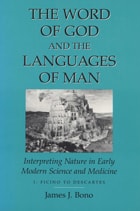
Word Of God & The Languages Of Man
Interpreting Nature In Early Modern Science And Medicine Volume I, Ficino To DescartesJames J. Bono
University of Wisconsin Press, 1995
James J. Bono shows how the new interpretive principles and scientific practices of the sixteenth and seventeenth centuries evolved in response to new views of the relationship between the “Word of God” and the “Languages of Man” fostered by Renaissance Humanism, Neoplatonism, magic, and both the reformed and radical branches of Protestantism. He traces the cultural consequences of these ideas in the thought and work of major and minor actors in the scientific revolution—from Ficino and Paracelsus to Francis Bacon and Descartes. By considering these natural philosophers in light of their own intellectual, religious, philosophical, cultural, linguistic, and especially narrative frameworks, Bono suggests a new way of viewing the sociocultural dynamics of scientific change in the pre–modern period—and ultimately, a new way of understanding the nature and history of scientific thought. The narrative configuration he proposes provides a powerful alternative to the longstanding “revolutionary” metaphor of the history of the scientific revolution.
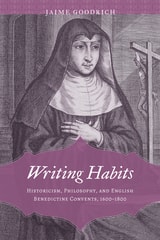
Writing Habits
Historicism, Philosophy, and English Benedictine Convents, 1600–1800Jaime Goodrich
University of Alabama Press, 2021
The first in-depth examination of the texts produced in English Benedictine convents between 1600 and 1800.
After Catholicism became illegal in England during the sixteenth century, Englishwomen established more than twenty convents on the Continent that attracted thousands of nuns and served as vital centers of Catholic piety until the French Revolution. Today more than 1,000 manuscripts and books produced by, and for, the Benedictine convents are extant in European archives. Writing Habits: Historicism, Philosophy, and English Benedictine Convents, 1600–1800 provides the first substantive analysis of these works in order to examine how members of one religious order used textual production to address a major dilemma experienced by every English convent on the Continent: How could English nuns cultivate a cloistered identity when the Protestant Reformation had swept away nearly all vestiges of English monasticism?
Drawing on an innovative blend of methodologies, Jaime Goodrich contends that the Benedictines instilled a collective sense of spirituality through writings that created multiple overlapping communities, ranging from the earthly society of the convent to the transhistorical network of the Catholic Church. Because God resides at the heart of these communities, Goodrich draws on the works of Martin Buber, a twentieth-century Jewish philosopher who theorized that human community forms a circle, with each member acting as a radius leading toward the common center of God. Buber’s thought, especially his conception of the I-You framework for personal and spiritual relationships, illuminates a fourfold set of affiliations central to Benedictine textual production: between the nuns themselves, between the individual nun and God, between the convent and God, and between the convent and the Catholic public sphere. By evoking these relationships, the major genres of convent writing—administrative texts, spiritual works, history and life writing, and controversial tracts—functioned as tools for creating community and approaching God.
Through this Buberian reading of the cloister, Writing Habits recovers the works of Benedictine nuns and establishes their broader relevance to literary history and critical theory.
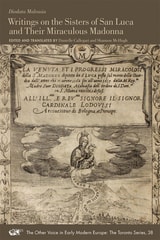
Writings on the Sisters of San Luca and Their Miraculous Madonna
Diodata Malvasia
Iter Press, 2015
The Bolognese nun Diodata Malvasia was presumed to have authored only one work, The Arrival and the Miraculous Workings of the Glorious Image of the Virgin (1617). In her recently discovered second manuscript chronicle, A Brief Discourse on What Occurred to the Most Reverend Sisters of the Joined Convents of San Mattia and San Luca (1575), her writing demonstrates active resistance to Tridentine convent reform. Together, Malvasia’s works read as the bookends to a lifelong crusade on behalf of her convent.